Learning
AIS Global Intensive: France
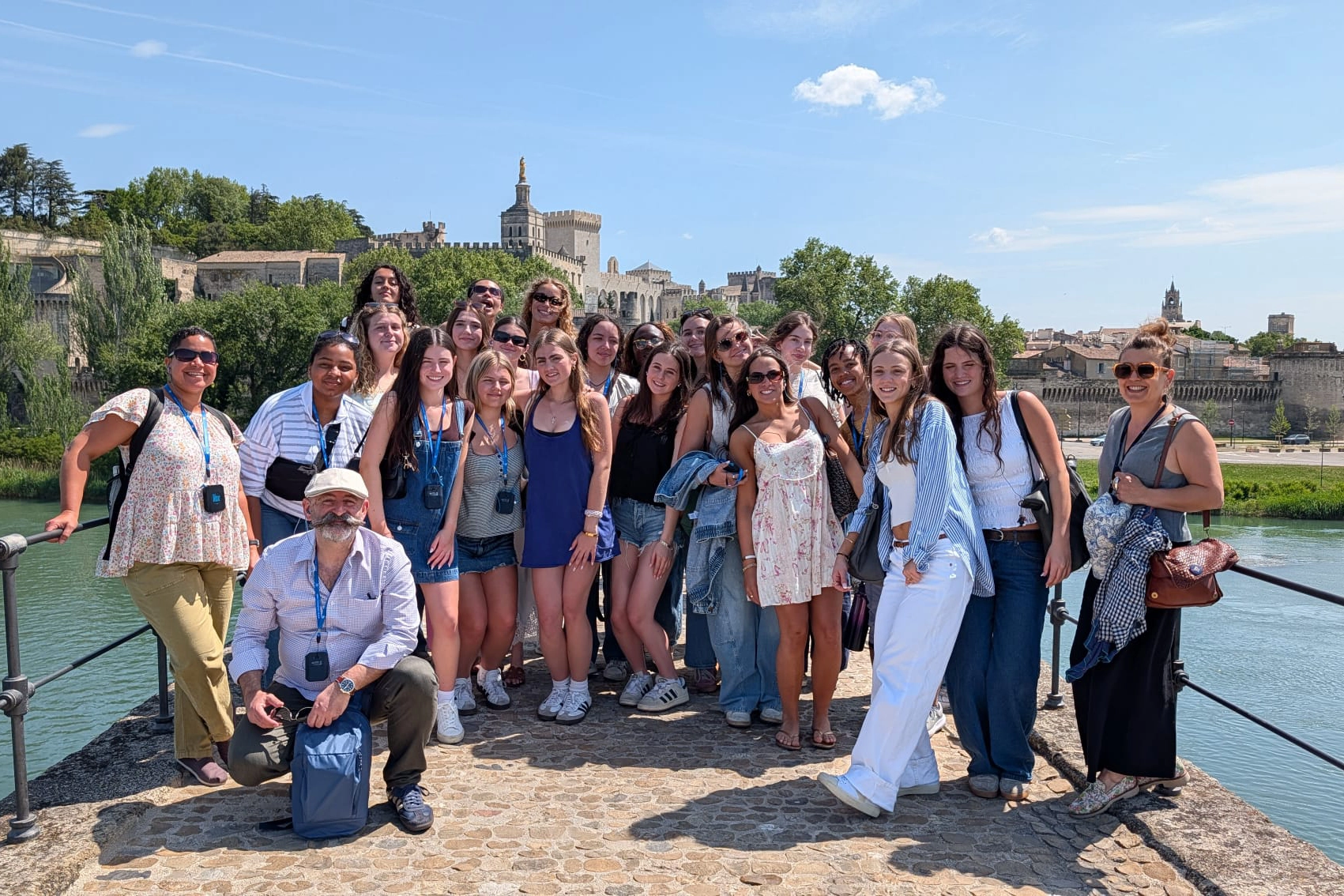
Students will spend over a week in Avignon, France studying the development of ancient, medieval and modern cities and learning about their role as political, economic and cultural centers. Some key themes explored will be the intersection of physical spaces and cultural values, the tension between individual and collective needs, and the often conflicting goals of different stakeholders, past, present, and future, in an urban community. We will “zoom in” on historical artifacts, monuments, and architecture to examine whose stories they tell and consider how present and future populations will continue to inscribe traces of their presence over their lifetimes. We will “zoom out” to examine how cities embrace their legacies, face their dysfunction, and strive to balance preservation with development.
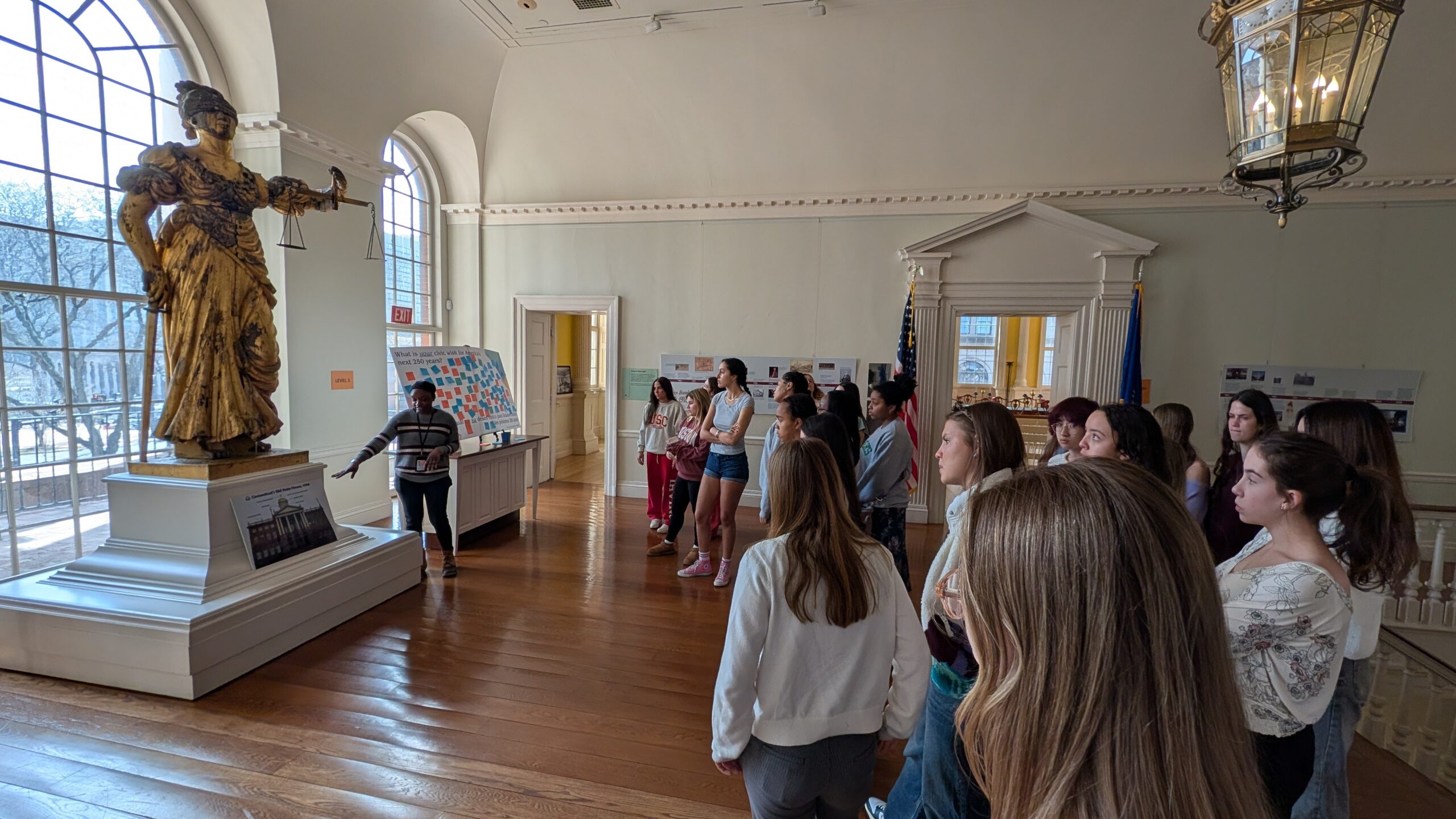
The students will use the small medieval city of Avignon as one of the study models and also the larger city of Marseille. The students will meet with local entrepreneurs, city officials and urban designers and visit other urban areas and points of interest in the area to get a 360 view of the place and learn about the region and how it became what it is today.
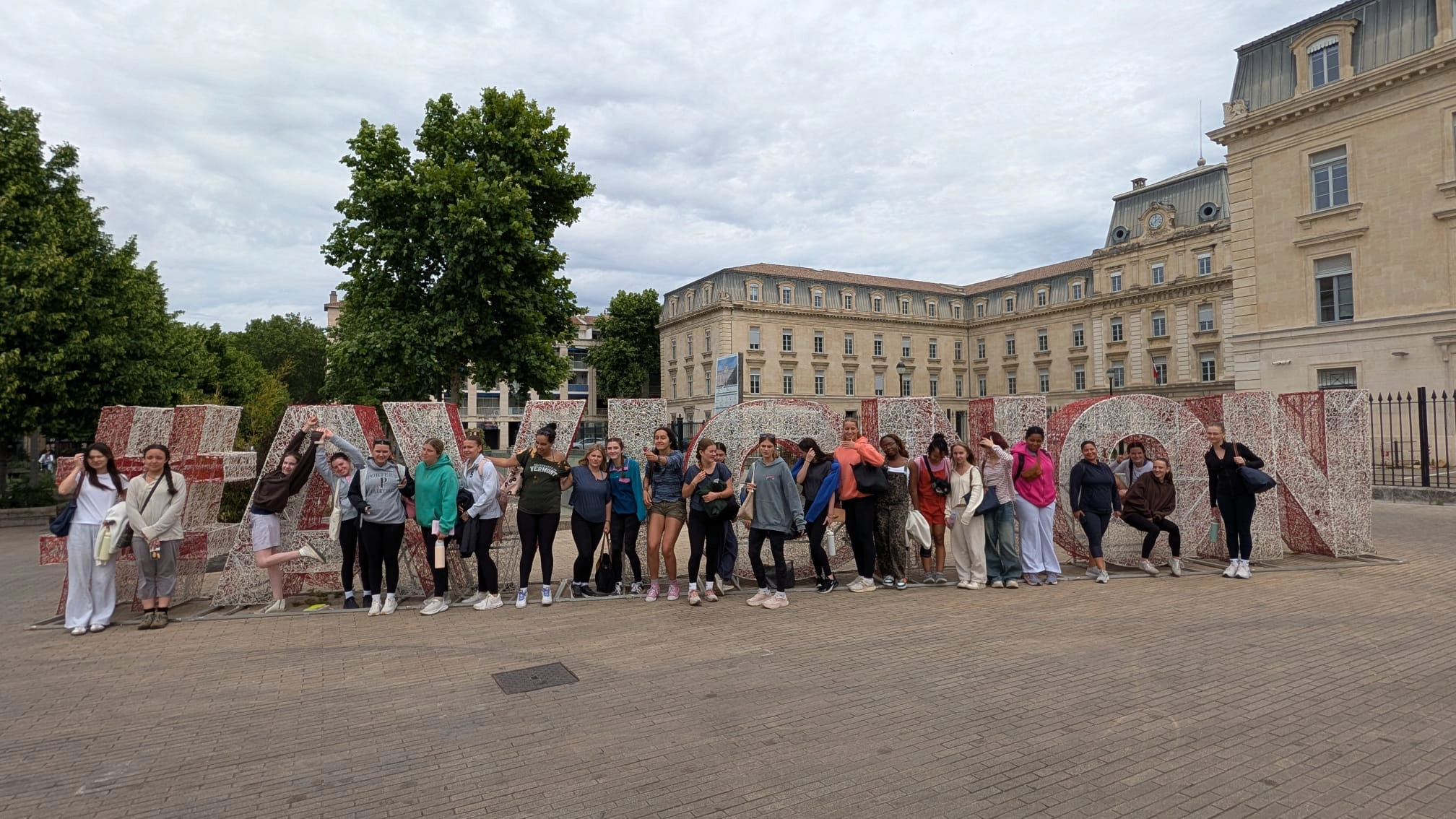
May 9, 2026
Student Author: Qinni
Today has been an eye-opening experience as I broadened my horizons regarding the different lenses one can view a city and its culture through, as well as the subsequent ways one can inscribe themselves into the legacy of a city and its community. We spent the majority of our day exploring Aix-en-Provence, a bustling, colorful city with an equally vibrant history. Known as the “City of Water” for its more than 600 natural springs, an invaluable rarity in the otherwise dry Provence area, Aix has been an attractive location to settlers as early as the Romans in antiquity. It has stayed occupied ever since then, witnessing countless other major civilizations. This rich history was clearly visible as we walked Aix’s streets. From the Provence area’s first church, St.-Sauveur Cathedral, to the old jail-turned-courthouse, and even the boulevards themselves, everything was a mix of different eras and relics.
What stunned me the most was the level of harmony maintained throughout the city’s architecture despite this. St.-Sauveur Cathedral had been a patchwork with austere 12th-century Roman doors, looming Gothic windows and a recently renovated modern bell tower; in the city centre, sleek plexiglass of the new inner courthouse could be glimpsed through the medieval limestone facade of Aix’s historic jail; down Aix’s largest boulevard, the Cours Mirabeau, one would be sandwiched between the “New” Aix, with grand, 16th-century mansions and warm yellow brick and the “old” Aix with meandering streets and narrow, packed shops. However, none of these juxtaposed architectural features and styles felt overwhelming or messy. Rather, the clarity with which Aix physically embodied its stones was refreshing for me in comparison to the cities I am from, which almost seem to be cannibalizing themselves in comparison with historic buildings and community spaces being constantly demolished and gentrified. It is precisely because of the high level of visibility Aix’s citizens have of the impacts and heritage of their predecessors that they have a unique awareness of the necessity for art and preservation.
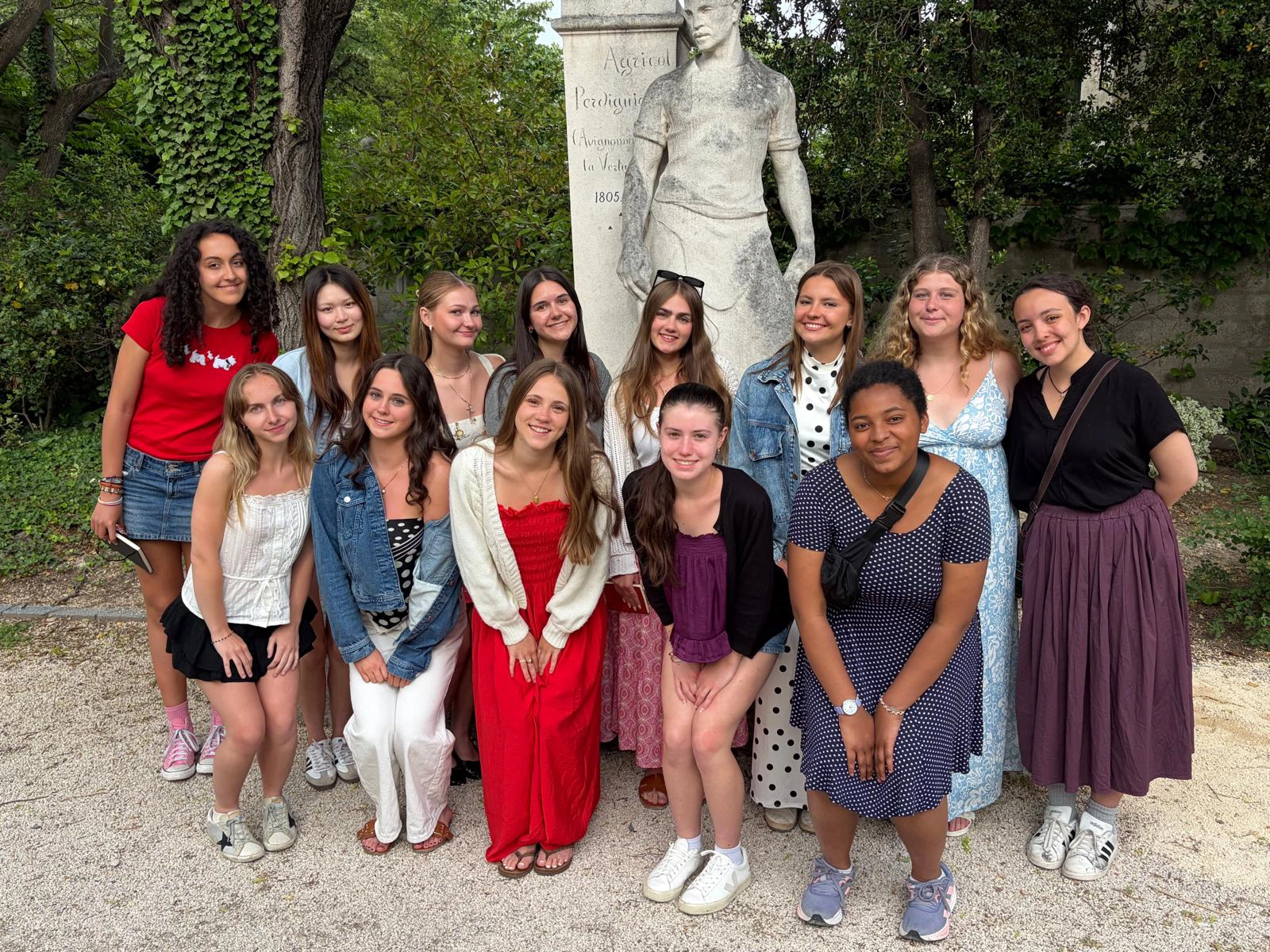
This was further emphasized during our visit of the Hôtel de Caumont. We learned from our guides that it had been constructed as a private mansion for an aristocratic family before being converted into a public school for music and dance until it was privatized and restored into a museum. We learned that the process for restoration was a highly complicated and demanding team effort where a careful balance had to be struck between preserving the original quality of the item and incorporating more modern, functional infrastructure; the Caumont was an excellent example of such a balance, with its beautiful Rococo-style rooms and modern exhibition spaces.
However, during our tour of the Caumont, we also learned that not all initial reactions to the museum had been positive. In fact, many locals had expressed resistance as themselves or their children had attended the music school and therefore had a personal connection to it, or were reluctant to lose the free access they had to the building once it became privately owned. This made me aware that my perspective as a tourist was still limited regardless of how eager I was to learn—I was only able to experience the Caumont from an outsider perspective of comparative privilege, mirroring the Aix locals who could understand the impacts of privatization and preservation on their access to the arts intimately but lacked the curator’s perspective that the construction of the initial music school had in fact led to the damaging of certain original features of the residence. It was a cycle where every impacted party informed the understanding of the status quo and their relationship to the Caumont for another.
In conclusion, today has brought two epiphanies on the ways in which people interacted with and positioned themselves in regards to the history and art of a city. As cities constantly reinvent and innovate their images in our ever-shifting modern landscape, Aix-en-Provence is an example of a positive feedback loop where easily visible inscriptions of the past allows us in the present to better understand and dictate our own legacy, be it as travelers, tourists or locals.
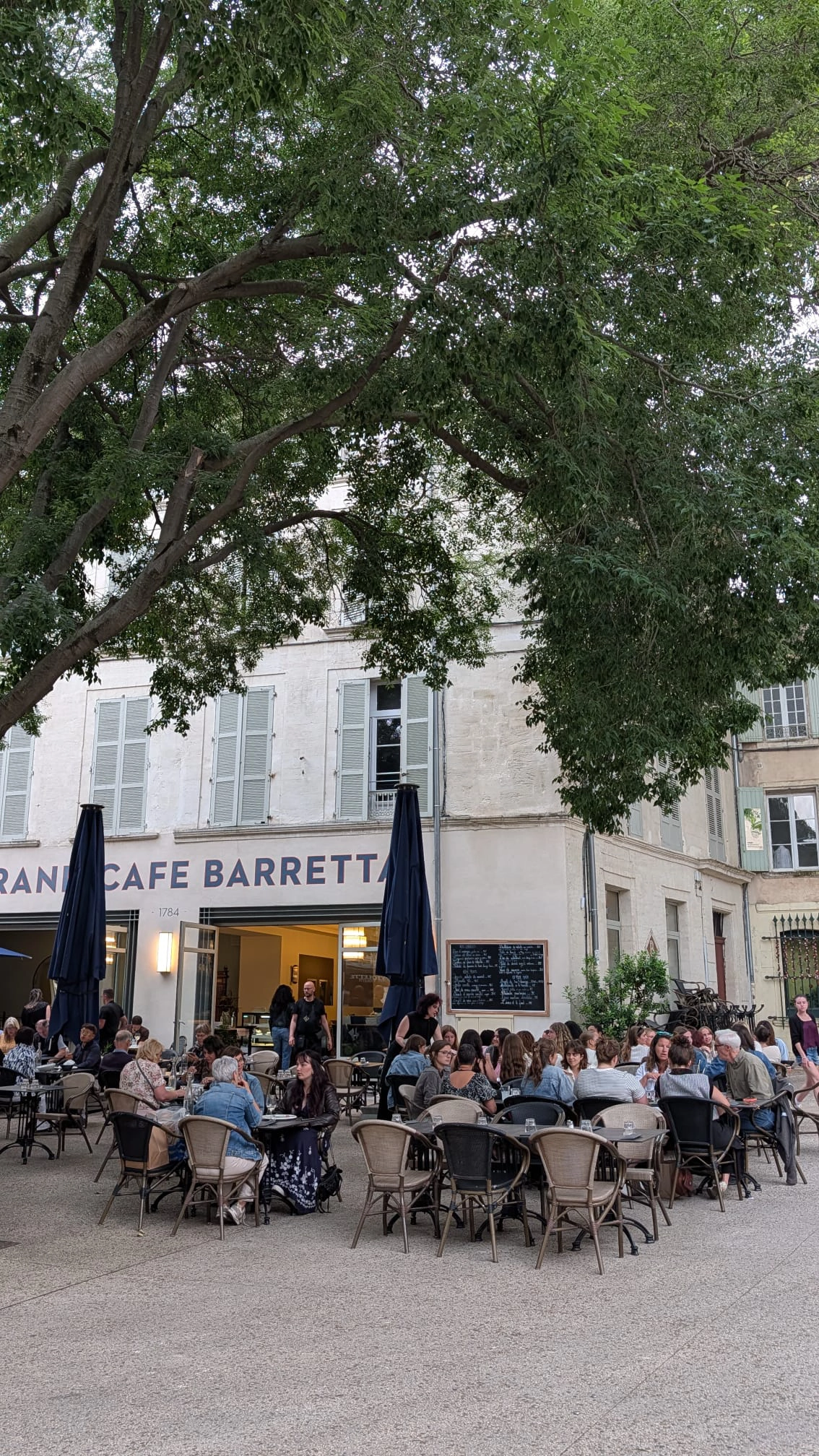
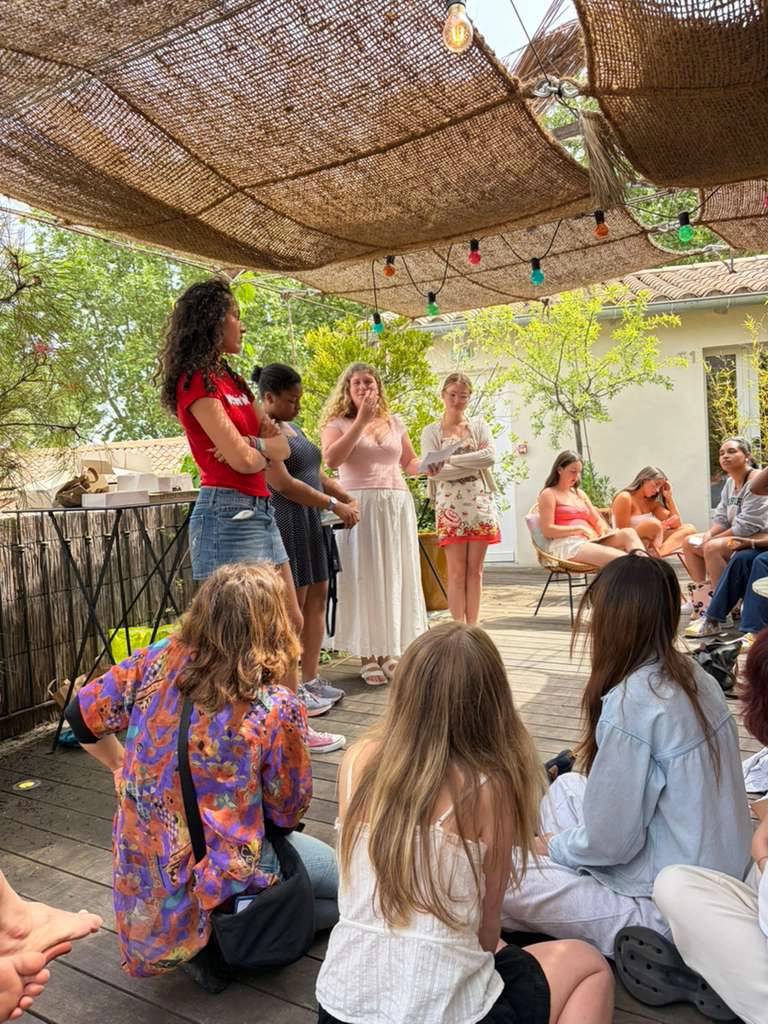
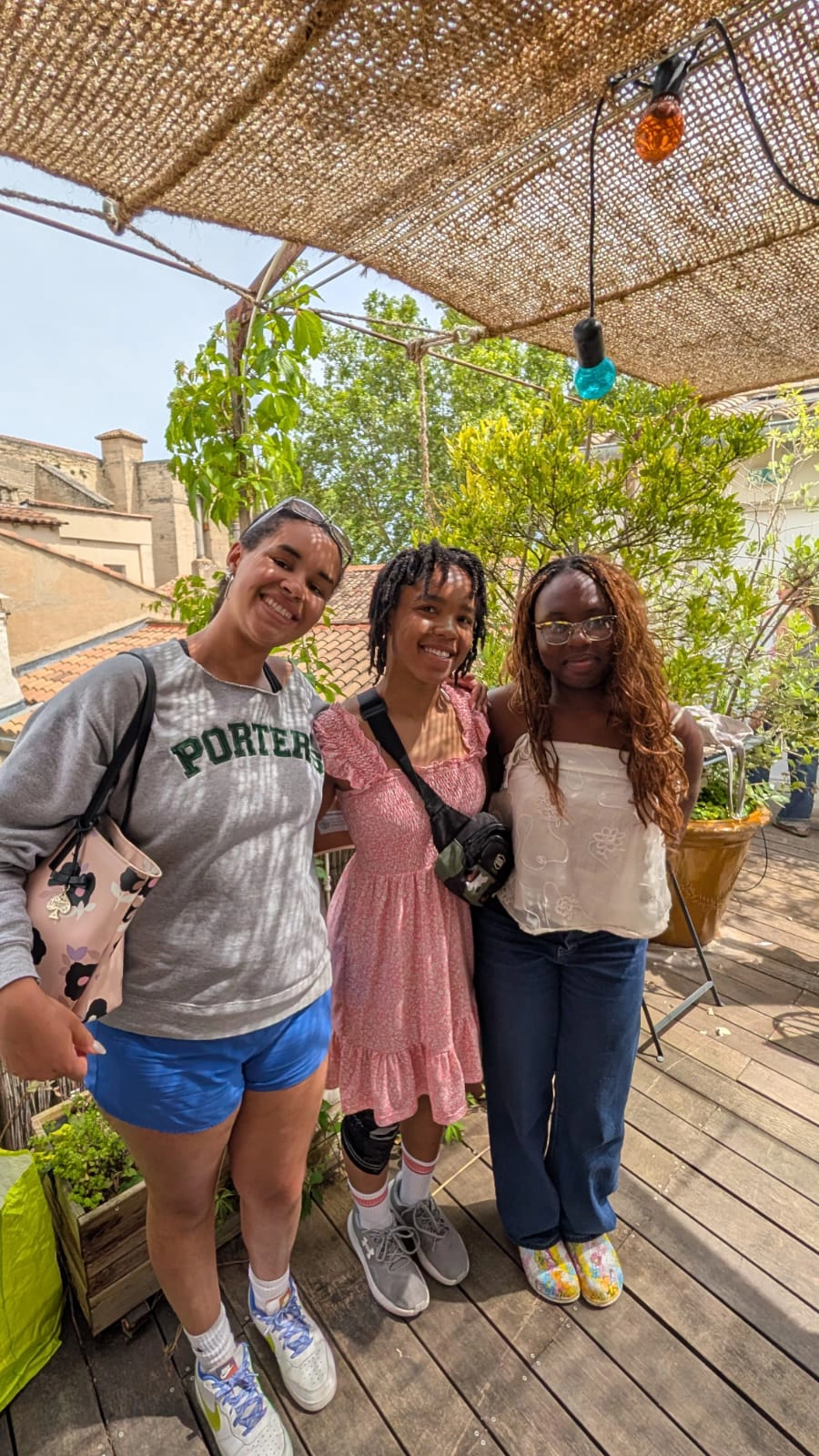
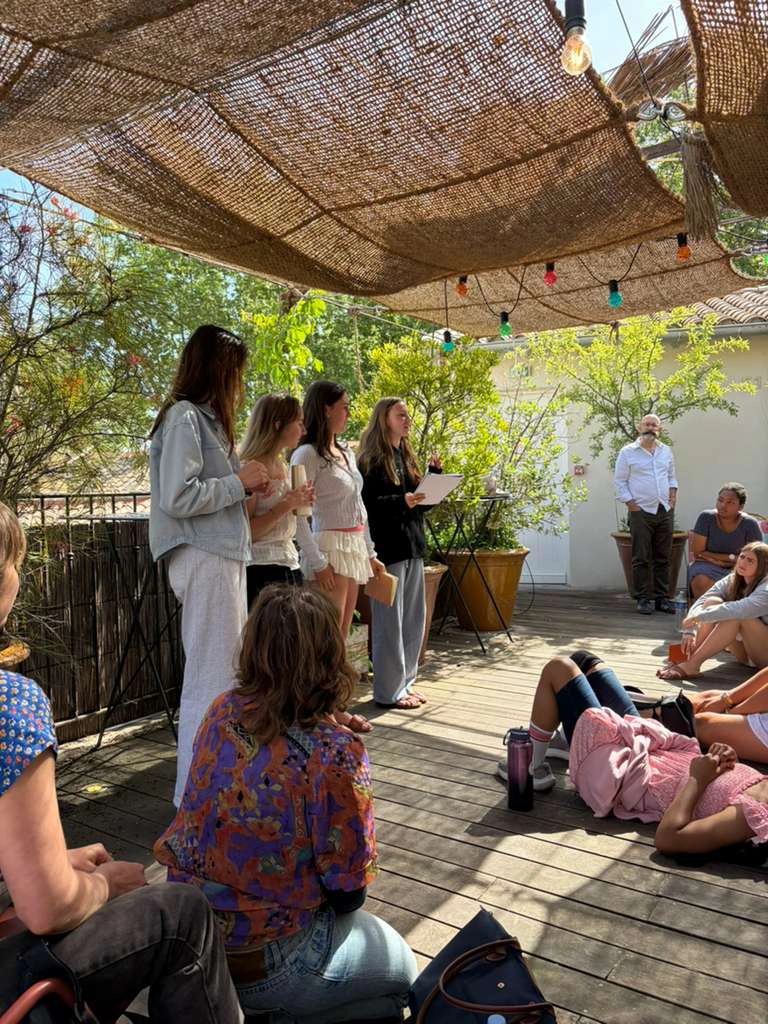
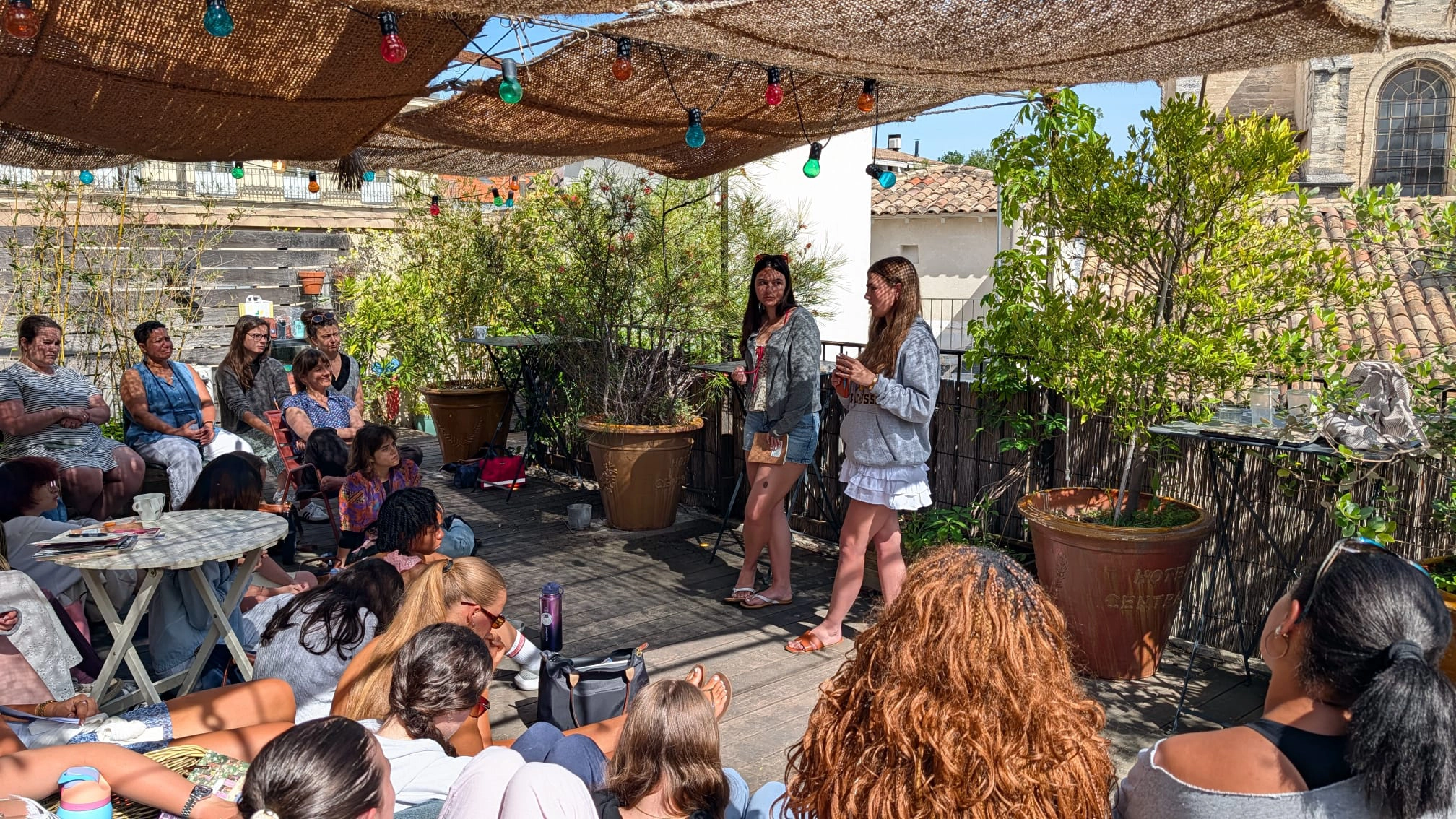
May 8, 2026
Student Author: Clara
Today the French flags were hanging in Aix-en-Provence. Metal gates were set up on the sides of the main avenue and elderly men, hunched over in tweed suits and caps decorated with military medals, were strolling down the city streets. Today was May 8, 81 years since the Allies accepted Nazi Germany’s unconditional surrender in World War II. Today is Victory in Europe, or V.E. Day.
The class arrived in Aix during the late morning and was fortunate to be given a walking tour of the city by one of our beloved Atlas guides (who happened to be raised in Aix), Elsa. While the style of the southern France city is not so unfamiliar to us after nearly two weeks here, it was a joy to explore and see—especially in the historical context of May 8.
Walking under an archway during this walking tour, I caught a glimpse of a marble plaque commemorating something that occurred in 1940 and was dedicated in 2000. The plaque had the French flag and the American flag. The same flag I pledged my allegiance to every morning for my entire childhood.
Looking around at the preparations for the festivities surely to happen later that day, I felt a strange sense of guilt. If a plaque can be dedicated with my flag on it only 9 years before I was born, shouldn’t this event hold greater importance to me? Victory in Europe was something Americans fought and died for. Yet to me it was just another day.
After going around Aix, Elsa led us to a museum that was previously a private mansion. Part of the home had been restored to honor and educate about the origins and original use, while another part was renovated as an art museum. We were provided with two tours. One, focusing on the history of the original rooms of the home that was constructed in 1715, led by a museum staff member. The second was focused on the restoration efforts in 2012 and was led by one of the restoration team leaders. There was so much effort to “keep historical soul,” the restoration expert said. At the same time, places always have to adapt to modern society, much akin to urban planning. Elevators, bathrooms, and other public necessities were added to the space to continue accessibility as it became a place for art and learning.
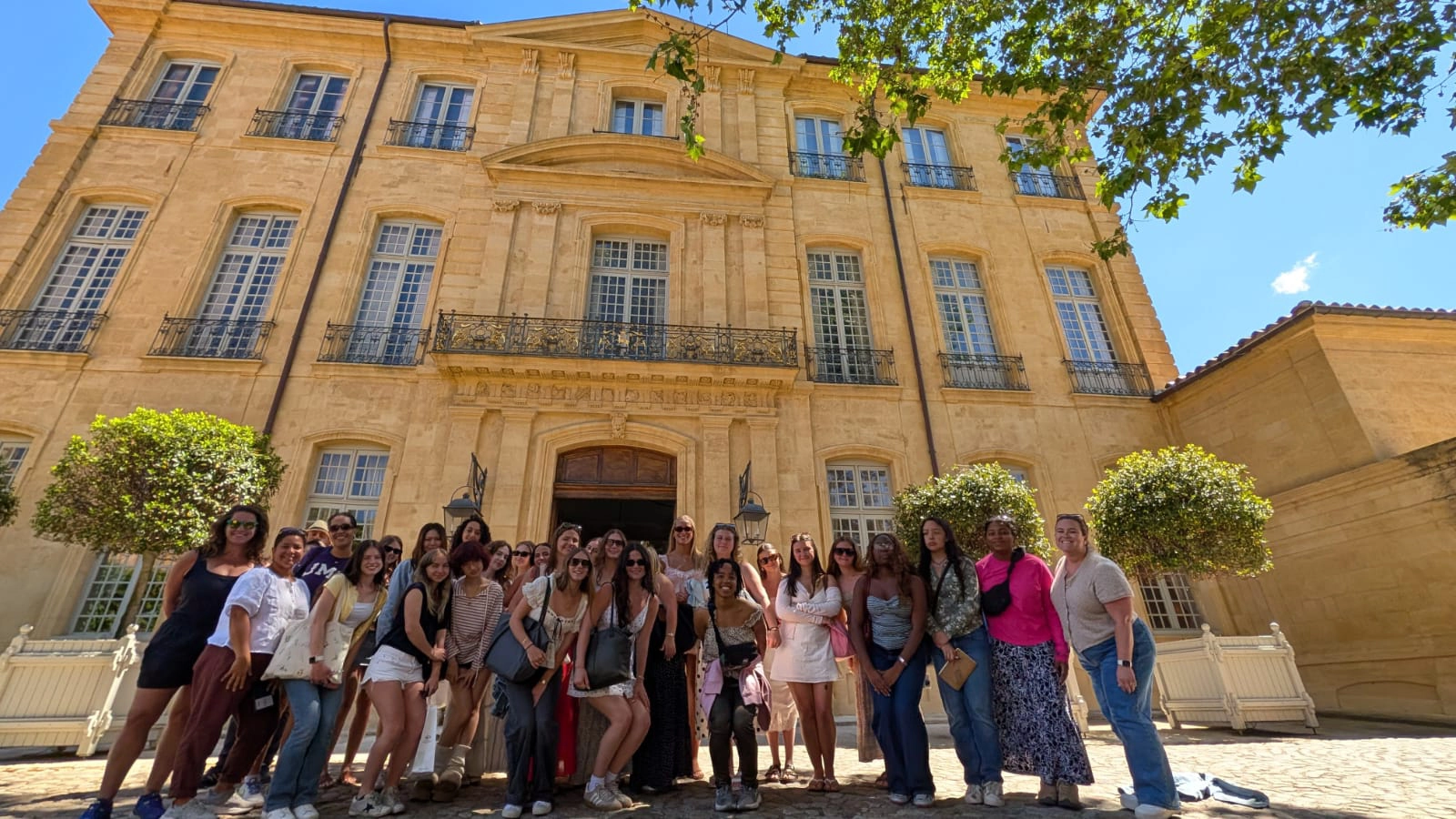
Being in a space meant for learners as a student felt right. Being in Aix as an American traveler on V.E. day felt strange. We have experienced the divisions of being non-locals in spaces usually intended for locals. Only today did it feel like my American identity was a weight on the scale. I have never truly celebrated the win of the Allies in World War II. May 8, 1945 was just as long ago for Aix as it was for America. And yet I think that distance I feel from these events is a great privilege I had not come to realize until this trip.
I, as a traveler, am here in Aix to immerse myself in the local culture. I also am responsible for examining how my identity interacts with that culture. I did spend more time than maybe I should’ve wondering if my presence in this city was more intrusive today than others. Really, I should have spent a greater time appreciating the constant celebration of history in Aix. Europe has changed so much since 1940. The population of the world is nearly a completely new one. Yet in these moments we don’t have to constantly be finding new ways to change the interiors of a mansion. We can stop, pause, and find the origins. We can recreate marble fireplaces that were destroyed or sculpt new wall moldings after they were erased. We can also line our streets with flags and friendly faces to celebrate a victory we may not have been there to see.
And I will not be in Europe next May 8, but I will take a moment to always remember our shared history and the shining medals I saw along the streets of Aix.
Student Author: Nina
The day started at 7:15 a.m. when my roommates and I woke up and got breakfast. As per usual, I had a croissant w/ Nutella, an orange, and my favorite drink, a chockyccino. We met in the lobby for 8:30 a.m. to walk to our bus taking us to our day trip in Aix. I was super excited because unlike every other day, we had no idea of the agenda. I liked this because it allowed us to be more present in the moment rather than focusing on later activities.
After we arrived in Aix, we got off the bus and walked through the town while Elsa told us about the city’s history. I learned that the city is built with layers of history; literally! We saw the concrete street replaced for a few steps with glass, revealing ancient structures that had been covered as the city grew and evolved over time. I learned that it is required by law for any site to be dug up and investigated before being built on due to the importance of preservation. As the city grew overtime, so did the urban planning. This is shown on the city’s grid layout, its grid separating the period of time when the city separated into the “new” and “old” by a very long and wide avenue called Cours Mirabeau.
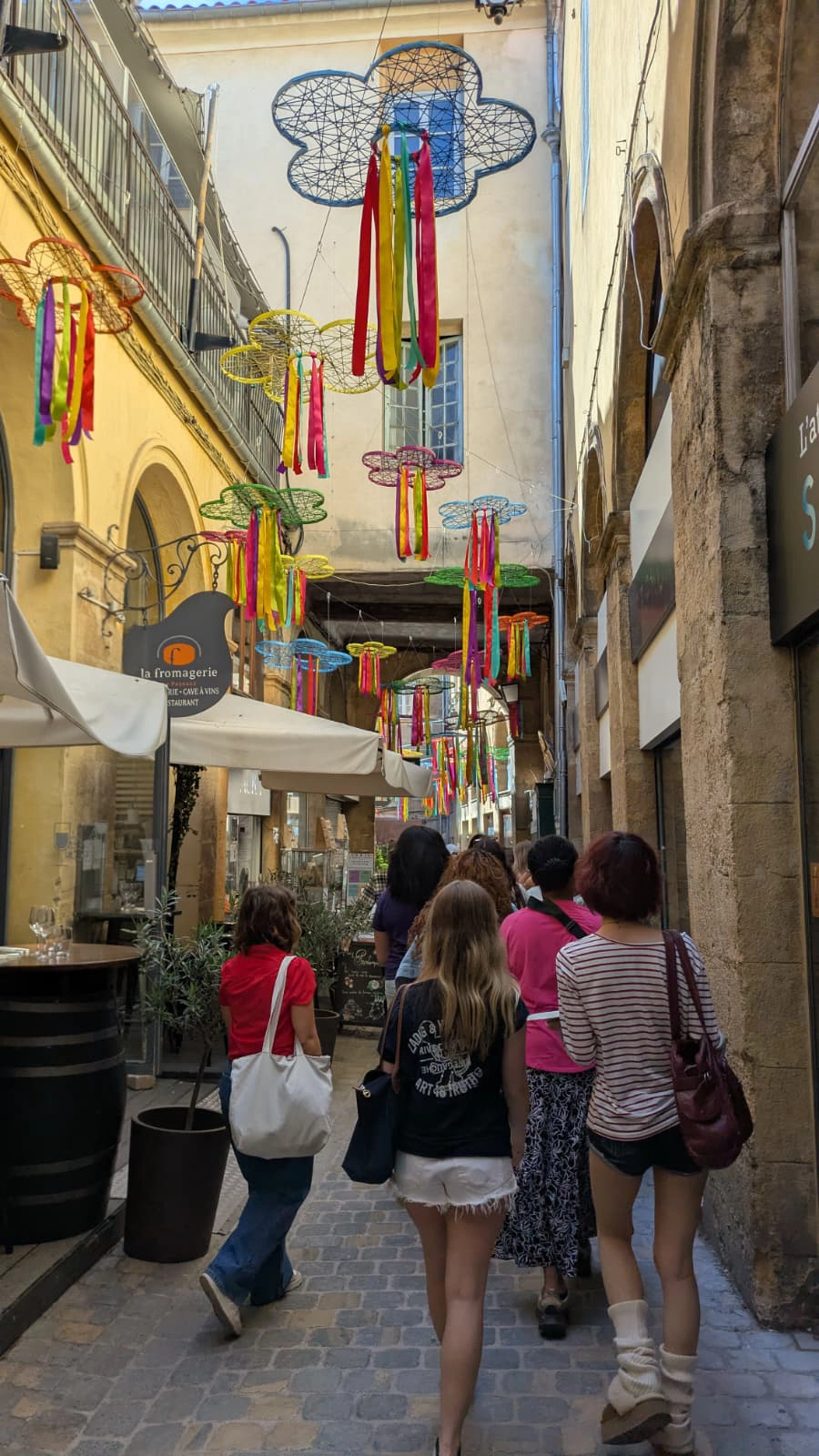
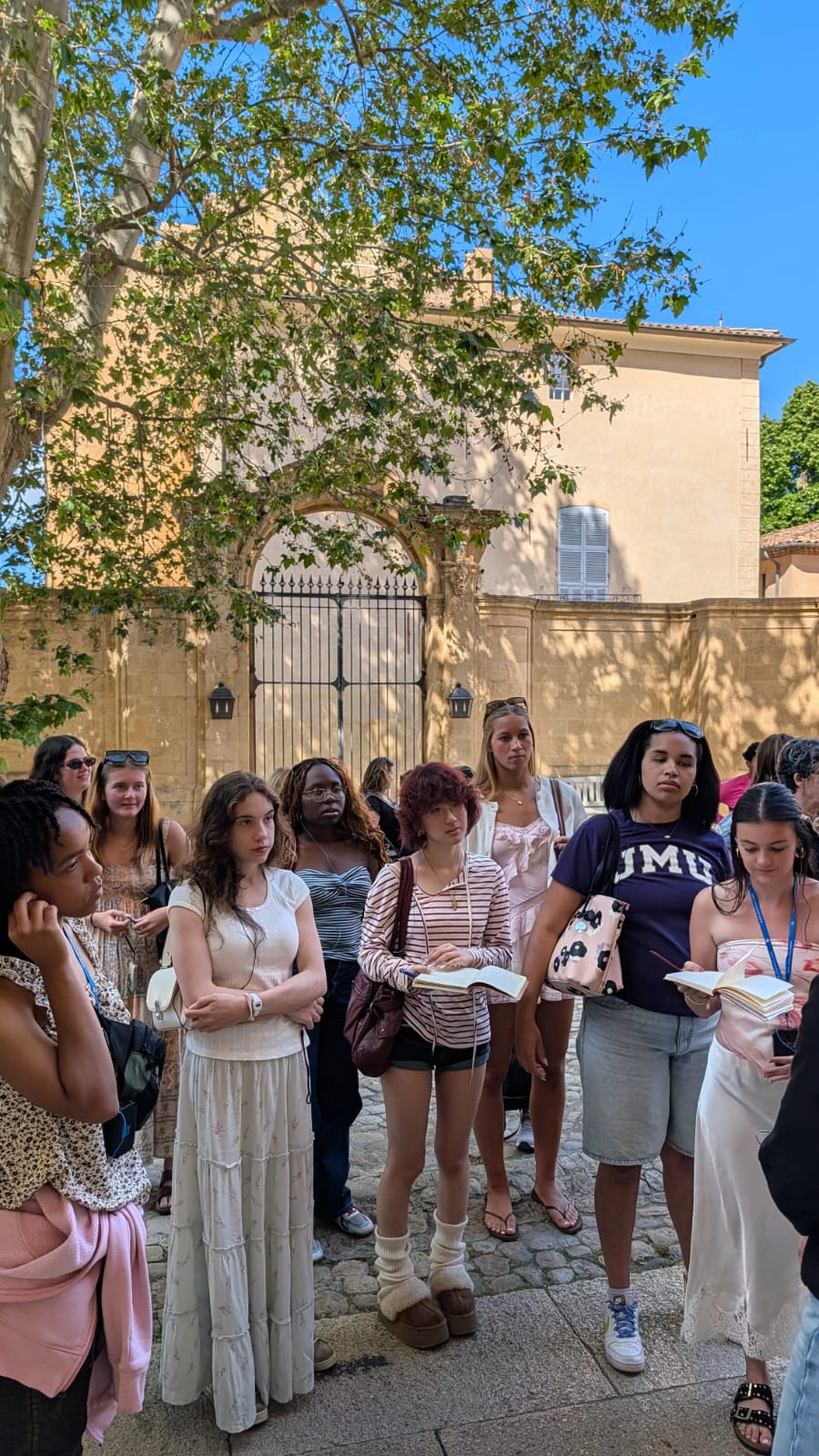
As we walked along this avenue, we saw tons of pastry shops with kind people offering us samples. I could smell the fresh food from the restaurants and bakeries. Unlike the other towns we visited, such as Arles and Marseille, Aix was the only town with fancy global stores/chains—like Longchamp, Subdued, Hermès, Polo, and other big companies; all of the other towns had local shops. I thought this was interesting because the presence/lack of stores made this town stand out and much more noticeable.
As the town was also bigger than the other places, I assume the reason for this is because it was more exposed to globalization that brought bigger companies than the other places that were smaller like Arles. I wonder if this could also be a result of the amount of tourism; maybe Aix possibly has a bigger number of tourists than the other places, causing bigger companies to open stores there. This is a similar difference between the towns like Avignon compared to Paris.
Even through the presence of both big shopping and crowds of people mostly speaking French, it was very clear that the city is built around its heritage. Before lunch, we went to Hôtel de Caumont. Here, the theme of preservation / meaning changing over time was continued. The building transitioned through being a family mansion to a music school to its current purpose, a museum. In being toured by our tour guide Eleanor and a woman called Marion who actually worked on the restoration herself, we learned the difference and specifically the importance of the difference between restoration and renovation.
Yet again, the theme of preserving the city’s ever-changing heritage is shown in this building. I found this process of restoration very intriguing; Marion worked with many people to combine the many skills necessary for restoring rather than renovating the building. We learned that she lightly scraped away at the walls to reveal the previous historical layers of paint or graining that had been covered or damaged. From there, the team was able to recreate or reimagine what the building probably looked like and restore it rather than renovating it and improvising or simply repurposing it.
I was curious about the building’s significance to the residents of Aix and how they feel about the restoration. Marion explained to us that this was a controversial subject because it is obviously very important to the city as its heritage shapes the actual city. The act of turning it from a “public” school to a “private” museum takes away from the space’s connection to the town, especially because not everyone can afford a ticket to enter. In addition, the museum is privately owned, so the amount of restoration versus renovation is really controlled by the owners to do as they please.
This connected to the essential questions of the class in these two ways:
- How we inscribe ourselves through the owners “curating” the view of history by choosing what to preserve, and
- What is the difference in perspective of the experience because I experience the museum in this restored view versus as past uses.
After the visit, we met up with Elsa’s mom for lunch at a restaurant below her childhood home. I had Sprite and chicken while playing BS with the table as always. Once we finished eating, we all got free time to wander and shop which was really fun because we got to go to a lot of different stores we didn’t have in Avignon or the other places. We made sure to use a map so we wouldn’t get lost! After wandering, we took the bus ride back and collectively sang Soda Pop. The day ended with dinner at Tessa’s house which was lovely; their house was so pretty and we ate yummy pizza! Tomorrow is our last day, so I am sad but I am excited to spend time with my peers tomorrow to enjoy our last day!
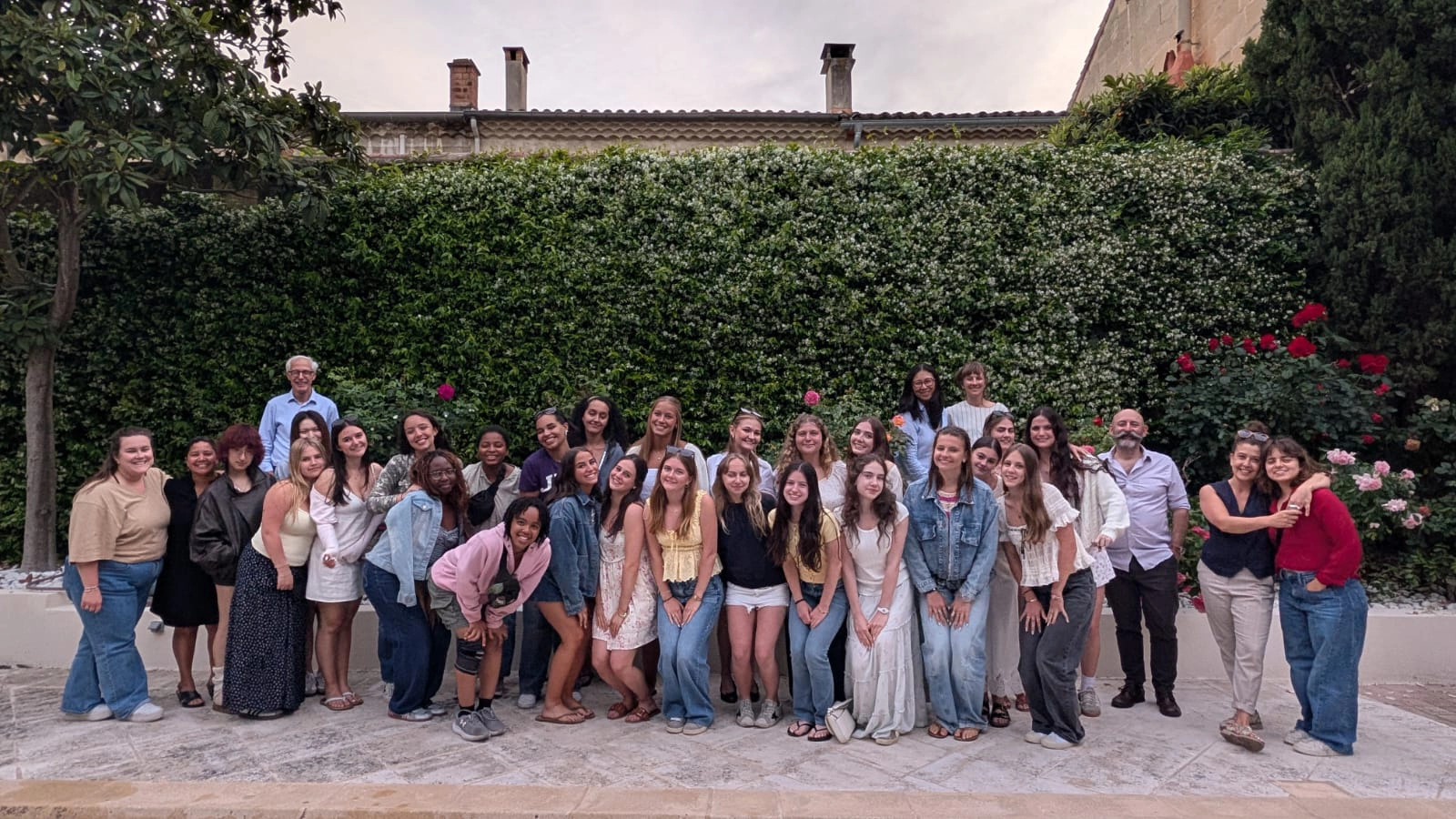
Student Author: Sophie
Today was the last weekday that we will enjoy in the South of France, and we spent it exploring the vibrant city of Aix-en-Provence. Aix is the home to 140,000 individuals—40,000 of those being students—as well as art galleries and artists, live music and musicians, 18th-century buildings… but it is also the home to our insightful tour guide Elsa, who we were lucky to have guide us through her city. Although I myself do not live in Aix anymore, and I had not returned since 2021, the streets still feel like home, and does so for even newcomers.
Coincidentally, we were in Aix on May 8, which is a holiday special to Aix and Provence in general, as it stands as the day of liberation from Nazis. Early on in our arrival to Aix, we made our way through the narrow stone streets coming closer to the fresh crowded markets, but before we arrived, we passed through the arch of the clock tower and Place de l’Horloge, the artifacts I had studied. I had walked beneath this exact structure with my mom on the first day we arrived in Aix before I was dropped off at boarding school here, and I remember her obsessing over the huge door of the Place de l’Horloge. I was overwhelmed by this new city, and completely unaware of the historical significance of the tower I stood under as I waited for my mom to finish taking 20 photos of the door. Back in that moment, I plainly saw the various vertical features lined on the tower: the clock at the top, the wide arched pathway at the bottom, and I probably was confused at the plaque and funerary urn that sits in the middle. As I walked under and through the archway this time in Aix, I looked up at the tower in a different lens; one that isn’t constrained to an uninformed lens about the environment that surrounds me.
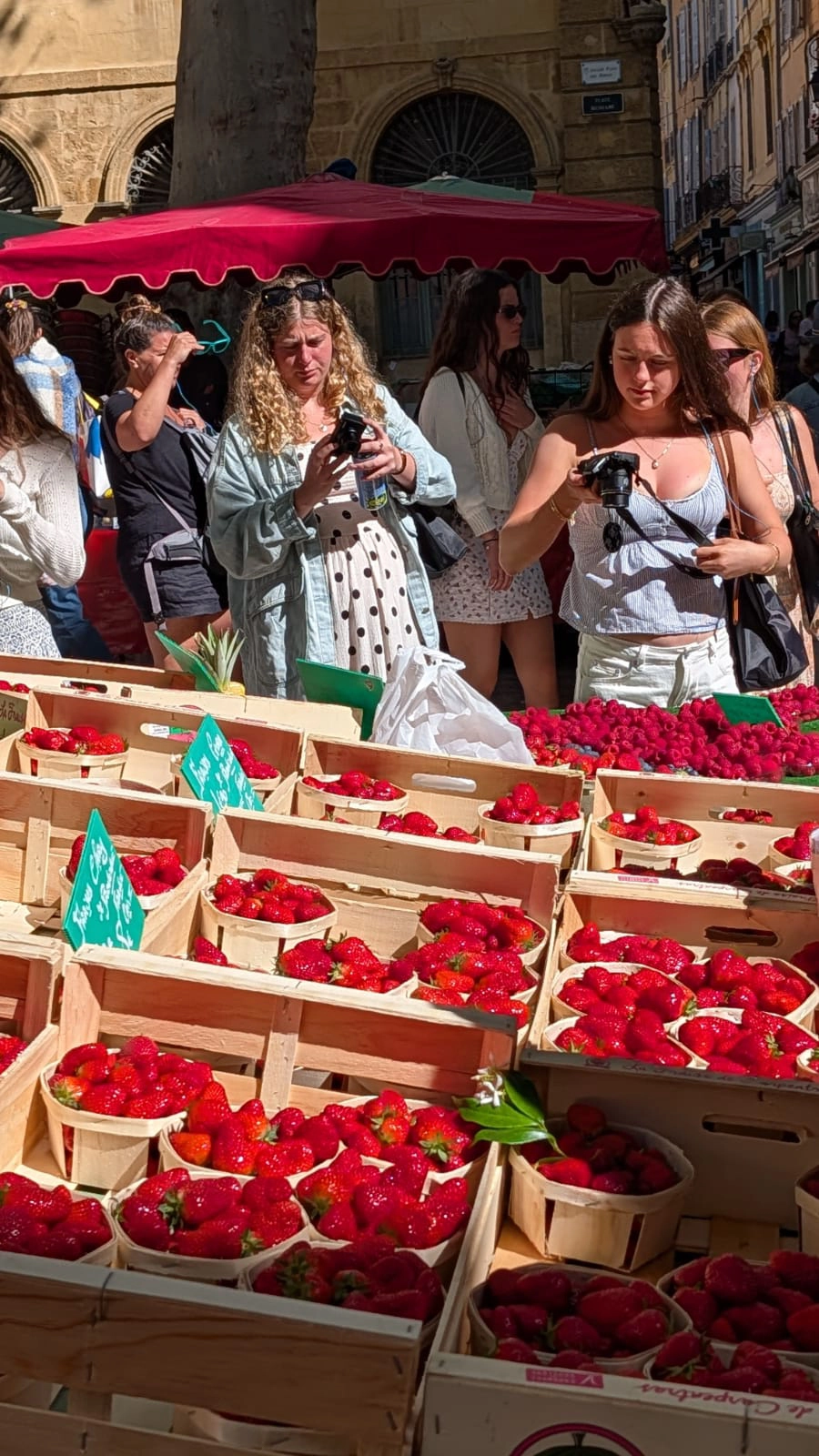
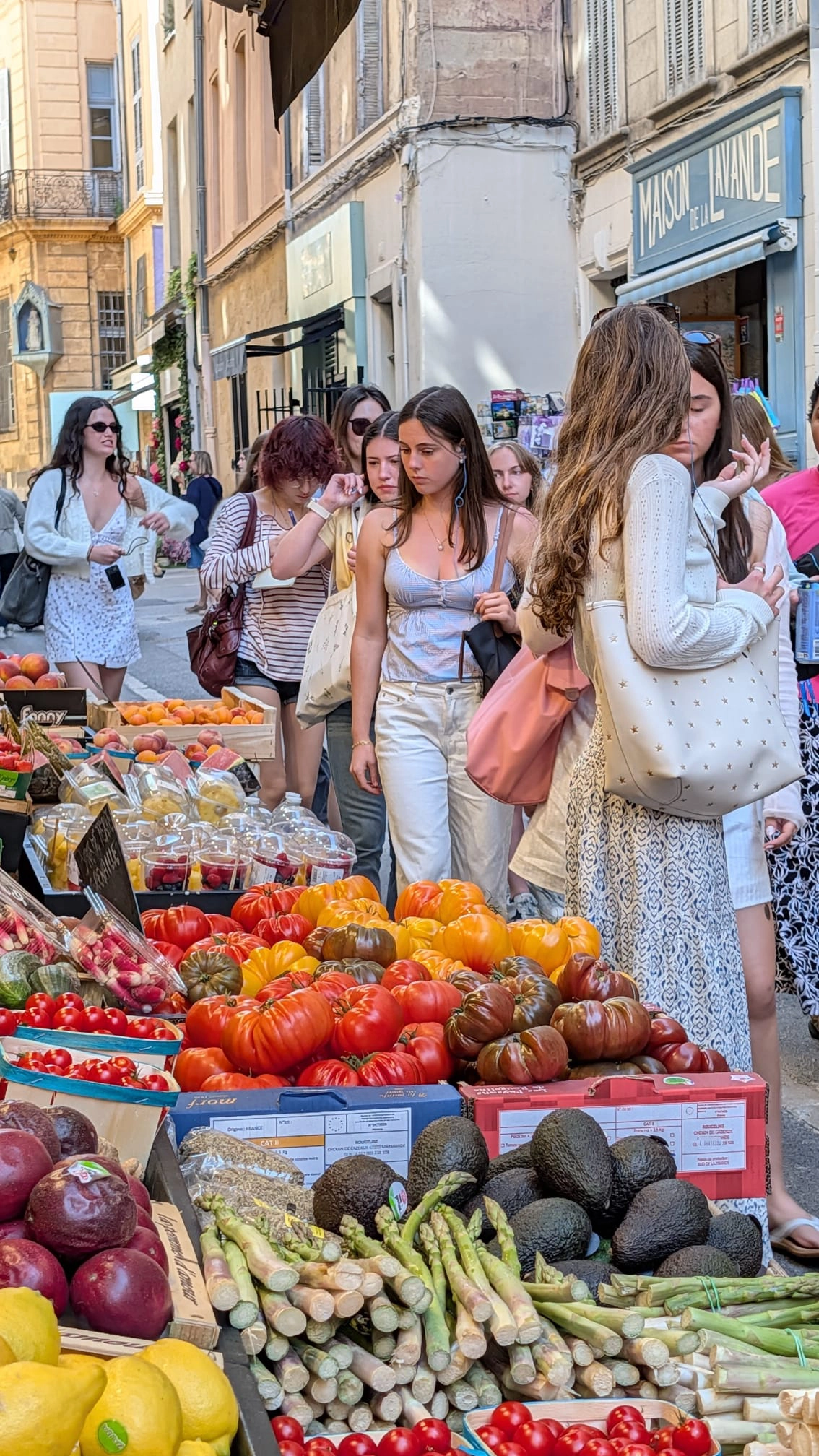
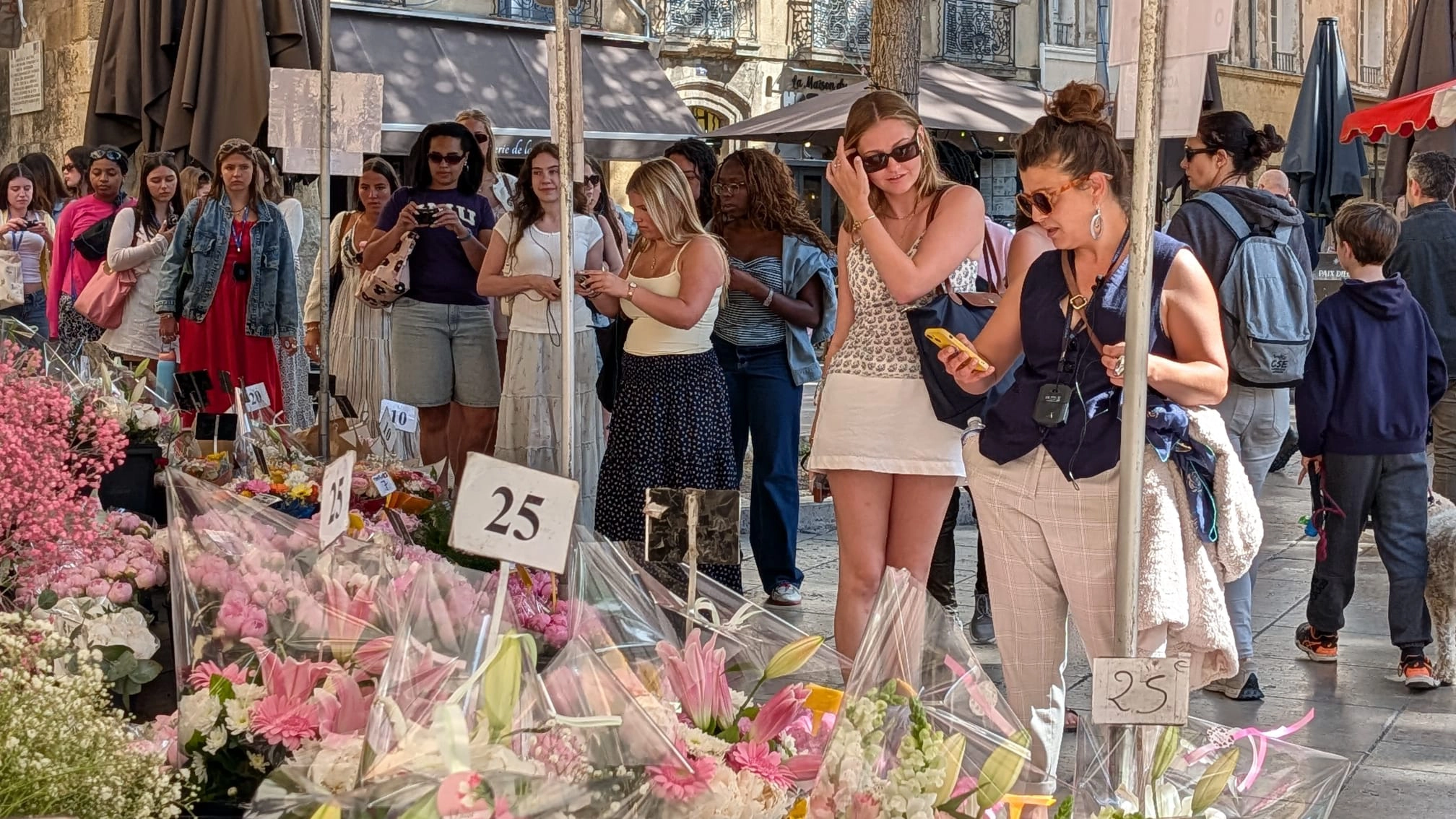
Surprisingly enough, at 13 I walked the streets of a city I knew nothing about. I knew where the nearest boba tea store was, where the beautiful water fountain was, and the main square lined with restaurants which is watched over by a statue, but I lacked understanding of the history of these structures, and how preserving and valuing the history of them influences the environment of Aix. Despite my lack of knowledge of the streets I visited every week, my perception was shaped by the various backgrounds of friends I met at my international school. For example, the only other student who stayed in the dorm house on the weekends was a girl from Switzerland, and she would buy snacks from Monoprix that represent a taste of her life back home. Explaining a city through lenses that aren’t solely yours is necessary for a well-rounded experience. Just as I had learned what food was meaningful to my friend from Switzerland, Elsa informed us that there’s an almond treat native to Aix called “calisson,” and when you’re eating it, it “feels like a hug.”
After passing through historical monuments, the markets, and the main square of Aix, we arrived at the Caumont Centre d’Art, which once served as a school for music, but was renovated in 2011/2012 into a museum. The carefully restored building, built under Louis the 14th, dates back to the 18th century. The building is a Greek Revival mixed with French Classicism, and its entrance is surrounded by 2 courtyards, with 2 gardens greeting the back. The interior was drowned in light that came in from the exaggerated floor-to-ceiling windows, which highlighted the limestone walls, molded ceiling details, oak woodwork, and golden mirrors that traced floral wall-papered rooms.
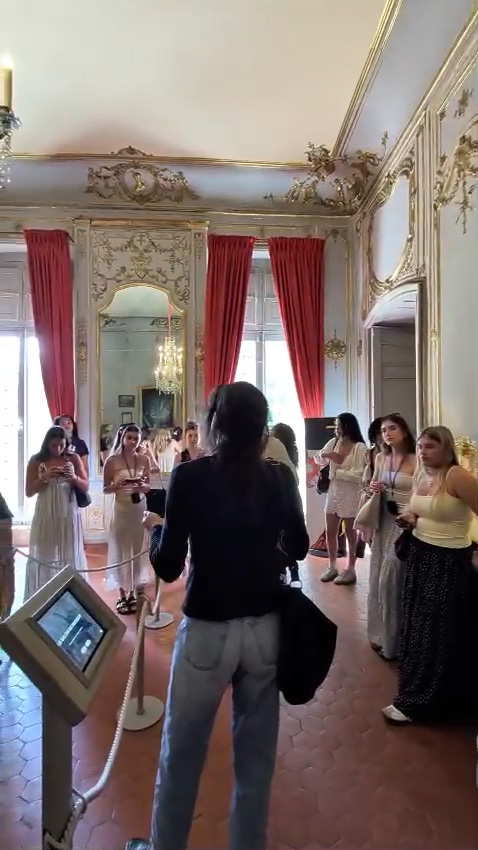
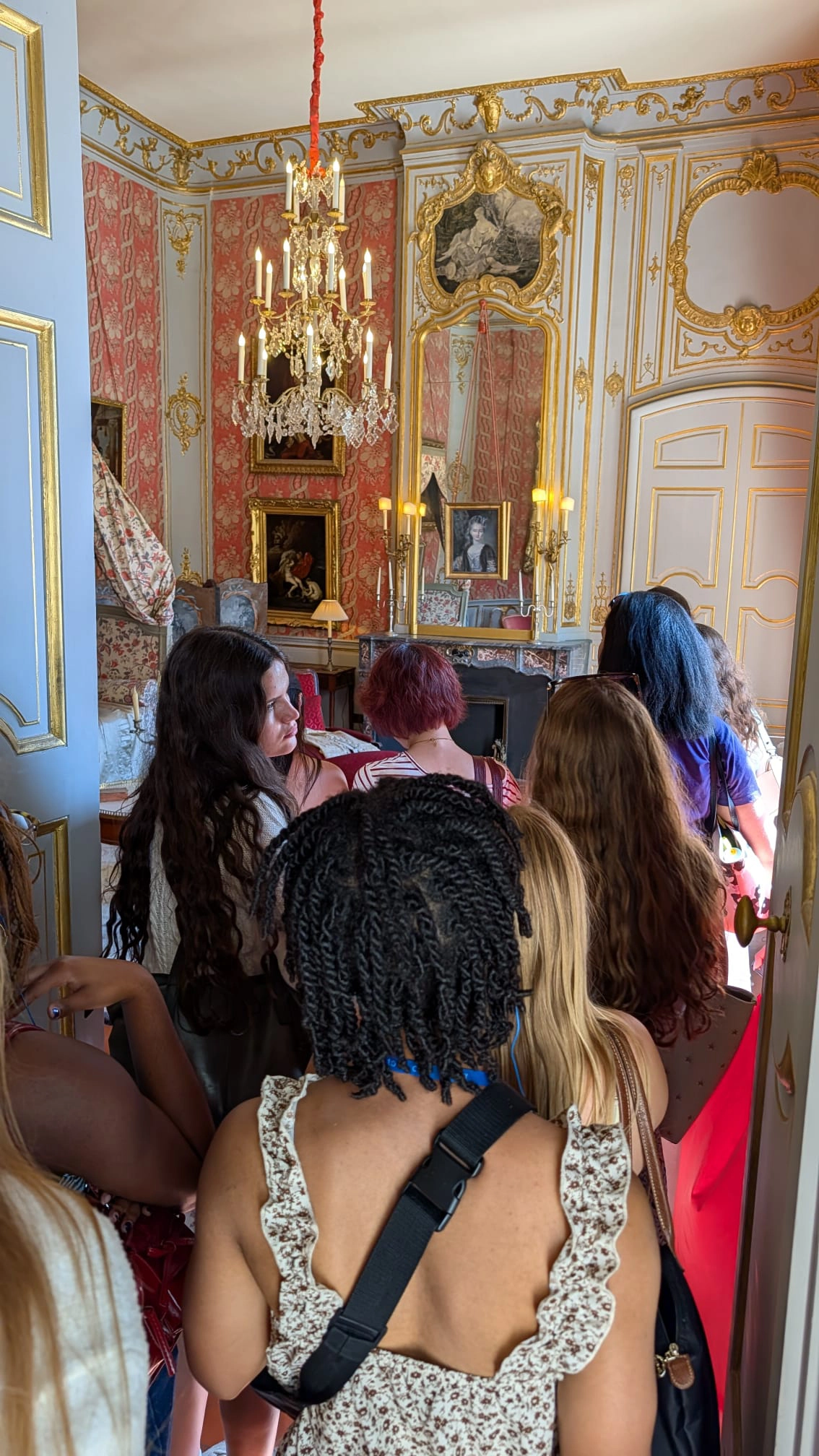
At the museum, we were greeted by a close friend of Elsa’s, Marion, who helped restore the museum. She is an artist dedicated to intentional renovations that are rooted in making historic buildings more functional, and not destroying them more. Marion emphasized the importance in recognizing the difference in restoring and renovating—restoring is keeping the historical soul, and how it once was, whereas renovating is more like an improvement and modernization. Unfortunately, in the 1970s, people were not interested in preserving architecture from the 18th century, and unfortunately many of the original details were lost. Fortunately, Marion and her team of dedicated professionals balanced restoring and renovating this building. I forgot the name of the technique, but Marion explained that in order to find the original paint colors in the rooms, certain tools are used to scratch surfaces such as windows or doors to reveal the color, which is then followed by research.
Beyond the outstanding historic rooms filled with artwork and beautiful furniture, there was also an exhibition in the museum. The walls were lined with artwork from various artists that produced works in the 18th century, and one artist caught my eye: Henri de Toulouse-Lautrec (1864–1901). Specifically, the color palette he used in all his paintings caught my attention, along with his ability to texture his work which made the subject and scenery look as if it was endlessly in motion; flowy and airy. His pastel color palette captured the delicate essence of Spring; as he used hues the color of the Marseille water, yellows, greens, and purples. The softness of his art reminded me of the scenery I saw this morning on the bus ride to Aix, which consisted of fluffy green fields that made me eager to run through them to reach the bumpy mountains in the far distance.
This view from the highway made me reflect on how the roles of planning and aesthetics truly shape the energy and community in a city. And if I have learned anything from my French mom or simply just existing in France, it is that the French value and care about aesthetics. I believe aesthetics can’t be born through new establishments or chain stores, which is almost entirely what Hartford makes money from today. Aesthetics are born through preservation that appreciates historic value, allowing the community to feel secure, without the desire to continue adding new establishments. Aix got its soul from its historic value and vibrant community that appreciates the city for what it once was and what it is today, but it’s a different story for Hartford. The highway in Hartford physically divided the communities, and it’s lined with billboards for fast food chains, which immediately influence one’s experience in the city. The billboards create a lack of space for our own thought of direction to explore the city, and Hartford cares a lot about convenience and money, while Aix prioritizes community and rather family-owned restaurants, which add to the soul of the city.
I really have enjoyed the fact that we were not given our phones on this trip, because it allows us to be the architects of our own experience in the cities we visit, without any outside influence. We aren’t influenced by the most popular restaurant on Google or one that has a 5-star rating—instead we get to freely navigate the city without the noise of businesses paying money to have the highest rating online.
Today was spent enjoying the vibrant city of Aix, and we ended it with a dinner at our peer Tessa’s house. Thank you to Aix and our wonderful Porter’s community that made today as joyful as it could be!
May 7, 2026
Student Author: Emma
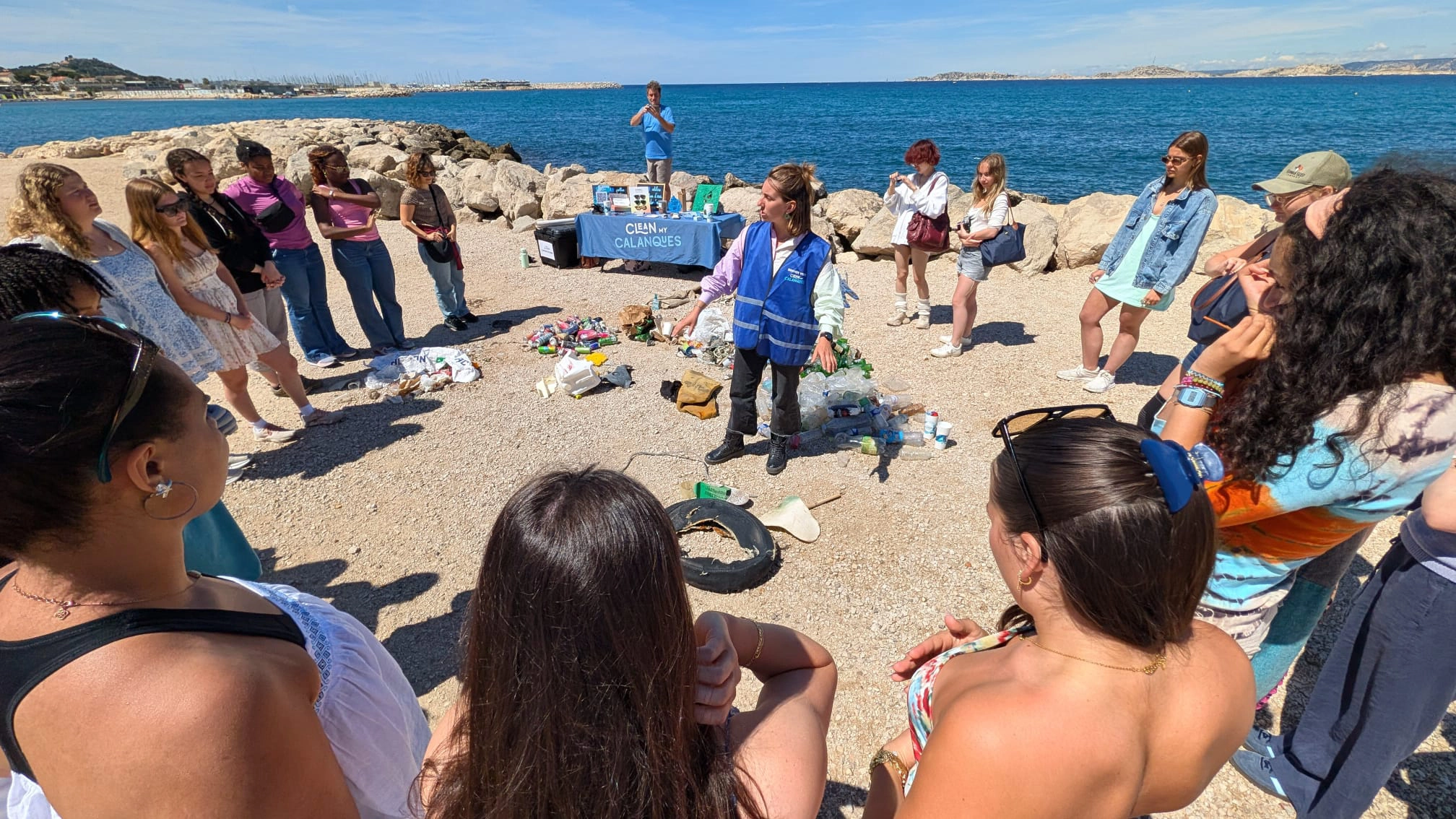
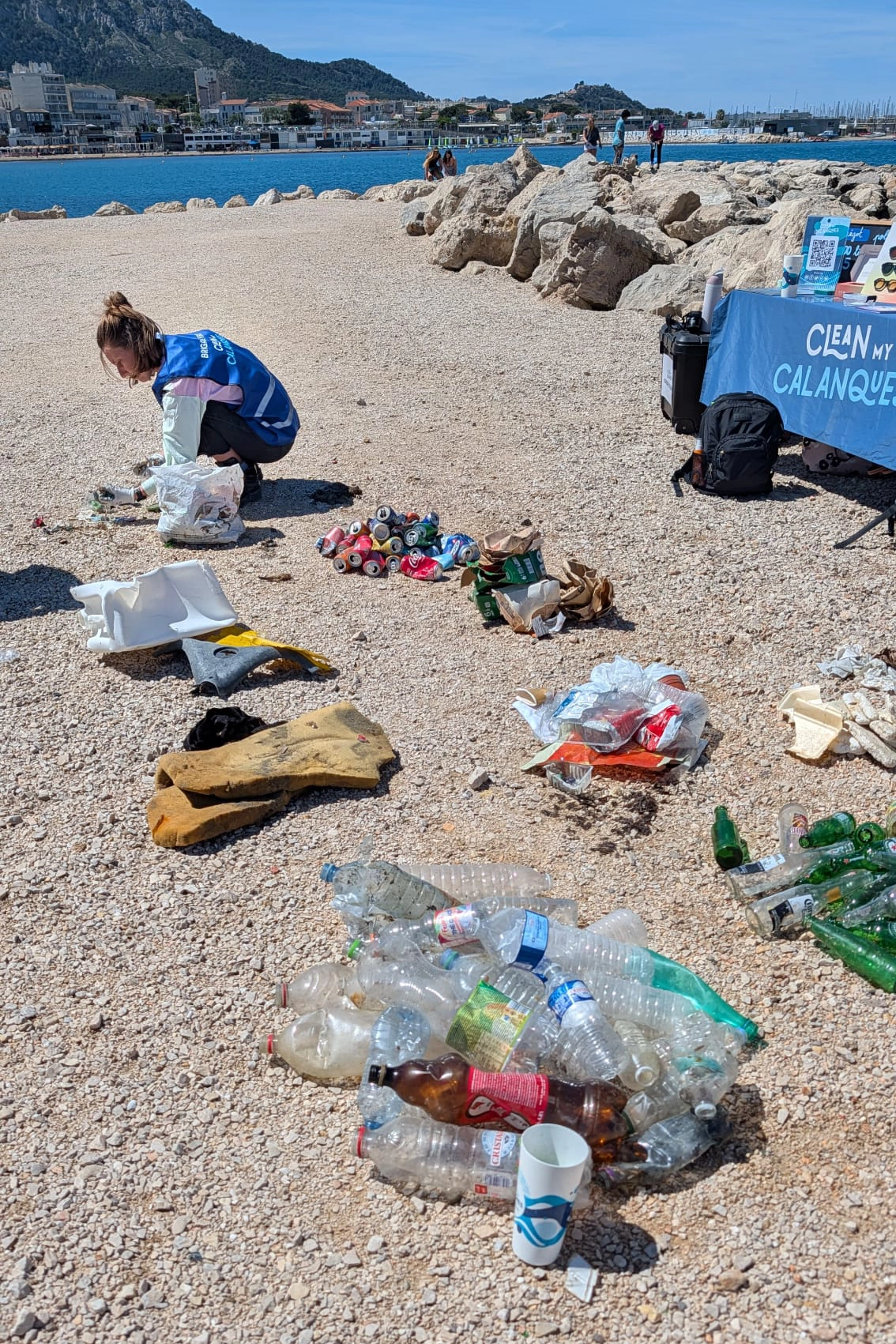
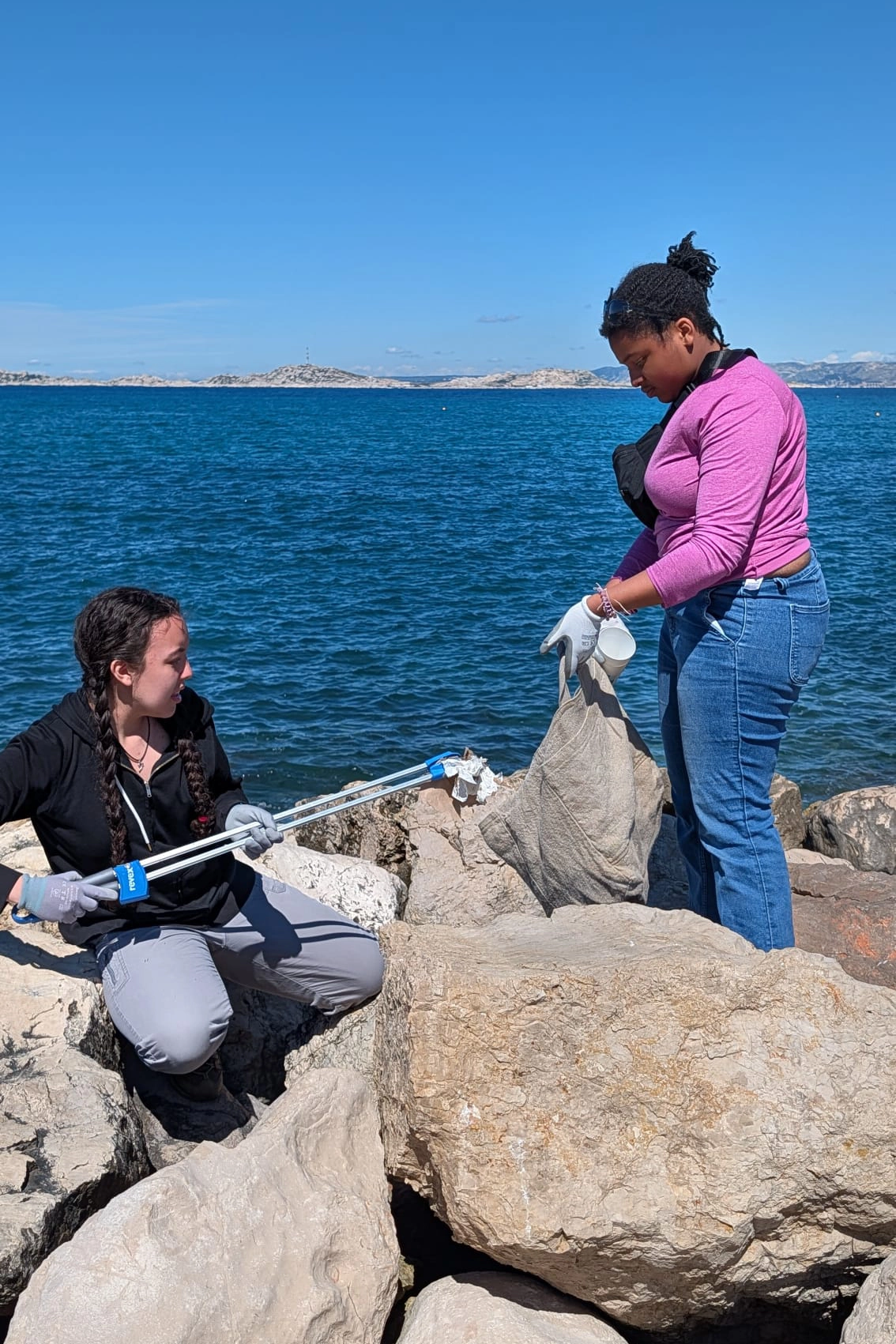
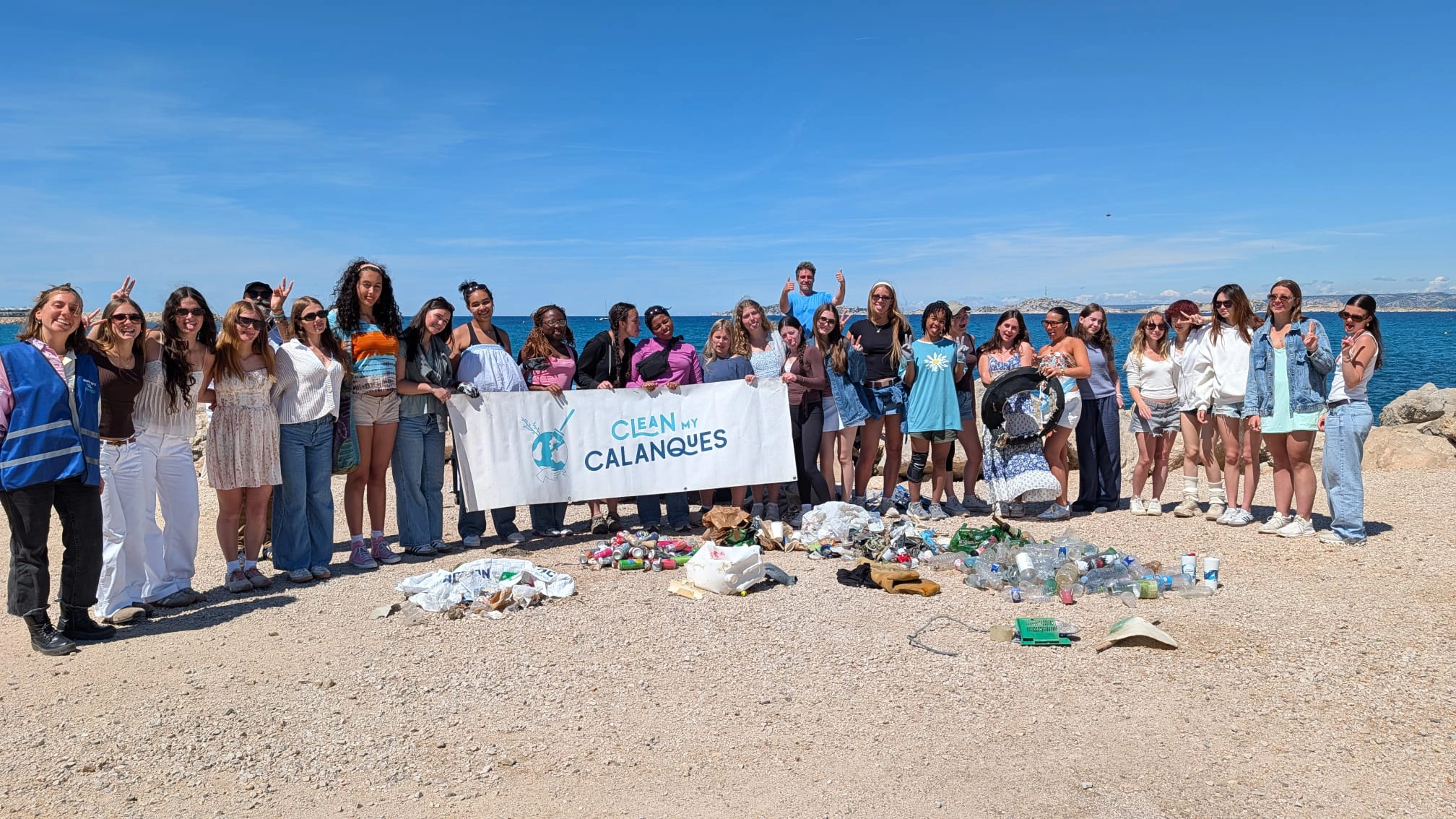
Today, we had our second day trip to Marseille. It was a beautiful sunny day. We spent the morning cleaning up a beach with an organization called Clean My Calanques. As a group, we were able to pick up 28kg of litter in only 40 minutes. Everyone was very pleased that we were able to make a difference so far away from Porter’s.
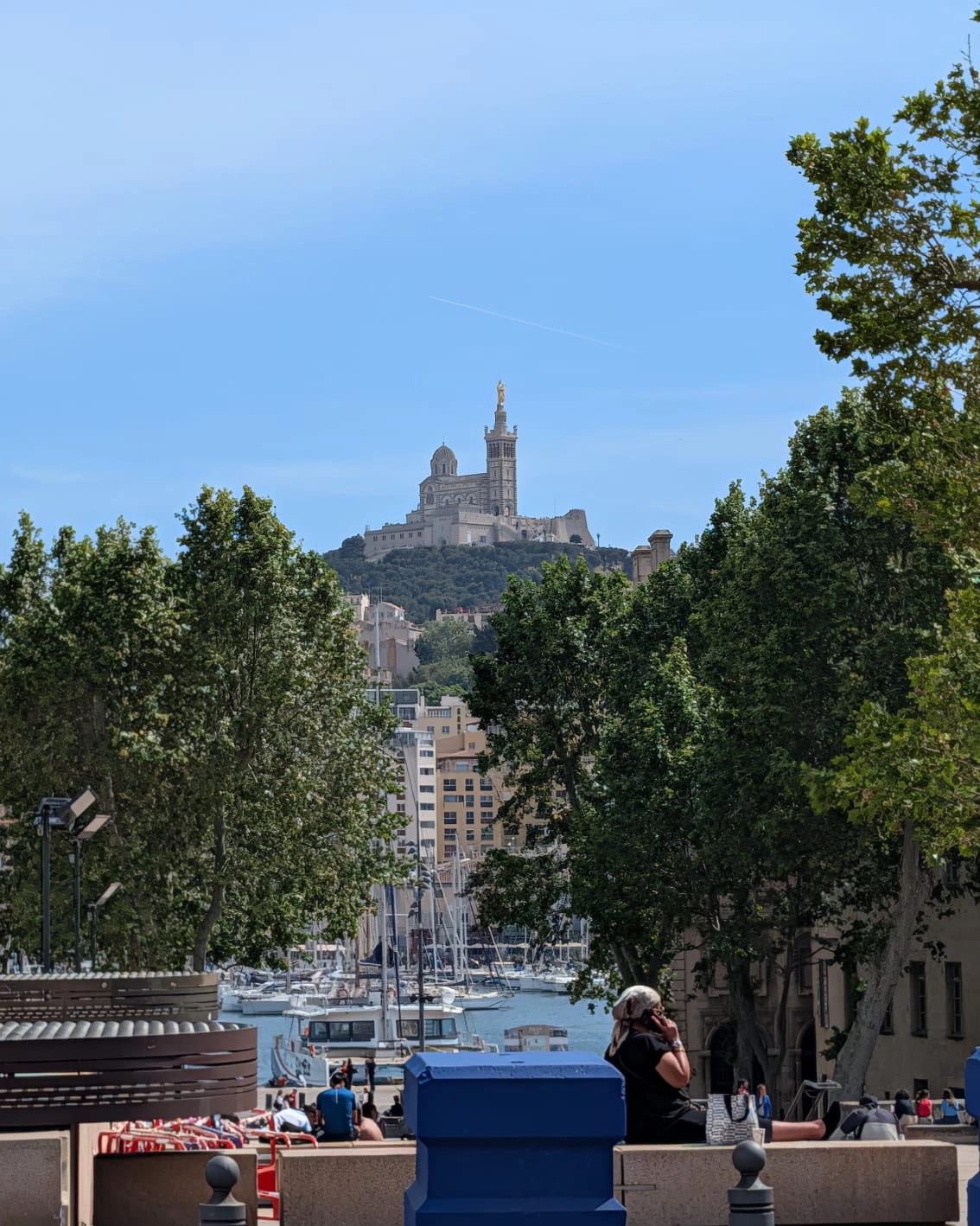
Later, we visited Notre-Dame de la Garde, a basilica that sits on the highest point of the city and is also the widely known symbol of Marseille. The temple is very impressive and features a massive golden statue of Mother Mary and baby Jesus. The statue is referred to as the Good Mother as all people of Marseille believe she is protecting them.
Marseille is an immensely diverse city when it comes to culture and religion, as there are loads of people living there from all around the Mediterranean (and the world) yet they all coexist very well. One detail that stood out to me was the fact that the people see the statue of Mother Mary on the top of the cathedral as just a mother, instead of the mother of Jesus, so that the people of Marseille are all “siblings” in a way, creating a feeling of unity through belief. It doesn’t matter whether people are Catholic, Protestant, Jewish, Muslim, Atheist or of any other religion, people will pay their respects and thank the Good Mother for protecting them.
For me, having grown up in a greatly diverse community, I felt strangely at home for never having visited Marseille before. I think that seeing so many people of various backgrounds gathering in a place (basilica) that is usually seen as for just one community to use played a huge role in that. Many of my classmates voiced feeling very comfortable and at peace, even without growing up in places where all spaces were shared by vastly different cultures. I think that this is a great reflection of how well Porter’s teaches inclusion and diversity rather than division, and both Marseille and Porter’s are great examples of the positive impact that kind of mindset has on a community.
Student Author: Katharine
On our bus playlist today, there has been one song that especially stuck out to me, particularly the line: “We live in cities you’ll never see on screen. Not very pretty but we sure know how to run free, we’re on each other’s team.” I’ve probably heard this song dozens of times throughout my life, but hearing it on the bus to Marseille today it was impossible not to apply the lyrics to the city’s history.
On our previous visit, Olivier made sure we understood how important Marseille’s community is and how throughout its tumultuous history and relationship with government, the city itself has always had a united identity. This afternoon we made it up to the highest point in Marseille: Notre-Dame de la Garde. We had talked over the course of the trip about how the traditionally Catholic symbol—the Virgin Mary—is instead perceived as a protector of all, particularly in Marseille. The gold statue of the Virgin can be seen from the entire city and is always the first and last part of the city to catch the sun or its reflection off the Mediterranean; particularly helpful for the sailors who relied, for centuries, on the cathedral as a lighthouse. A key characteristic of the port city has been that it has always been safe for sailors regardless of individual religion. I presume that this is what led to the Virgin’s symbolic evolution. Olivier, today, explained how every child of Marseille is also a child of “the good mother” (Mary); his explanation was only that “everyone needs a mother no matter their individual religion.”
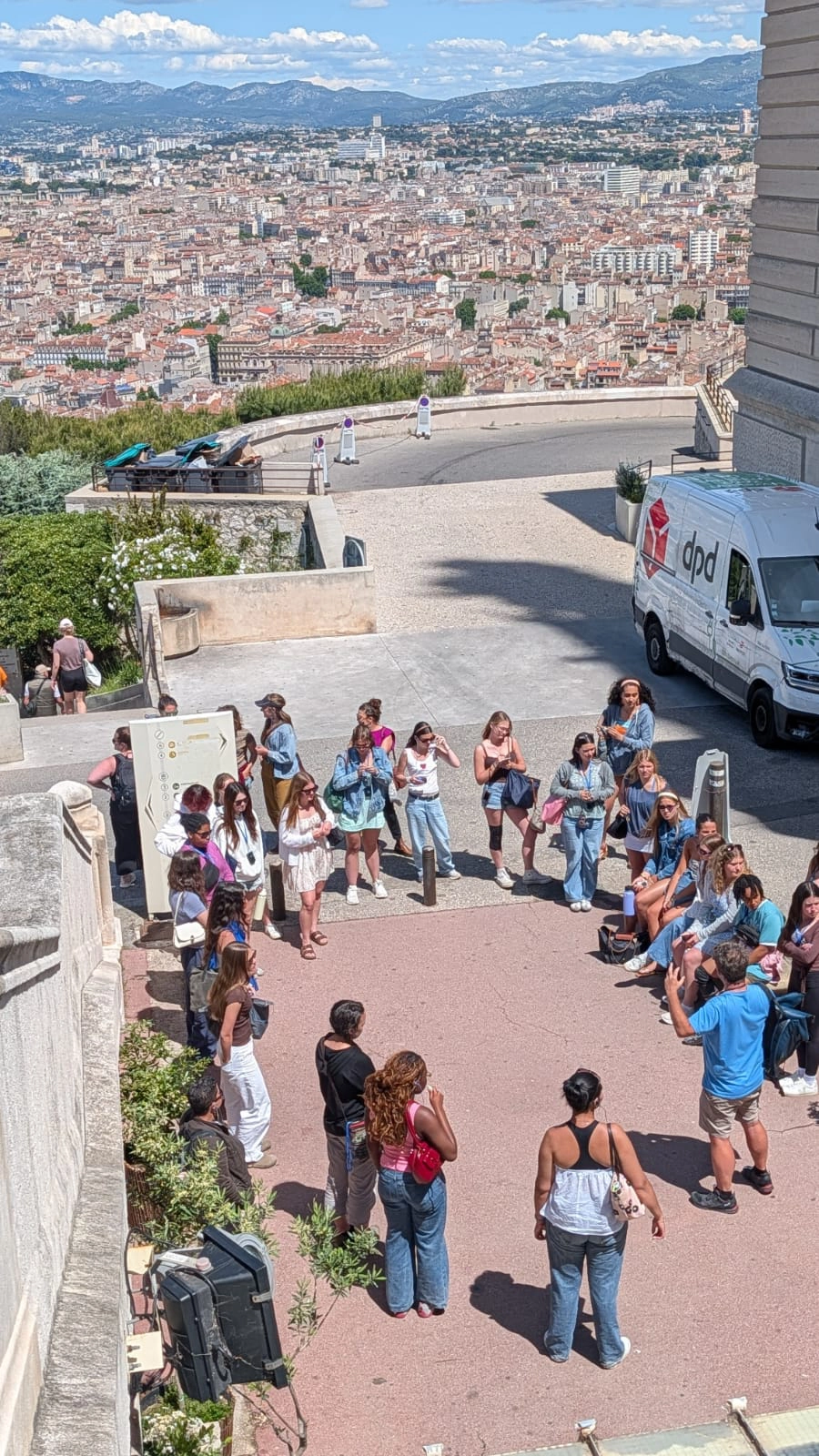
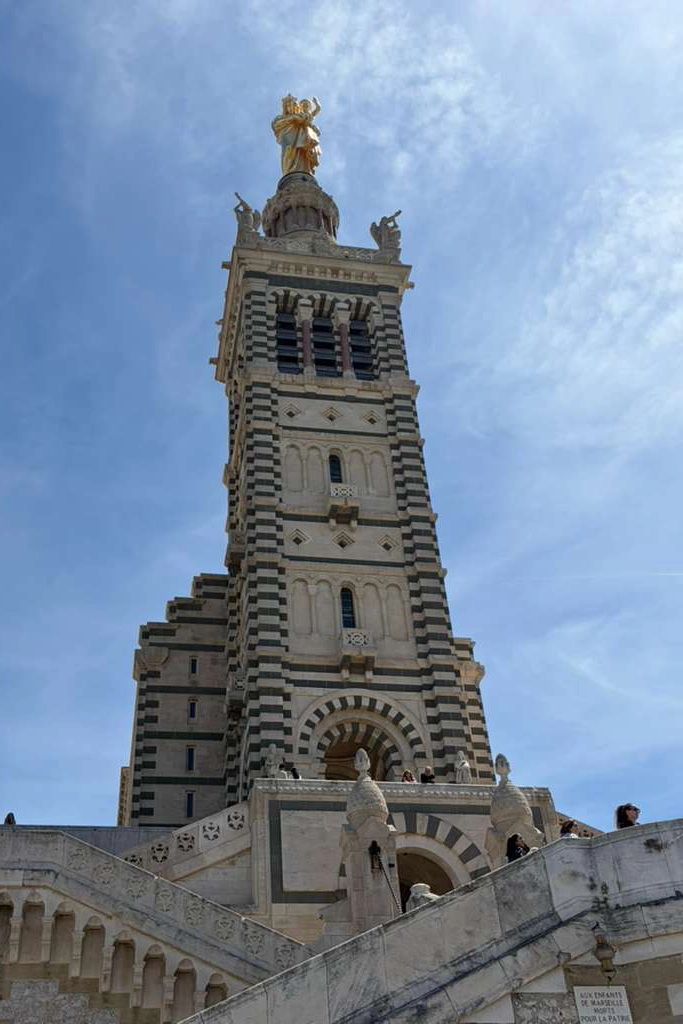
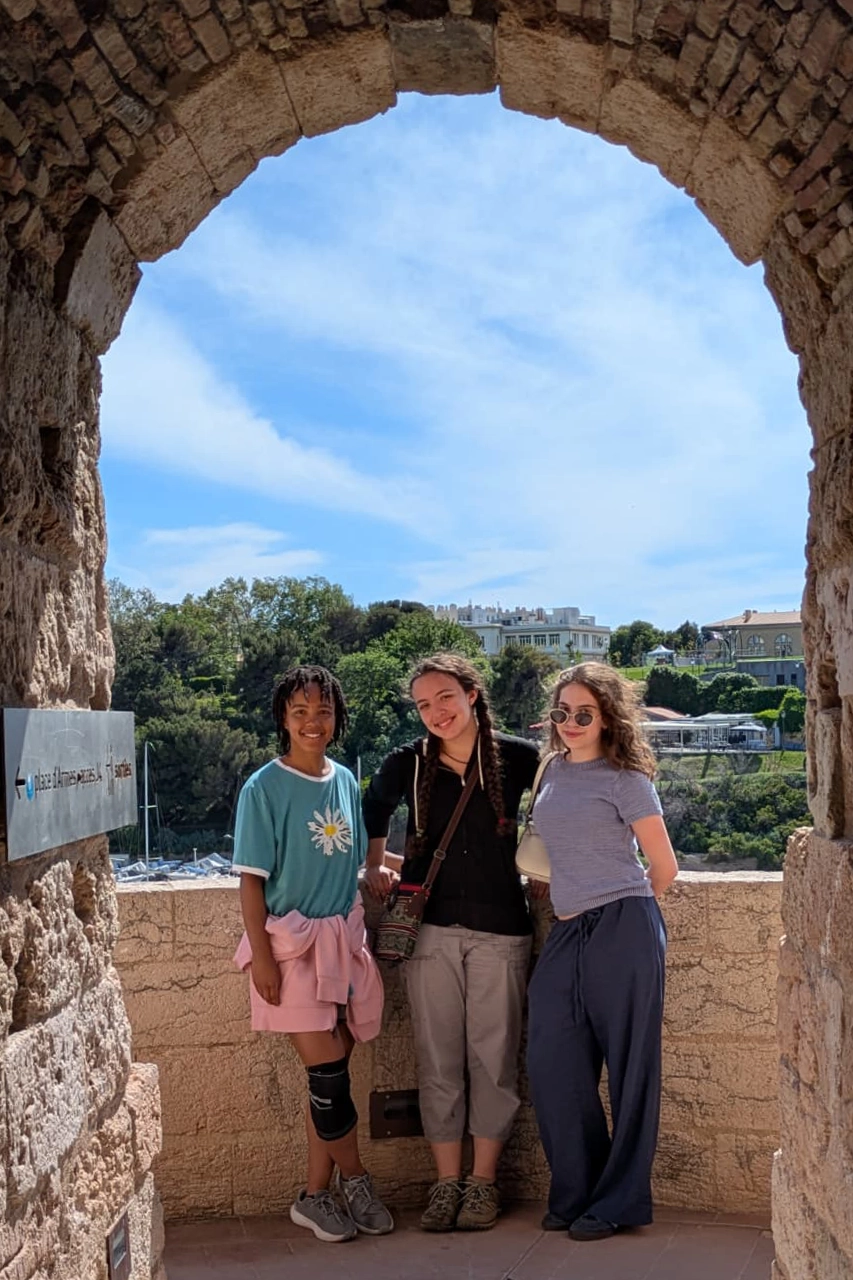
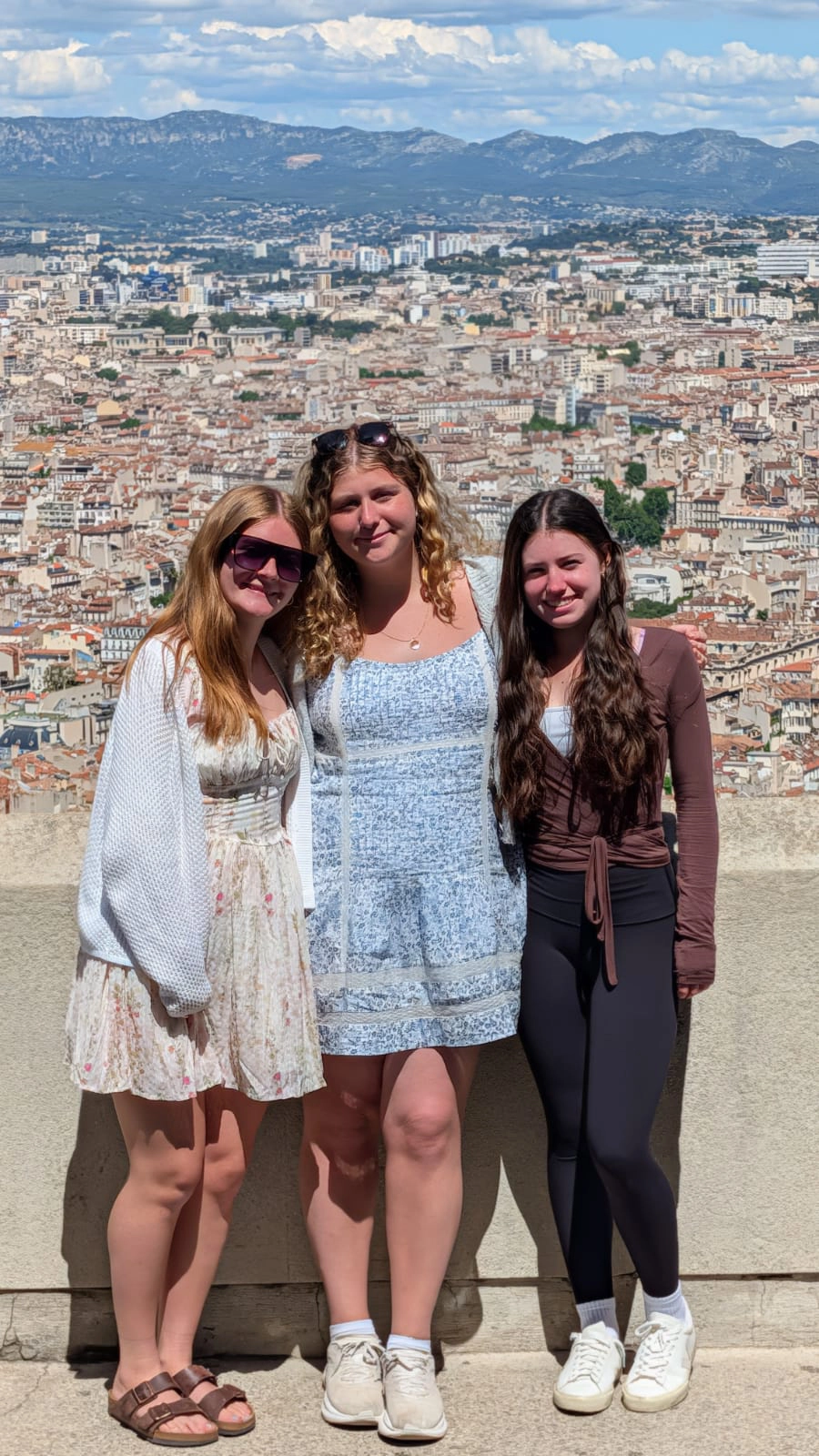
I consider myself relatively well-traveled, and everywhere I have been it has always been important to both me and those I’ve traveled with to interact with the local culture and people, yet I don’t think I even thought that it was possible for a city with such a large population to have such a prevalent sense of community, especially in the context of religion. I am still enamored by the fact that from at least 800 A.D. (when Notre-Dame de la Garde was built), the diverse city has bonded over religion; perhaps it is just because, in a way, the citizens all practice the same religion: the religion of Marseille.
Nonetheless, it is fascinating, at least to me, that throughout centuries of conflicts stemming from religion, this Provence city has managed to form its identity—and more impressively preserve said identity—when so many countries, with access to more funding and resources than Marseille, haven’t.
This song also makes me wonder if Marseille’s rough history—particularly in the late 1900s—and need to rebuild itself so many times, played a part in their centralized identity. In the cathedral, we marveled at the paintings that lined the walls. Gold frame to gold frame, they tell the stories of how the residents of the coastal port city have been hurt by plagues and wars, as well as other tragedies over time; but more importantly, how the community has come together afterwards, to support each other and heal their city that lies beneath the gold statue of their “good mother.”
Lorde’s song mentions “cities you’ll never see on screen,” and even though Marseille is relatively big, there are still tons of people who have never heard of it. If geography or history isn’t something you’re particularly passionate about, when would it have come up in a conversation during our 16-18 years? Even then, just because we know the name of a city doesn’t mean we know anything about it. I take this to mean that no matter what you think the limits are for the possibilities of functional societies—or anything really—there will always be instances that prove otherwise.
May 6, 2026
Student Author: Eliza
Today the class visited Arles and we engaged with two primary spaces. The first was a fresh market with Provence goods catered towards the local community. The second was the Luma museum, a contemporary experimental space for international artists. Our class approached both spaces with the “traveler not tourist” mindset that we have been practicing. But the catering and audience of the places changed how our approach was received.
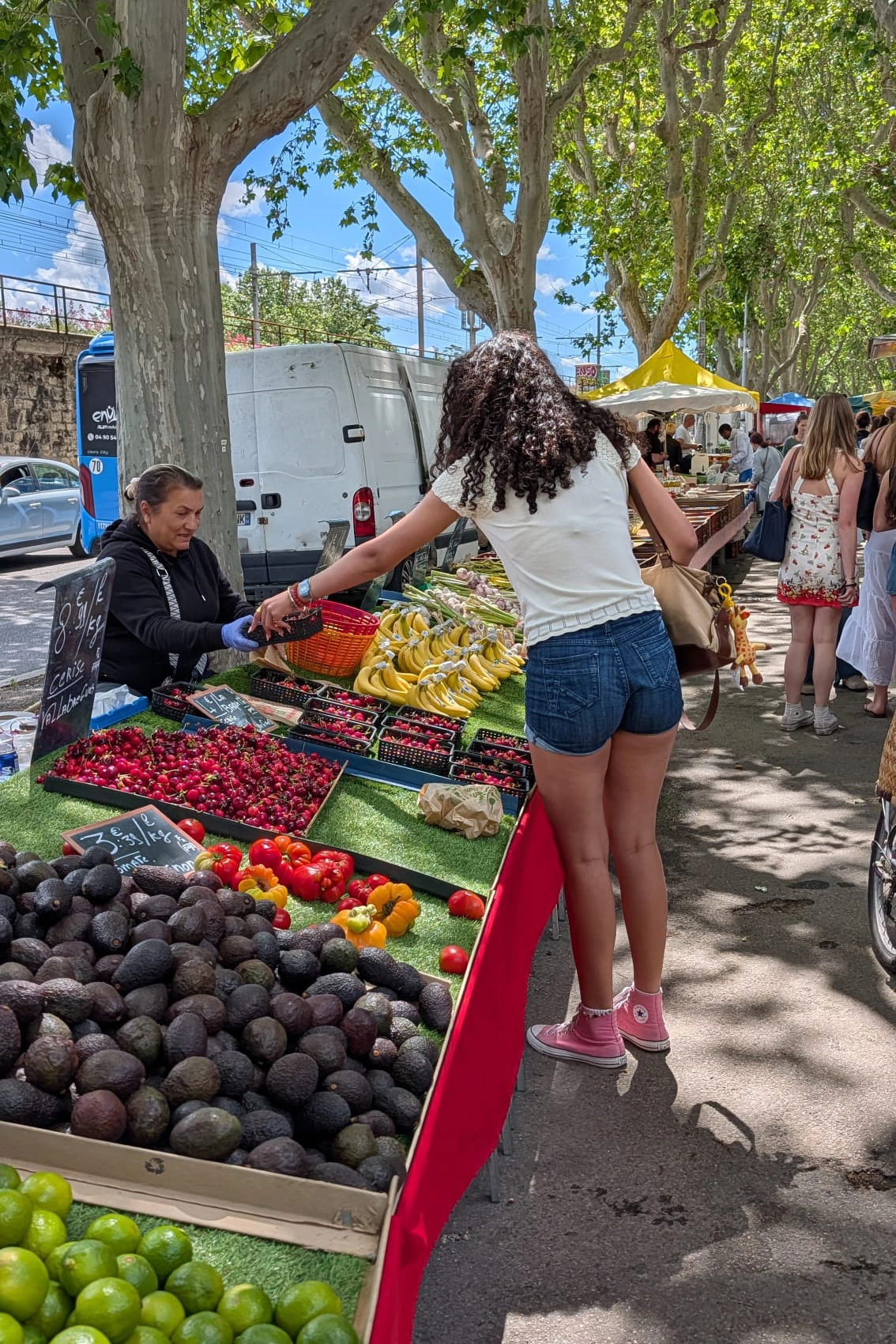
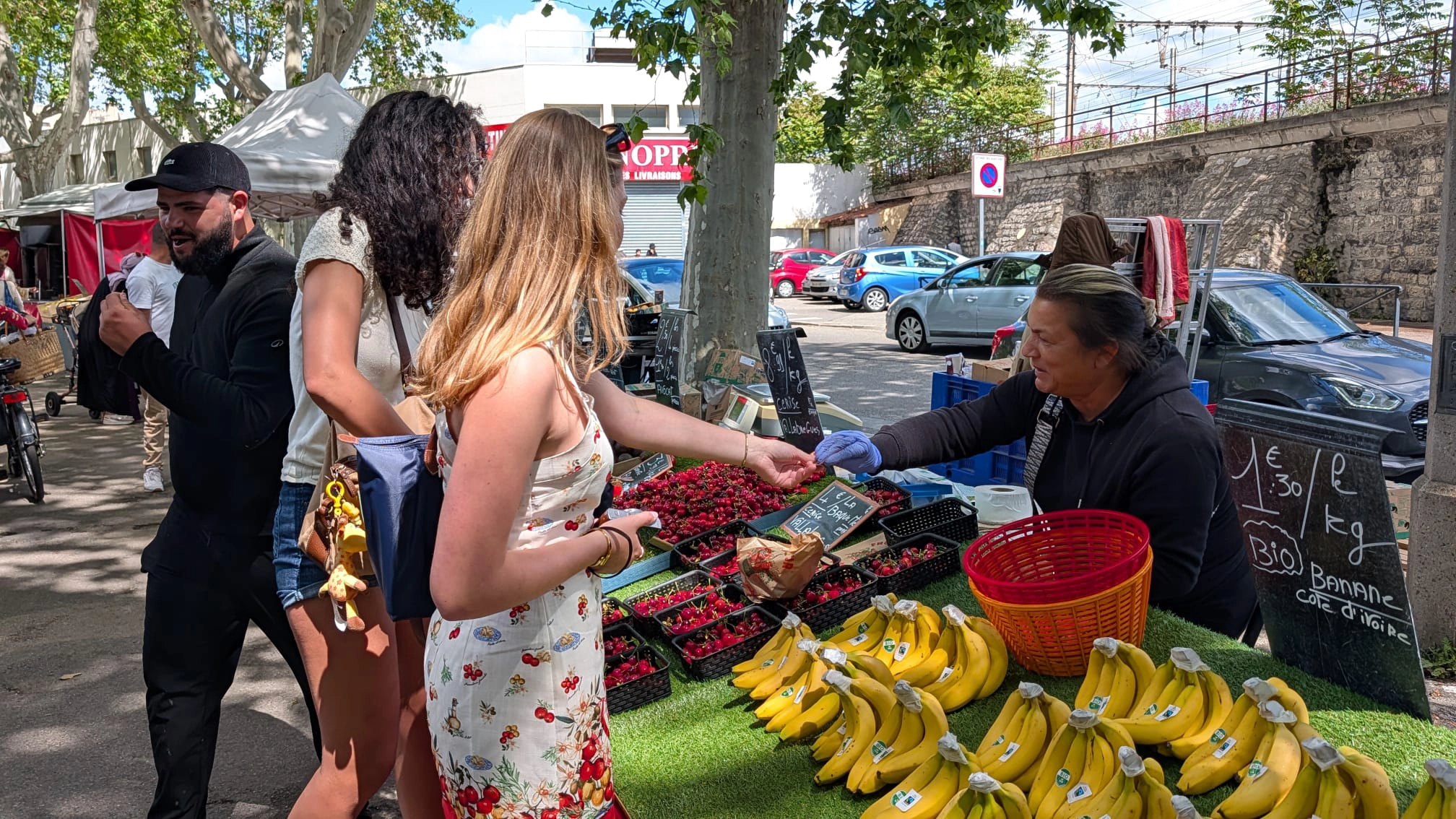
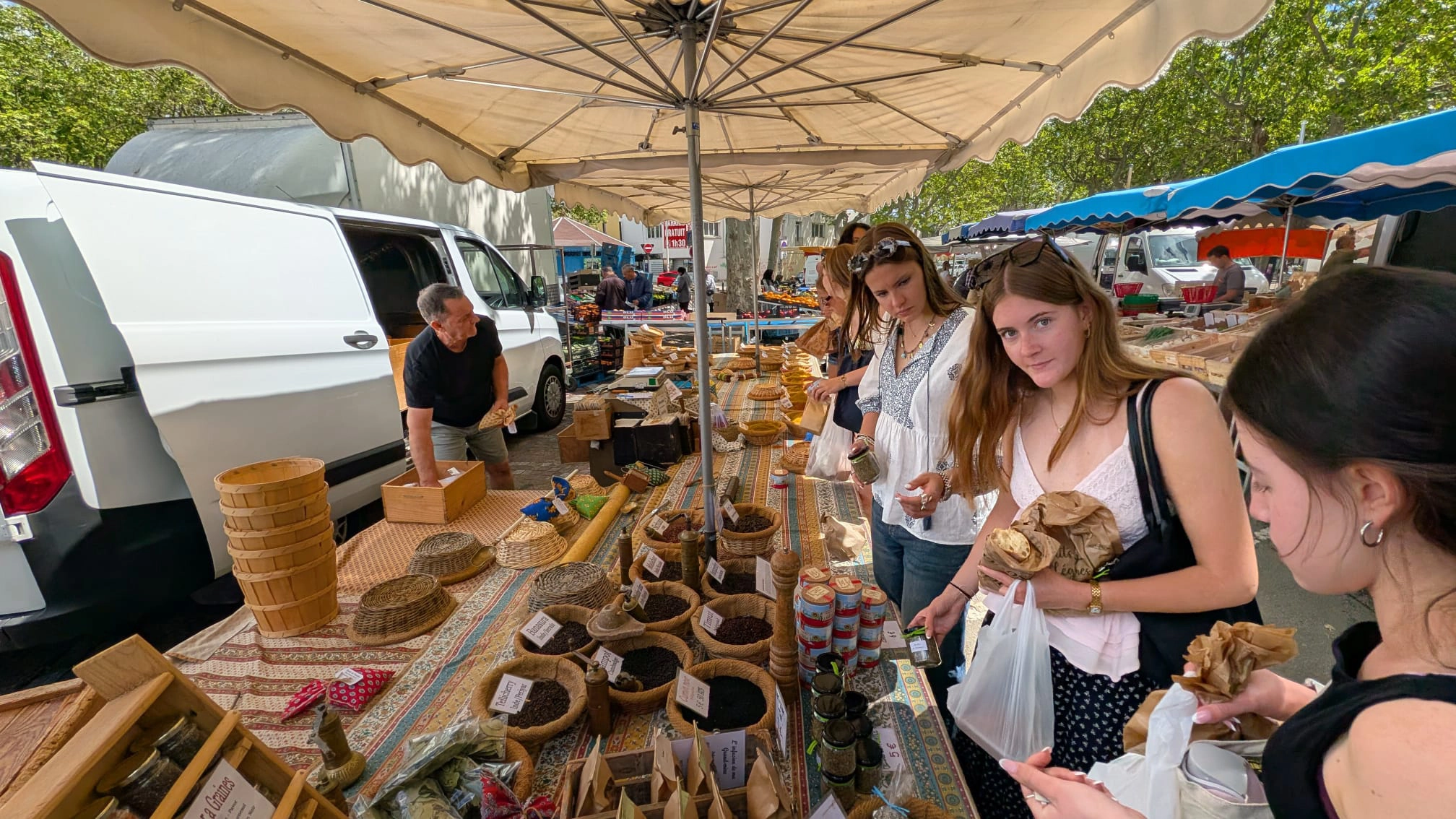
In the market, our group was unable to blend in and integrate to the environment. Our large group and stylized outfits blew the cover. While the local people conversed and purchased goods from friendly faces, we paraded through. Our group was respectful and excited, but the divide felt very clear. One problem was the language barrier and our inability to learn from and meet the salespeople. I had expected this gap to be frustrating, but I had underestimated how much of a disadvantage for learning it would be. Similarly, we were unfamiliar with many of the food products being sold, which made it difficult to decide and support the businesses. I felt overwhelmed by how clearly out of place we were. It was not a bad time, in fact, I was very happy to be there, but it solidified an understanding that we would never quite fit into a local community space.
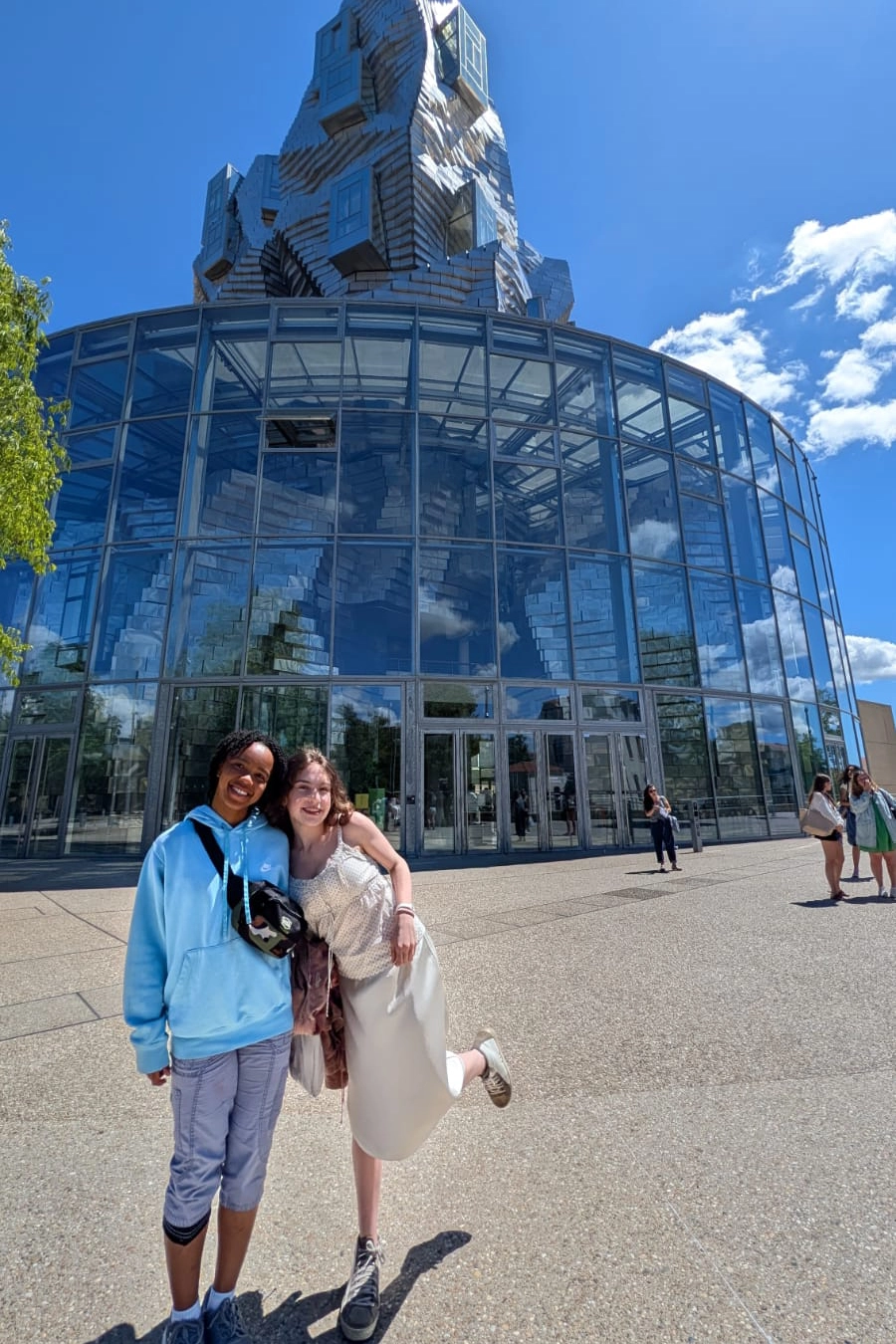
In contrast, the Luma felt geared towards a universal collection of people. For one, the space was so much larger in the museum, so we were not an overpowering force. Instead, the structure put us in a new perspective where we were fully immersed in each exhibition. The first exhibition was a film by French/American artist Camille Henrot. The language was in English with French subtitles. The subject of the exhibition fitted “into the veins,” explored cross-culture topics and connections. Art at the Luma felt accessible for our group, while challenging our worldview and seeing new perspectives. The Luma was built to invite local and traveling visitors. The other Luma guests were friends, families, and couples from different backgrounds. On the way out, I noticed a school group from Italy start their own tour.
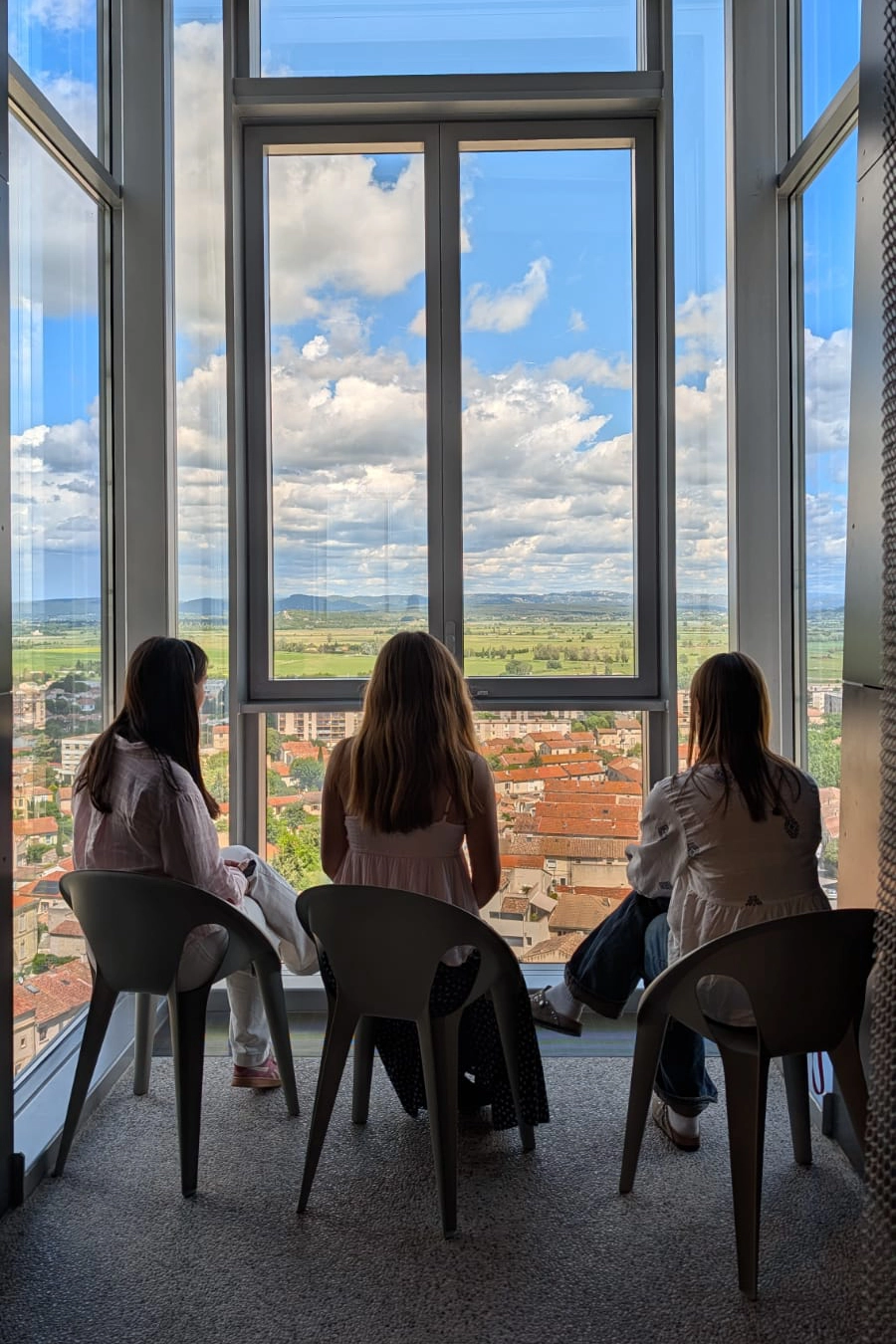
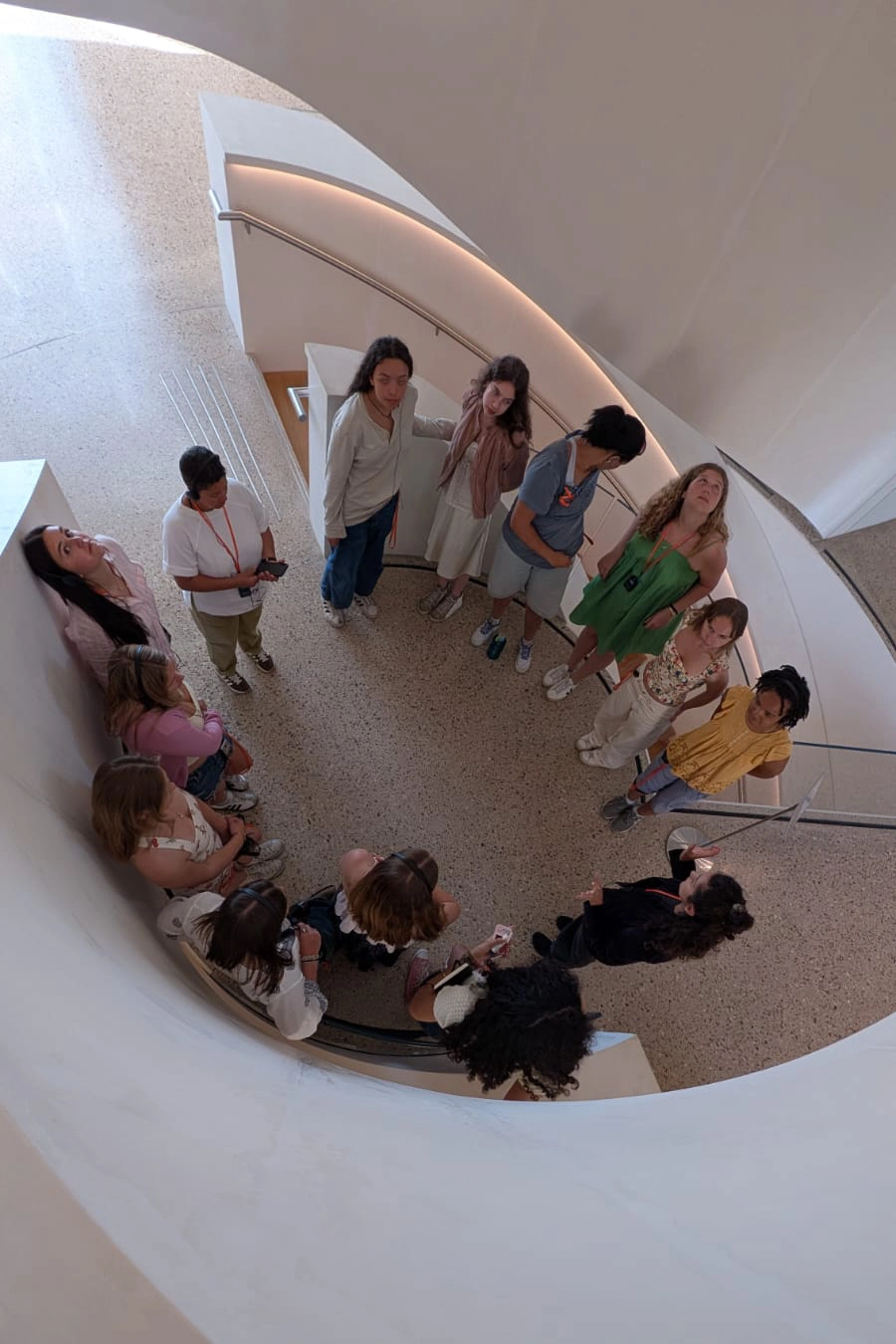
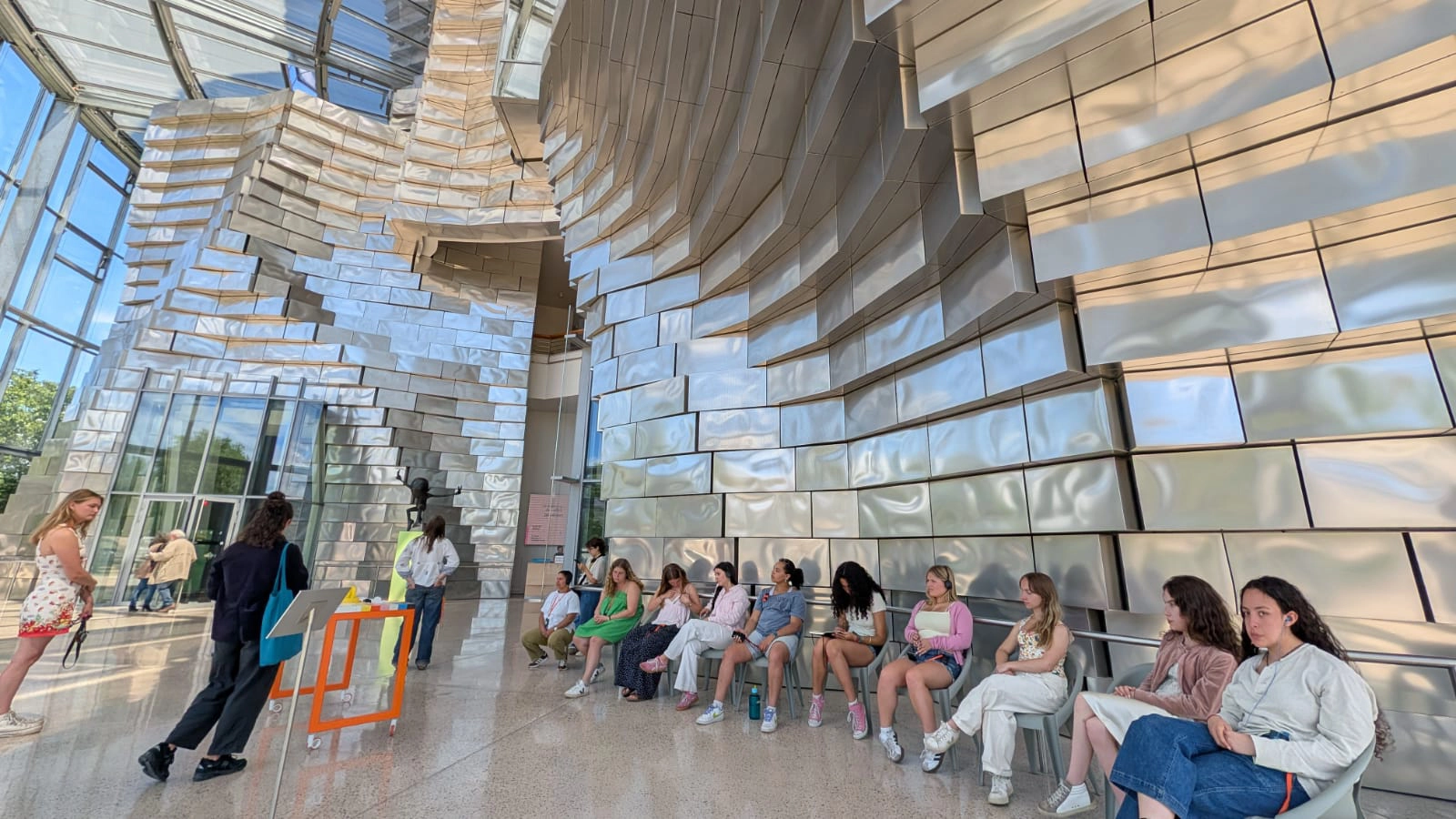
Both spaces offered different kinds of diversity and lessons. But the levels of tension when traveling with our class group changed completely. The challenges of fully experiencing the market when it was not a space built for us created a reminder and reflection for how identity and culture can enhance or leave a gap of understanding. When exploring the Luma, it required no major culture shifts or group adaptation.
By experiencing both levels of comfort, I was reminded how difficult it can be to manage the space we take up as visitors. When we travel as a group of non-locals, we impact the experiences of everyone else there. This has felt uncomfortable and challenging, but without living, observing, and shaping the different spaces, we would miss out on how the space could impact or shift our world understanding.
Student Author: Naomi
Today was a change from our last couple days because we took a lovely day trip to Arles! This trip started off with a little adventure, where we had to pivot a bit because of a delay on the train. However, it meant that we got to take a different train to a beautiful town called Tarascon, and then took a bus to Arles. While I was on the unexpected train and bus, I was looking out and saw many repurposed buildings which looked older but were still used for modern purposes. This continued throughout the Arles trip as well, and really got me thinking about what we choose to preserve or continue to use.
In thinking about this, I found our visit to the Arles Amphitheater incredibly additive. The amphitheater has had several uses throughout the centuries: from a Roman amphitheater to a town with over 200 residences, and then back to an amphitheater. The evolution only happened due to what was needed or considered important at the time they happened. When it was constructed, it was for entertainment. When it was a town, it was because the walls provided safety in a time of war and danger. When it was restored to an amphitheater (as it has had several uses), it was because the time of strife was over and the town was not considered necessary by those with power: though it came at the cost of people’s homes.
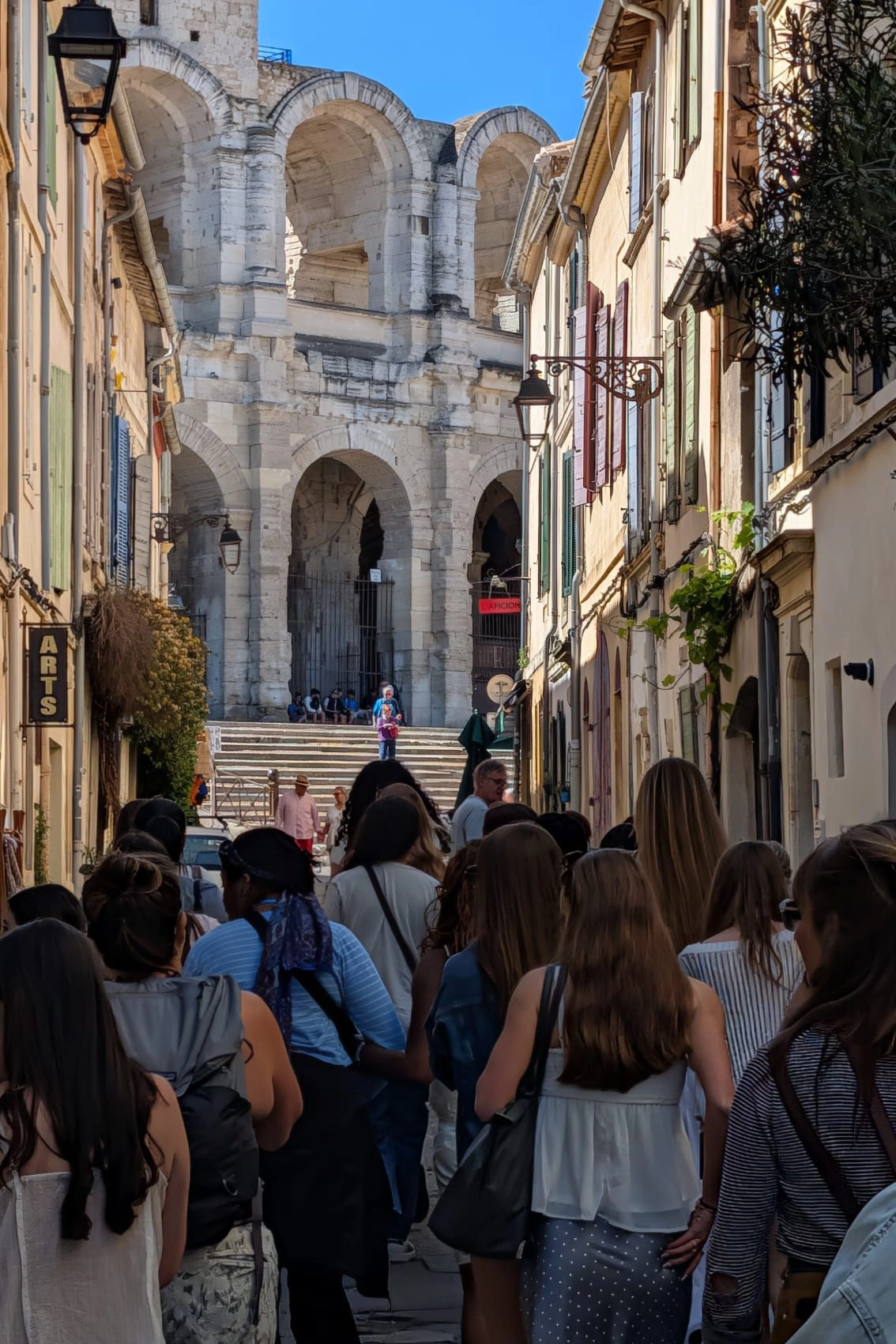
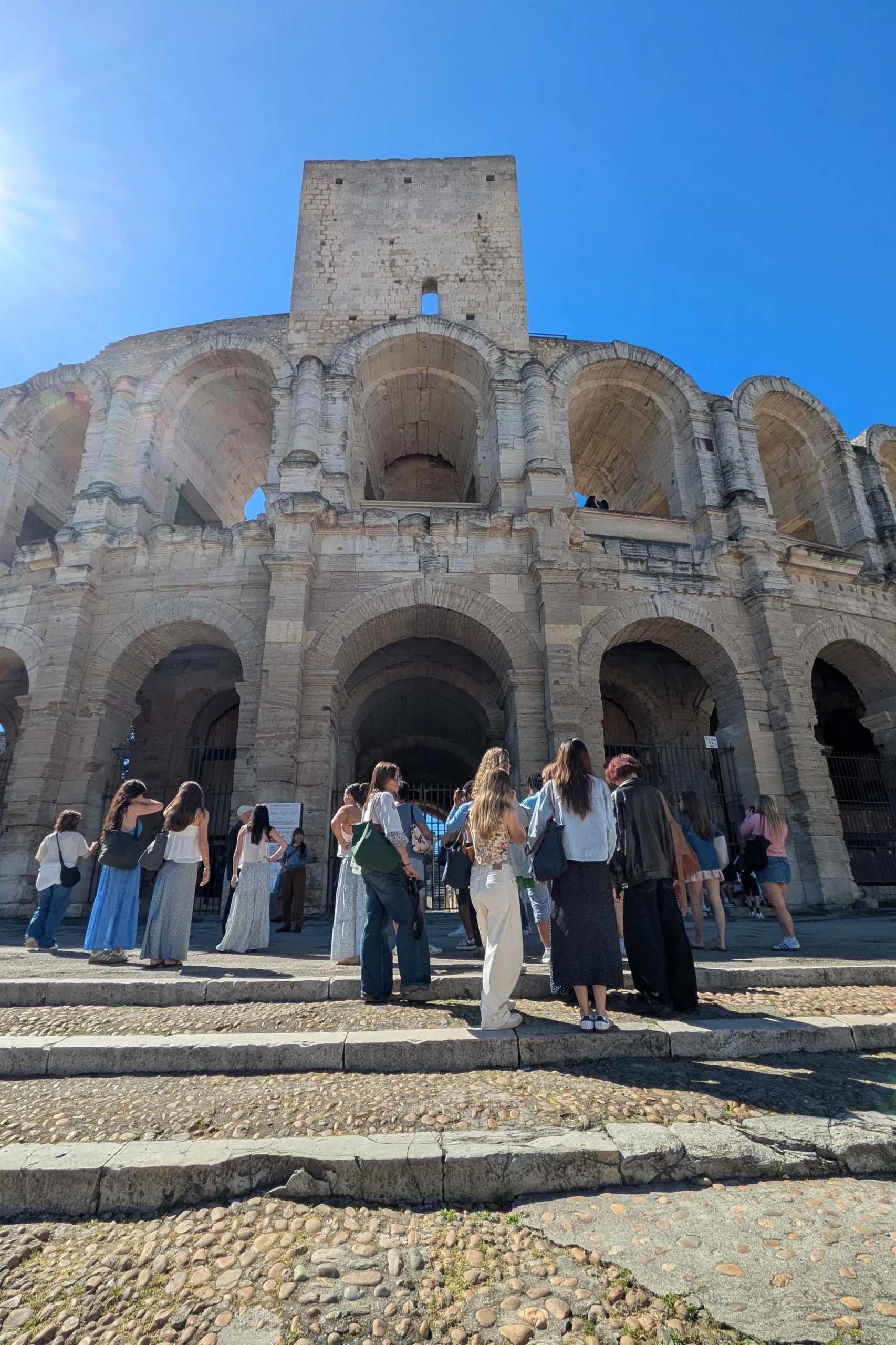
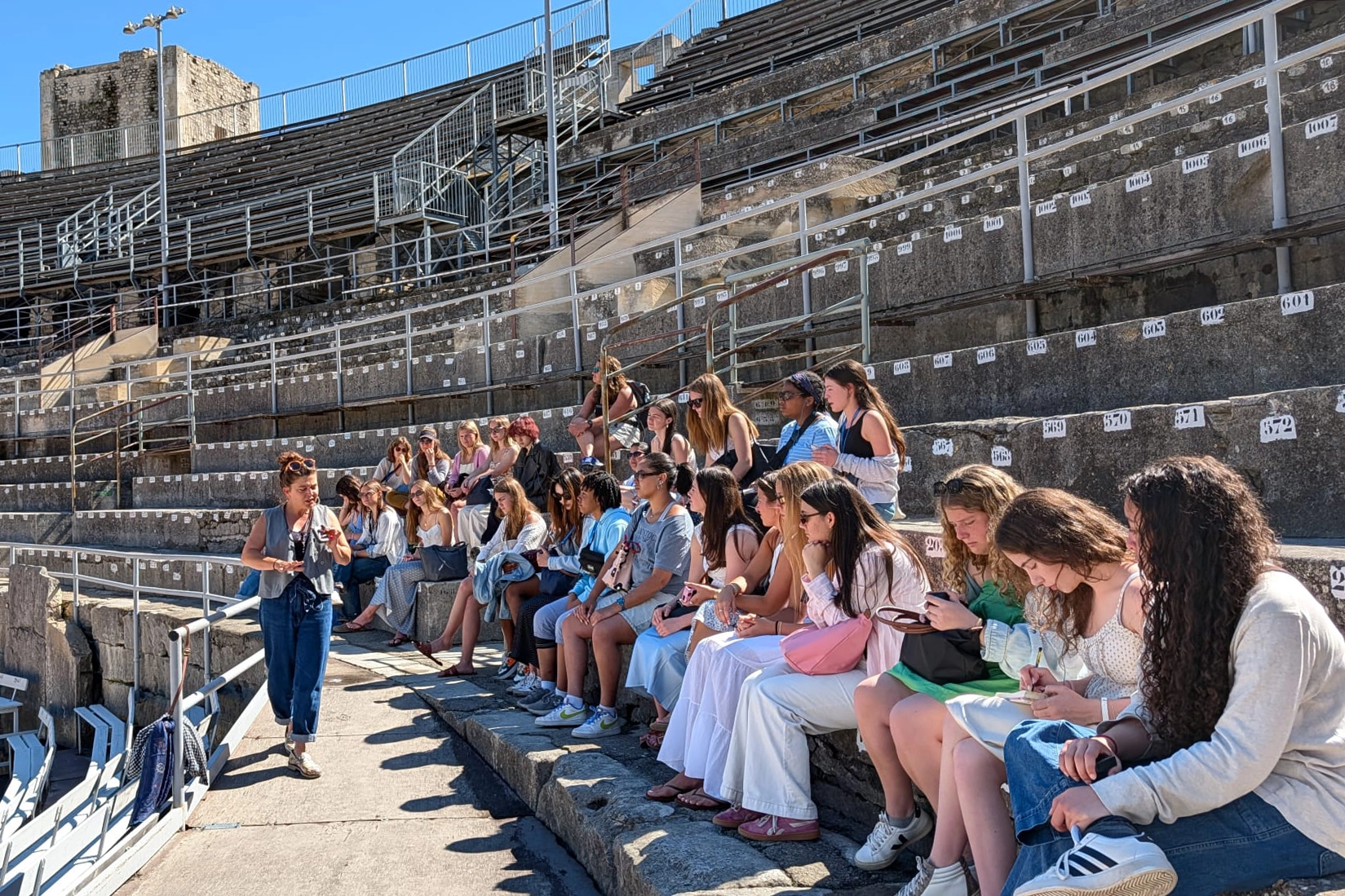
This all taught me that preservation happens when people have the resources and power to preserve something, and that things continue to evolve when that is necessary and there is no other option. In a similar vein, we also visited the LUMA today! Part of this incredible arts facility and museum used to be used for the nearby railroad. However, it was abandoned and later adopted by the LUMA Foundation. This is another case of something not being preserved but rather reused for a different purpose. (This was also something we saw at the Pope’s Palace.)
As we continue the trip, we have seen many cases where things are preserved for the sake of education or respect. This is deeply important and certainly to be considered at any site. However, to me, Arles provided a new perspective—one that asked if preservation was worth ignoring necessity? How can we preserve history while moving forward as humanity? And what circumstances allow us to preserve or not? As the trip continues, I hope to explore this more.
May 5, 2026
Student Author: Genevieve
Today, my cohort ventured to two museums. We split into two groups based on our interests and sought to discover the differences of each museum we visited.
My group first went to the Lapidaire Museum, which is centered around Ancient Roman and Greek history. The place contained many tapestries, pots, and vases with colors of black, white, reds, dull blues, and gold. This contrasts present Avignon with blue, brighter colors and a bigger variety. When it came to preserving a part of history, the museum showcased ancient tablets that contained rules and codes. My friend Savannah taught me that such law systems are kept in Avignon today and regarded highly, even if they’re used for different circumstances.
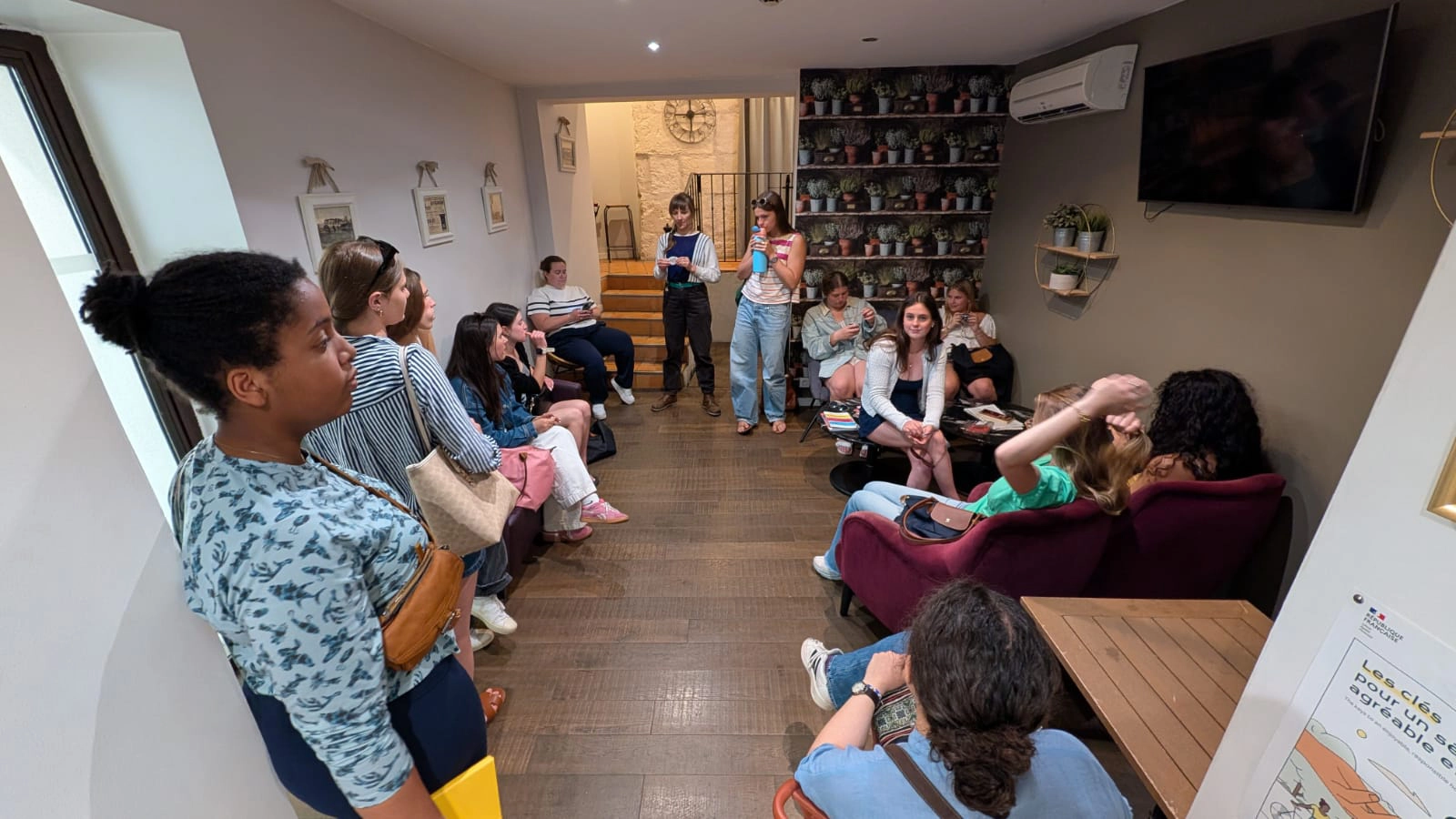
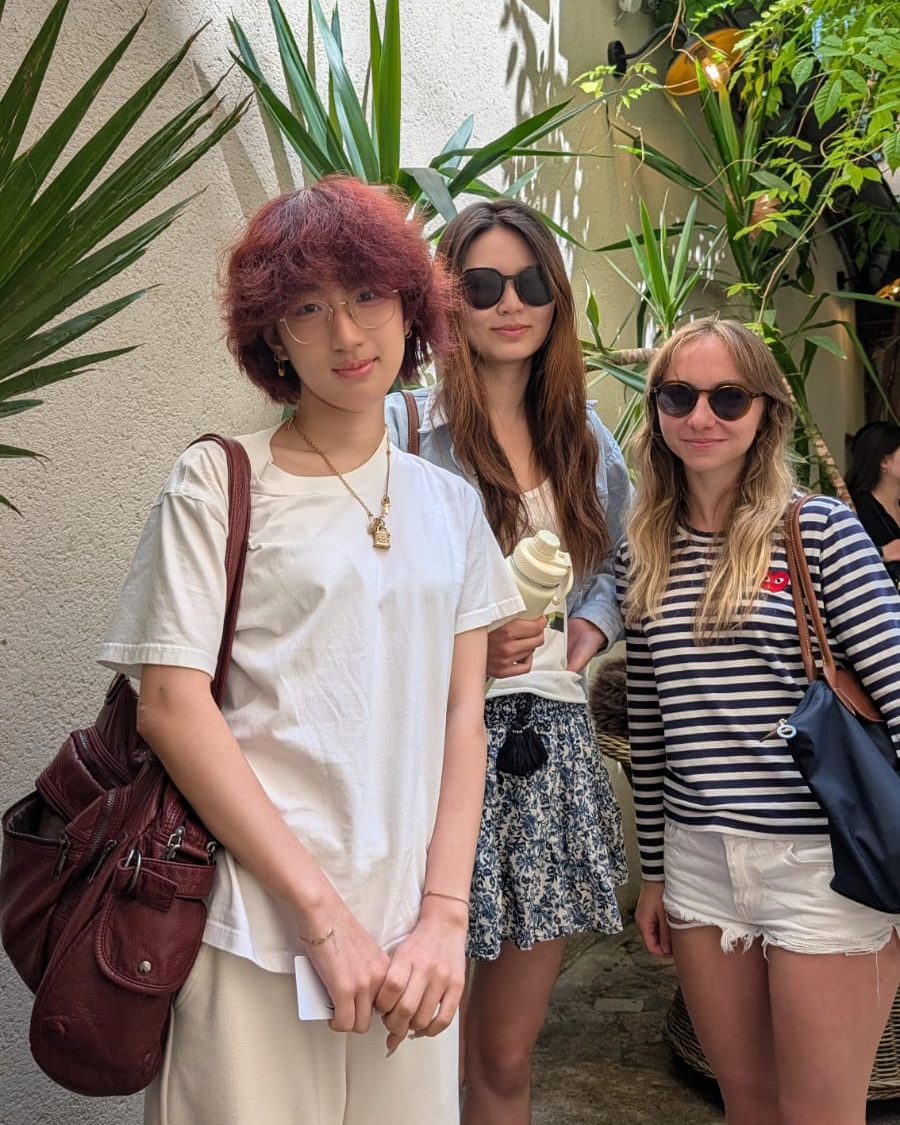
Through learning about the Lapidaire Museum, we saw how parts of history in Avignon can be preserved. I also learned museums want to focus on the identity a city or region wishes to convey. In the Lapidaire Museum, my group and I witnessed many statues that were decapitated. My chaperone Eirini explained how this was due to the occurrence of the French Revolution, for many people faced the guillotine depending on what side they were on. Also, when France was remodeling itself and stepping into its own identity, they determined they didn’t want to be known for their ancient Roman history and decapitated similar statues to discard it. My group and I were glad at least there’s one museum paying homage to this history, even if parts of France disliked it.
Another museum that highlights the identity France wants to convey is the Petit Palais Museum, which focuses on art and using it to depict the life of Christ along with other religious figures. I always used to think museums were only meant to preserve old history of a region or city, but I realize how they’re also here to bring awareness to a society’s key values. France is very much in tune with art and their religion, and the Petit Palais Museum does well to express these interests. In general, museums help people connect with their culture, whether its past or its identity, especially in France where most museums are cost-free, letting residents and visitors have easier access to knowledge. From my experience, I learned museums aren’t just meant to preserve history but also express the identity they want others to know them for.
Student Author: Sofia
For me, today revealed the contrast between how locals and tourists experience Avignon. Reflecting on my experiences, I realized the assumptions I hold about this city. Although I’ve learned about Avignon’s history in the classroom, listened to tours led by locals, and interacted with storeowners, I was still stuck in a tourist mindset. This trip, I’ve searched for the answer to my question: what attracts residents to move to and stay in Avignon? I struggled to find an answer; as far as I could tell, no major enterprise or industry pulls people here.
However, as my group searched for answers to our project in the tourism center, four pamphlets caught my eye. Each detailed activities for a different age group: 0-3, 3-6, 6-12, and 12+. I realized I had already experienced the answers to my question. Avignon’s conveniently-designed infrastructure, walkable family-owned restaurants, greenspaces that foster community, and 365 days of sunshine attract residents. When we envision ourselves in a city, it’s because we want to live there, and that is precisely why 100,000+ residents live in Avignon.
Following a reflective morning, we visited different museums in the afternoon. I explored Le Petit Palais, which features medieval Catholic art. The collection was beautiful, and I noticed how certain aspects raise accessibility while others are barriers to art appreciation. For instance, the free admission and lowered security measures allow visitors to experience the paintings in a more authentic way. Looking two feet away at a Botticelli piece feels more intimate, facilitating a greater sense of connection to the artwork. In contrast, in American museums with pieces of the same caliber, barriers and security guards ensure long-term preservation, but also prevent visitors from truly engaging with what they see.
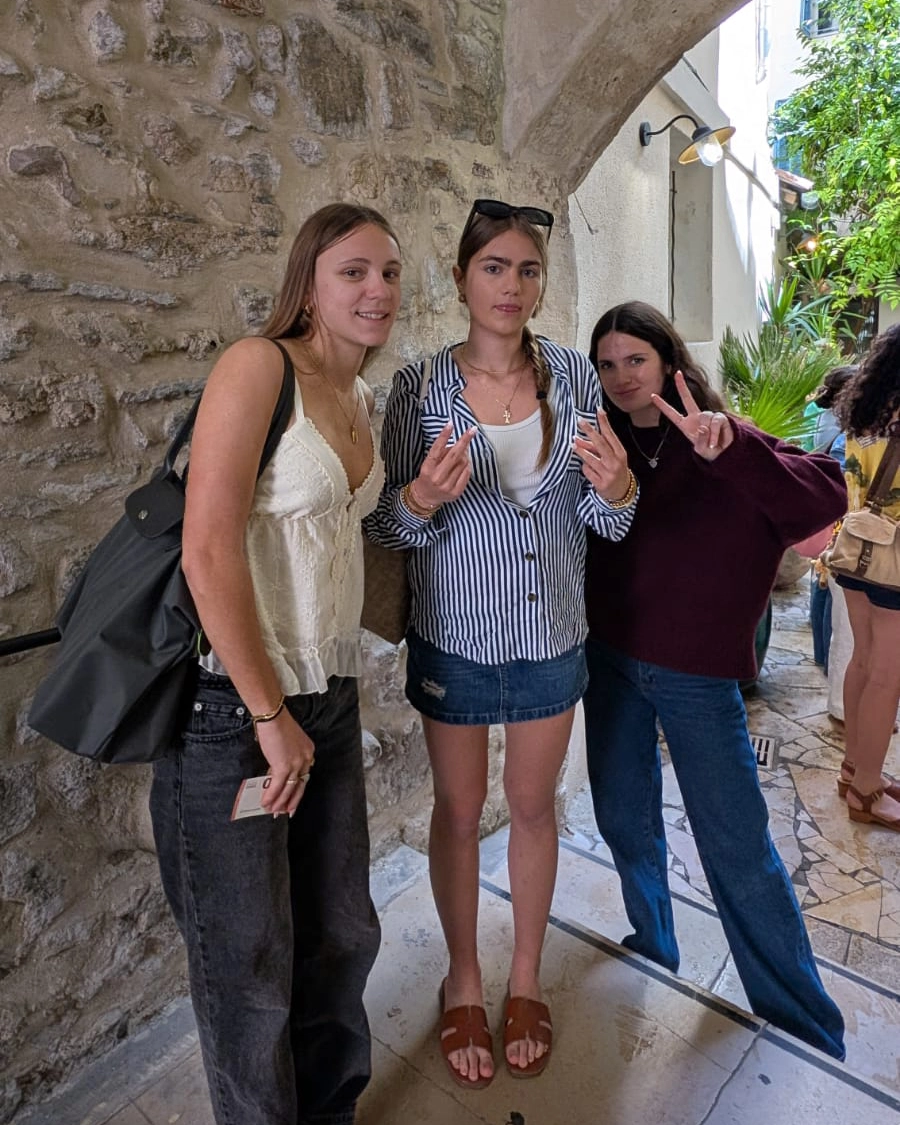
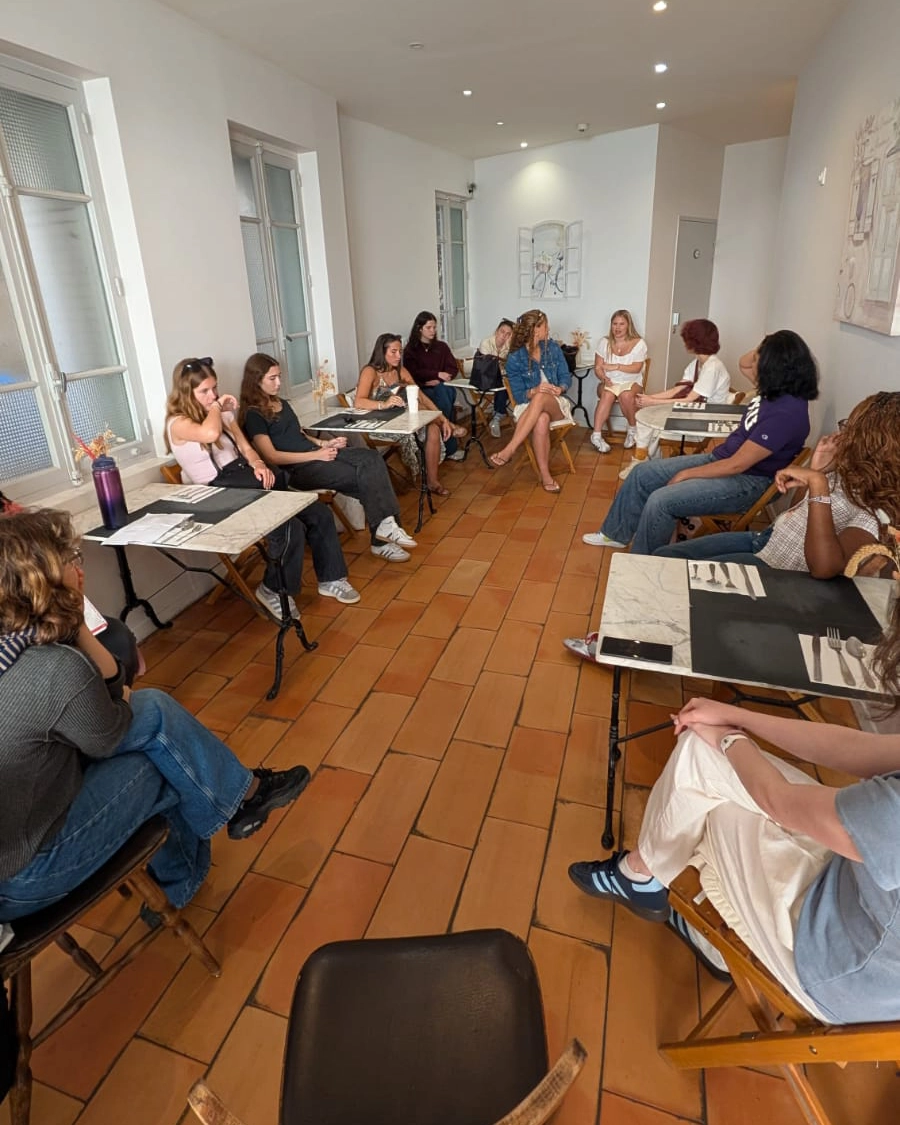
My visit to Palais du Roure further convinced me of the unique intimacy that Avignon’s museums offer. Formerly the home of a prominent Italian family, the rooms are well-preserved and feature a plethora of different antiques, from oil portraits to dining sets. I felt like a guest in someone’s house, admiring the intentionally curated rooms that brought me back in time.
Overall, today brought a welcome change of pace from activity-filled days, providing space for meaningful learning and reflection.
May 4, 2026
Student Author: Avery
Today saw an end to our streak of beautiful weather here in Avignon, but that didn’t make it any less special. It rained all day, which affected our ability to enjoy the outdoors as much as we have this past week, and made me need a break in our hotel once or twice, but actually, rain in Provence is a more interesting sight than sunshine because they get 300 days of sun in this region. Despite the unfortunate weather, we persevered and had a very exciting day investigating how Avignon has changed over time.
My cohort began the day with a walking tour with Julien, a tour guide here who also organized our cooking class yesterday. Julien took us all over the city, telling stories and facts about Avignon’s history. He pointed out many buildings that were all built in different centuries, and thus had differing architecture styles.
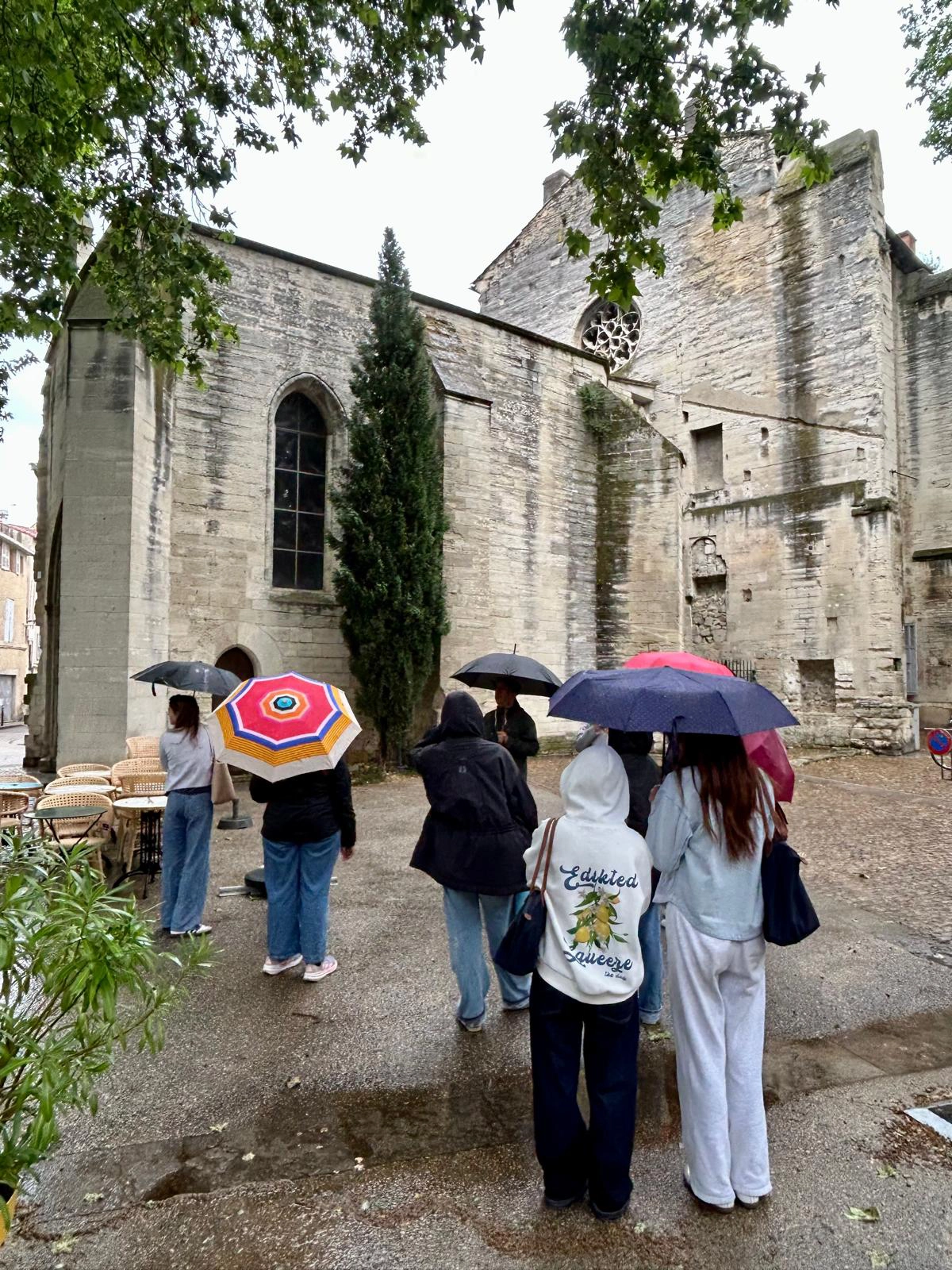
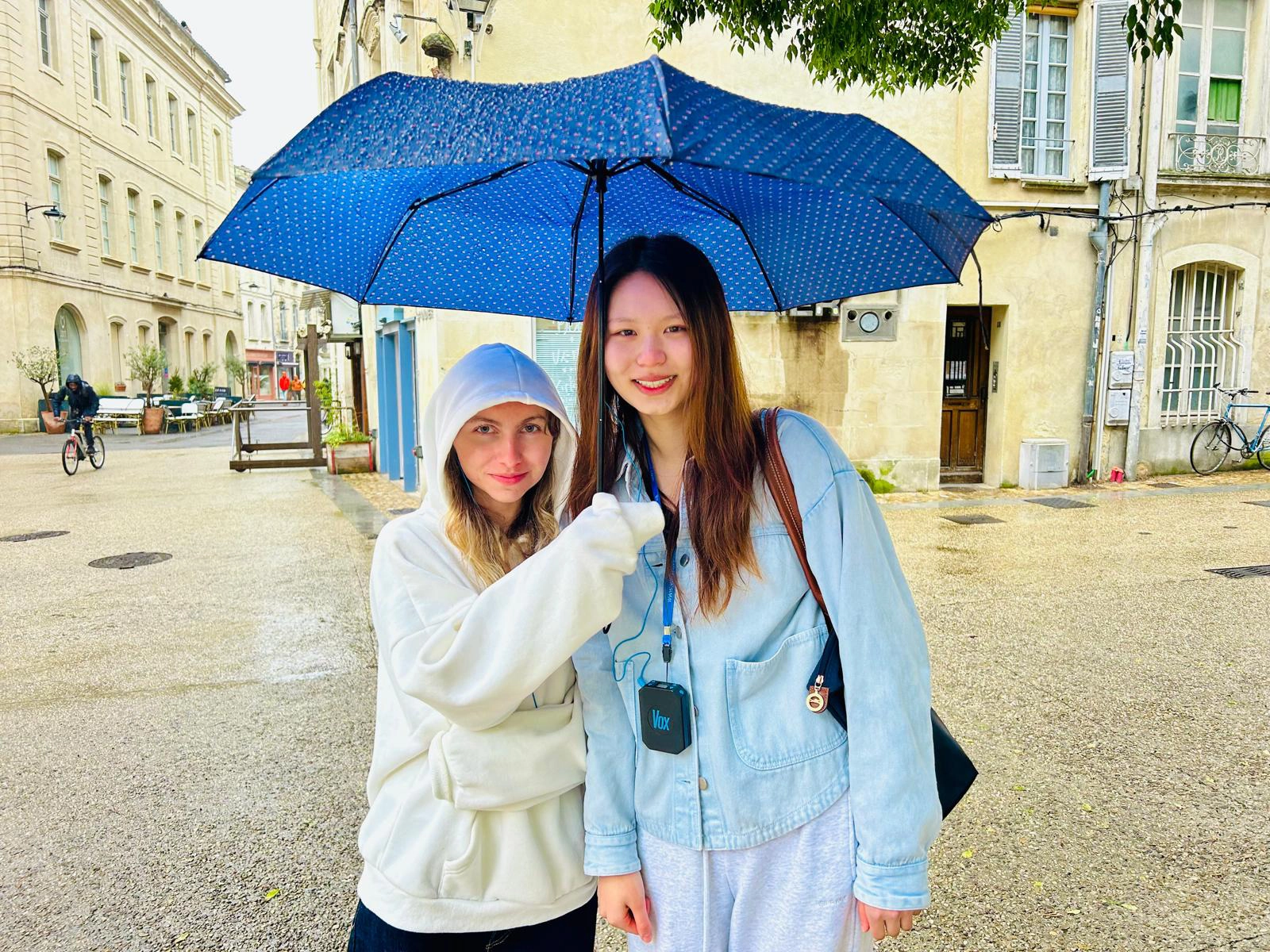
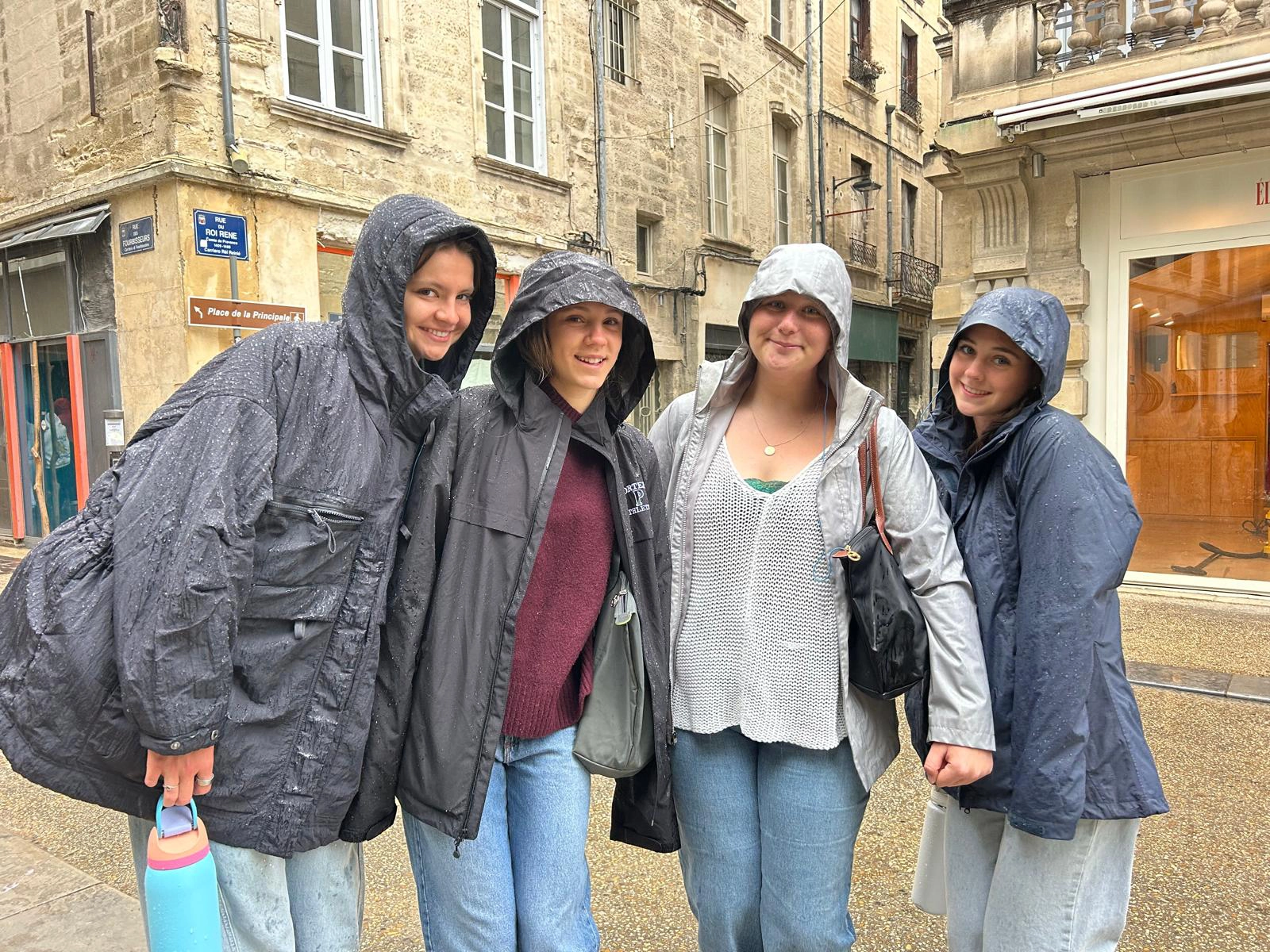
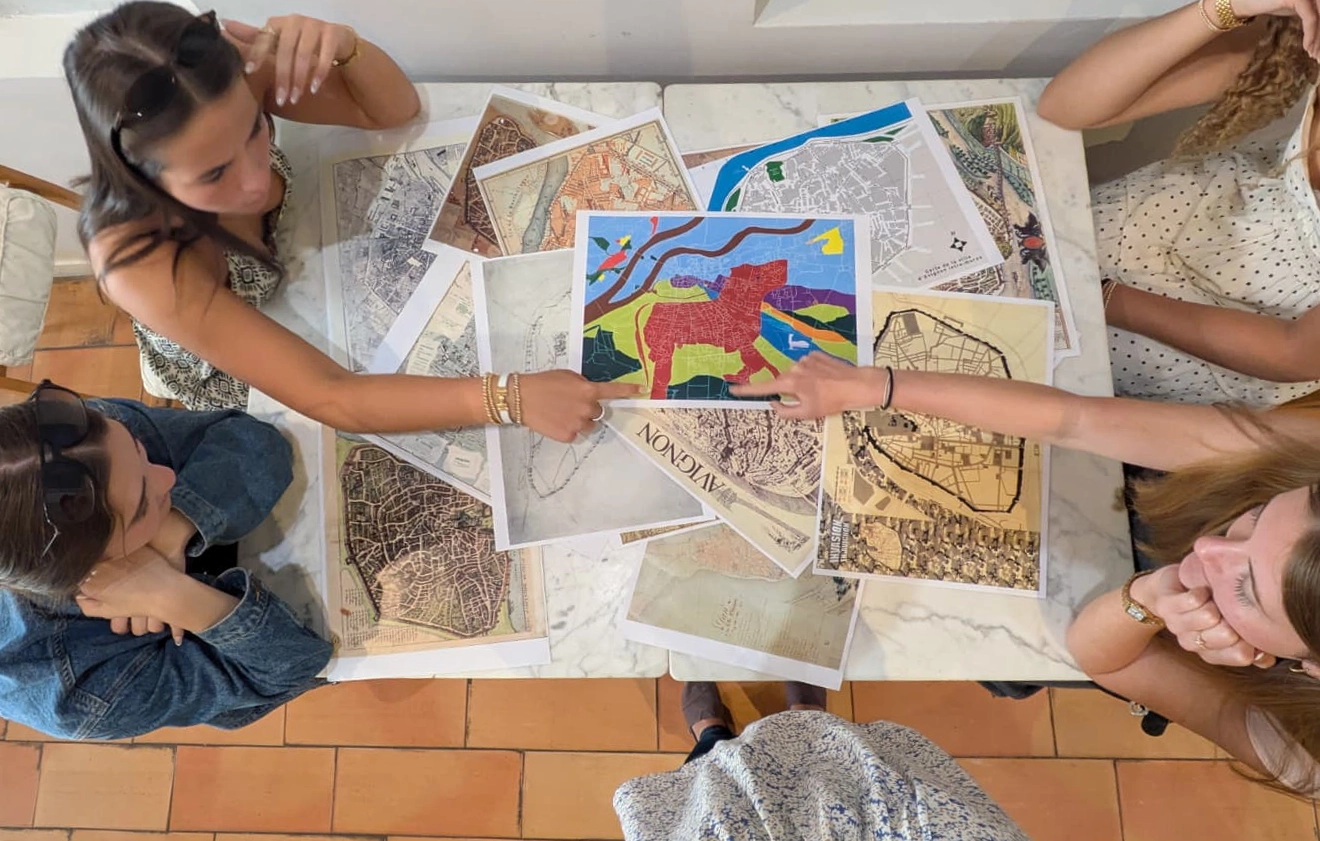
He asked us to notice the “lasagnas” of many buildings around the city, where different styles from different time periods were stacked on top of each other. It was tough to be doing a walking tour in the rain, but the tour allowed me to notice details about the city that I wouldn’t have before, like the Mother Mary statues on every street, and the history behind them. After the walking tour, we did a map activity where we examined maps of Avignon from throughout the centuries. With these maps we were able to visualize how the city expanded. We noticed that expansion was primarily inside the walls for a long time, and only relatively recently did the city grow to outside the walls. We also got to engage in conversation about who makes the maps and for what purpose they are making them, which connected to our class discussions about stakeholders and who makes the decisions that form narratives.
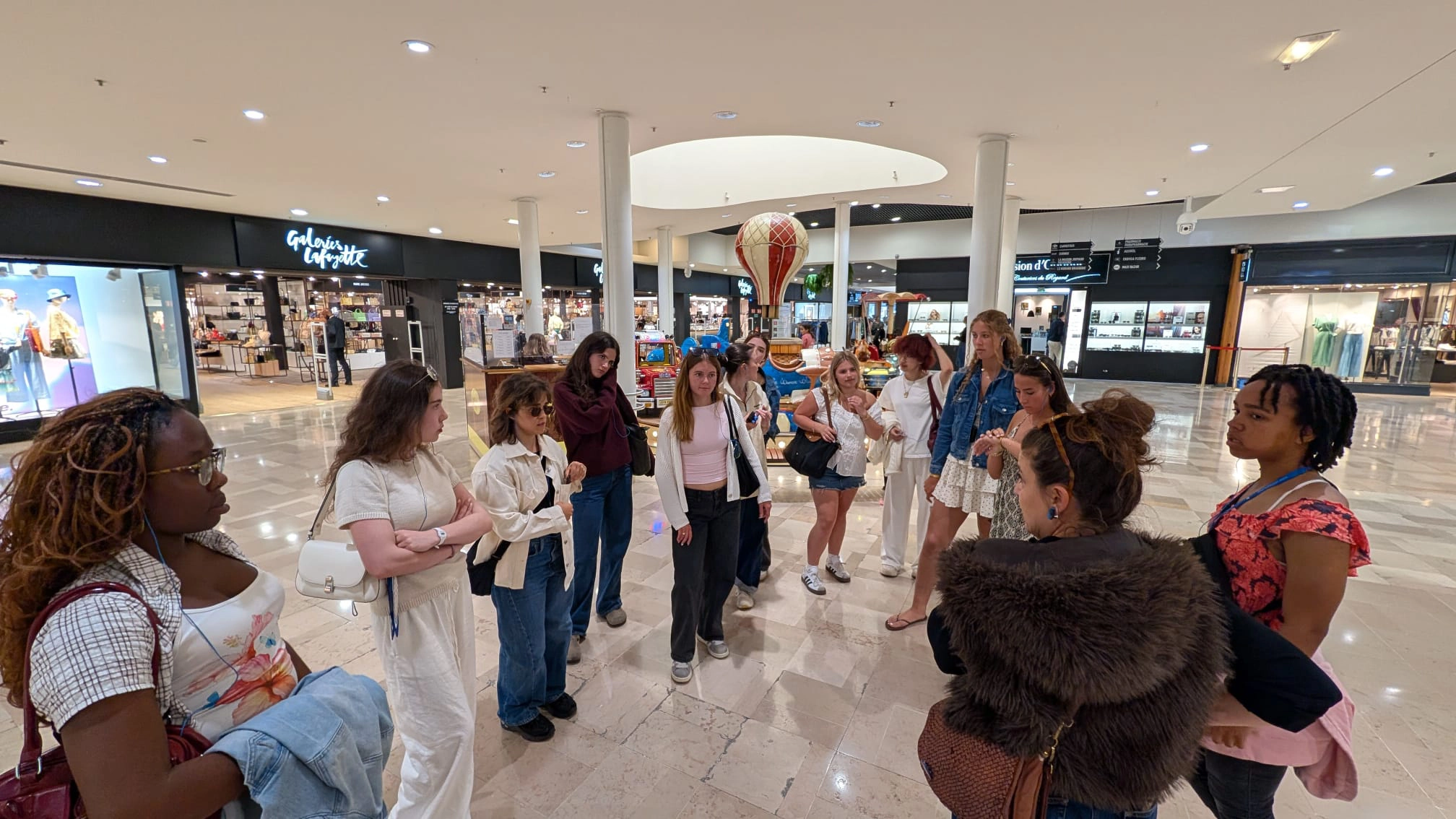
For our final activity of the day, we got to see Avignon from a new perspective. For the first time in the program, we ventured outside the walls and into the greater city to visit the mall Cap Sud. I am very glad we got to see this today, because most of Avignon is outside the walls, as shown to us during the map activity. Julien even told us during our tour that only 25,000 of Avignon’s 100,000 person population lives in the walls. At the mall, I got to see the many similarities and differences between a Provençal mall and my local one back home. Cap Sud was smaller than any American point of reference, but carried the same level of variety, with clothes, jewelry, makeup, and food places. I was even comparing some stores to the ones back home! Overall, the mall was a glimpse into everyday life in Avignon, and also showed us the modernity of this city. We ended the day choosing to do a cohort dinner at Pinocchio instead of a DIY one in small groups. The food was great and we played a very joyous game of cards as a group. A little rain couldn’t spoil a lovely day of learning in Avignon!
Student Author: Goodluck
Today has been a cold and dreary day. The grayish-blue skies cover the sun and have completely stolen my joy. But it has been a less busy day, which I am grateful for. The only big activity we had was our tour with Mr. Julien, a man whom we met yesterday at the cooking lesson. Mr. Julien had a tall, roundish frame. He wore a newsboy hat, a green rain jacket, and carried a long umbrella.
Mr. Julien knew everything about Avignon: every back alley, every street, and piece of history. I knew that Avignon was a smaller city, but it is so small that people know each other or talk as if they had spent a whole lifetime together, which is something I recognized in Mr. Julien’s interactions with the people whom we passed by during our tour.
Our tour started at the Rue des Corps Saints (Street of Holy Bodies), where Mr. Julien gave us a brief insight into the history of Avignon. What stood out to me was that before French became the general language, some parts of France like Avignon spoke Provençal. It had a Latin origin, and when you walk around the city, some street names are in Provençal dialect. Mr. Julien told us that his grandfather spoke the language, but because of how old it is, it is now considered a dead language.
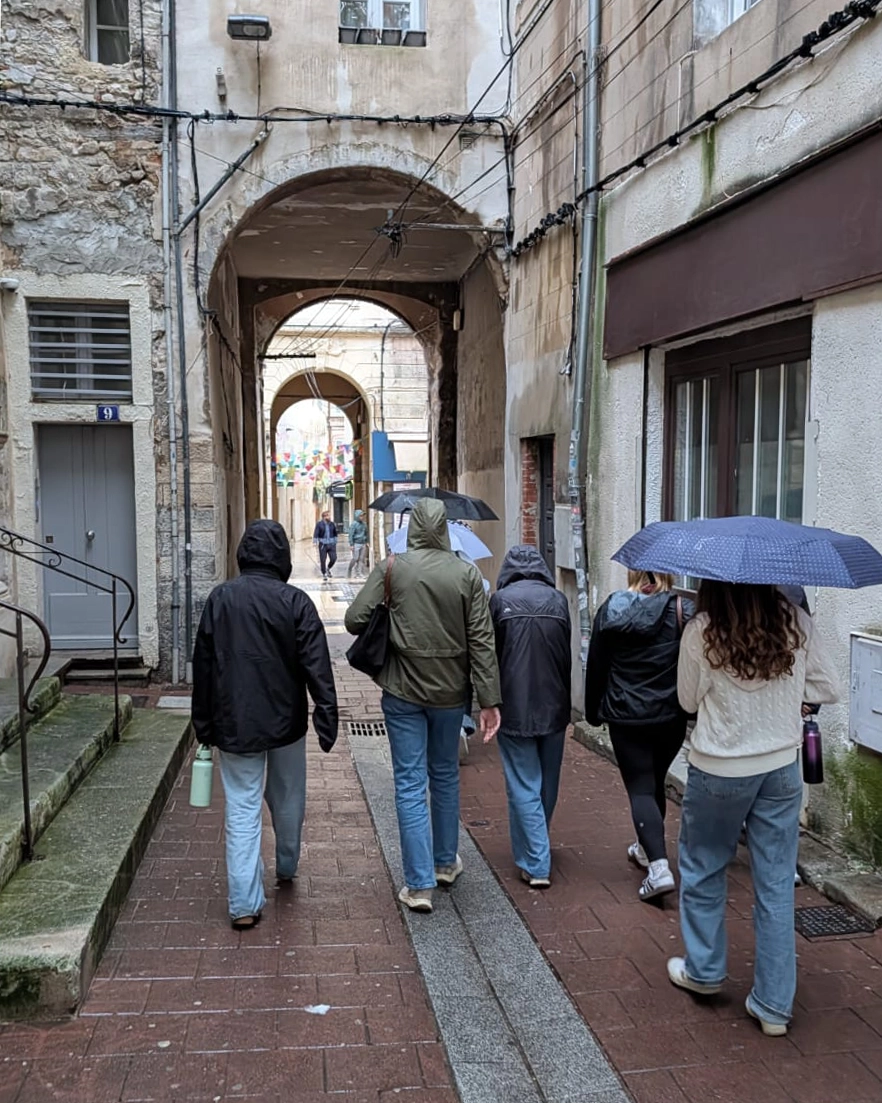
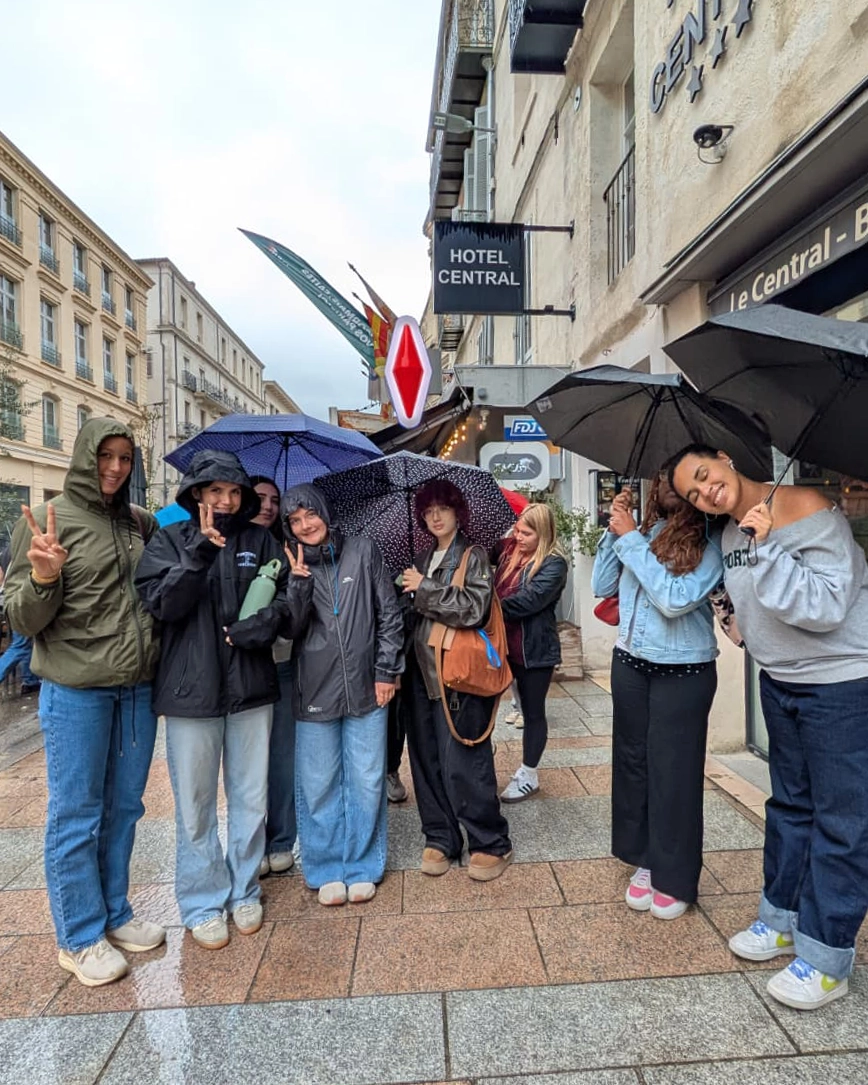
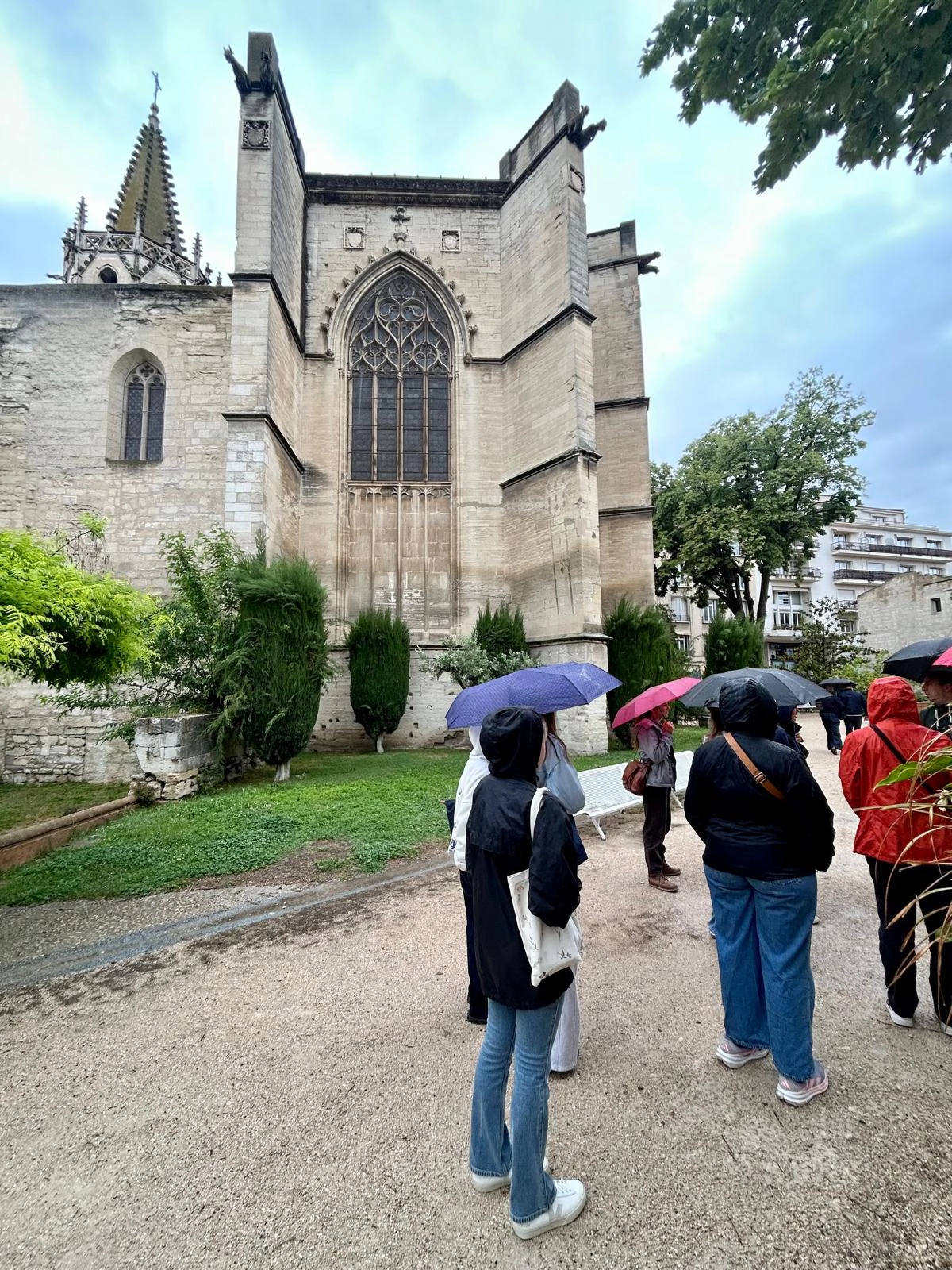
It makes me wonder how many things have changed or have been left behind in order for the majority of the city to evolve. As we were walking, I saw the restaurants were empty because it was Monday. Not many are outside since it is considered a rest day for the French, and the rain has forced everybody inside.
One thing about the French is that they do not play with their breaks; if they need a day off, they will take it. I think that is why the city is so lively when the sun is out, because people have more time to interact and genuinely enjoy each other’s presence.
Back to our tour: Mr. Julien had us play this game of “spot the Mother Mary.” Because Avignon has Catholic origins, there are many churches and a multitude of Mother Mary statues. People spotted many at the top corners of buildings, in front of churches, and shops. Mother Mary is viewed as a sign of protection, and I, as a Catholic, was shocked by the multitude of religious statues (in a good way).
In Avignon, there is a homogeneous style. Although shops may have the same style with big windows reflecting the insides and solid colors around the windows, they also have outside seating for customers. Some other buildings are old mansions that have been turned into housing complexes for the people; each building has its own long, rich history.
Avignon is particularly good at repurposing old buildings, such as churches that have been turned into restaurants, or shops, or even hangout spaces. The pavement in Avignon is different in some areas. Around the restaurants, the pavement is cement or of rocky texture, but around the marketplace, the pavement switches to tile texture, which is something I have never seen. It’s cool to witness but also dangerous for pedestrians, especially during rainy weather.
Avignon may be an older city, but it is innovative. People have learned to live around the historic buildings, which has allowed for the preservation of their history and the existence of their modern lifestyle. Because of this, it has created this beautiful coexistence of the old with the new.
May 3, 2026
Student Author: Leah
Today was an exciting and anticipated day for the whole class, especially me because on an earlier project I did a deep dive on the Pont du Gard aqueduct, which we visited! Up on the aqueduct, I saw things from a completely different angle and was able to slow down, breathe, and enjoy the moment. Previously, we have discussed contrasts in differences between French and American culture, highlighting how we perceive the passage of time. The French have a slow and leisurely approach to their daily routines, while Americans tend to be much more fast-paced, especially in urban life. It is rare to see someone walking around with a to-go coffee cup or a drive-through; unlike America, French culture appreciates downtime, sitting and soaking up a moment rather than rushing through it.
This is very unlike what I am used to and when I first arrived, it annoyed me a little. Meals droned on as waiters didn’t bring the check and I was constantly stuck behind slow walkers. My experiences today changed how I approached this shift.
We started our day by attending a cooking class at an incredible restaurant in the area. Preparing the food was a slow task. We chopped each vegetable carefully and we made mayonnaise, which required ages of whisking. Next, we shadowed their chef as he prepared us his spin on a classic grilled cheese. He was very passionate and precise with every ingredient he added, and you could tell he cared deeply if we enjoyed the food. This encouraged me to stop and take things in, noticing all the seemingly small things I would have missed in a fast-paced lifestyle.
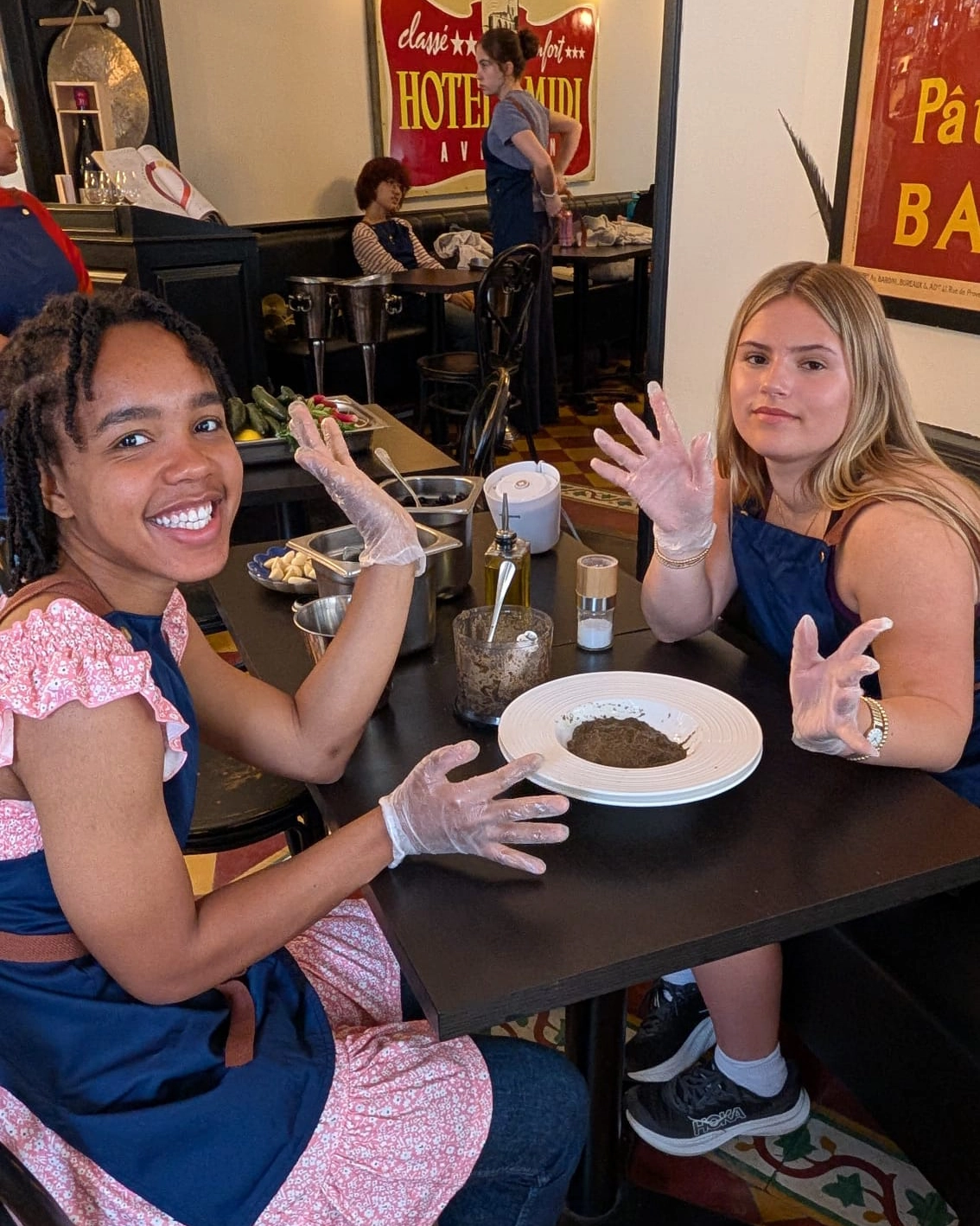
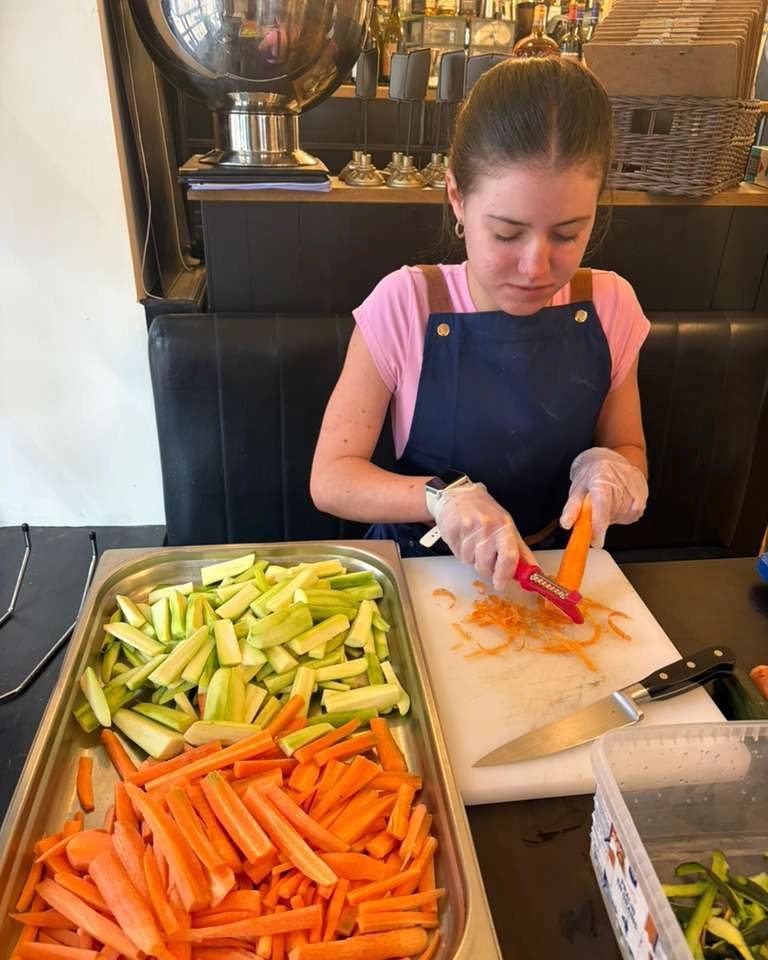
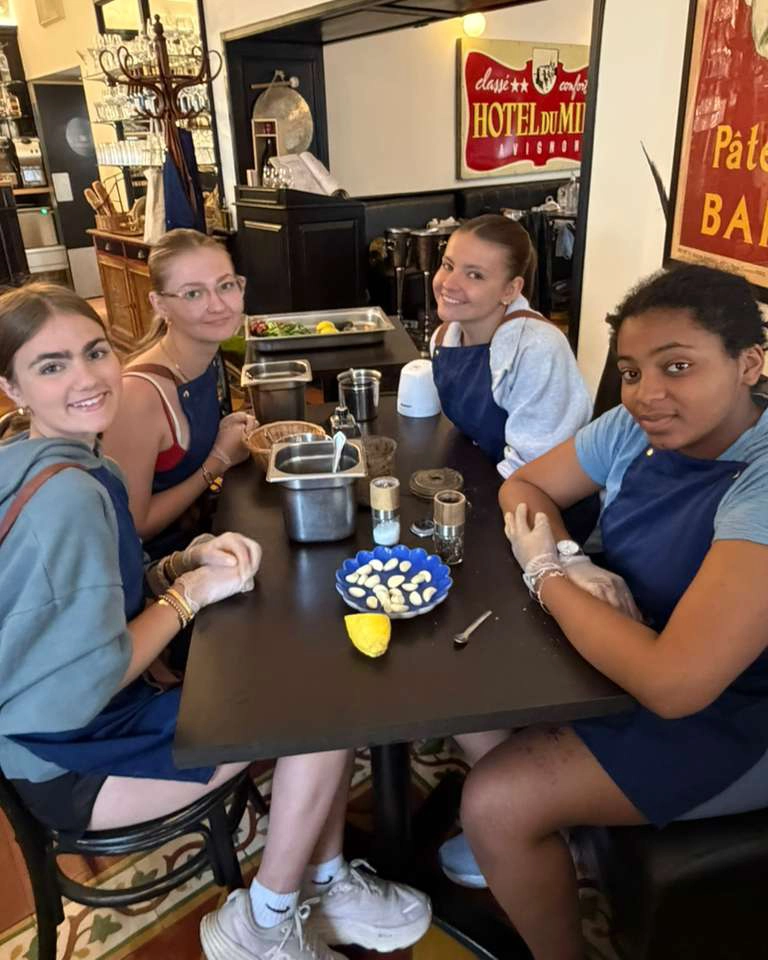
This brought me a new appreciation for how detailed and thoughtful the chefs are. I noticed the vegetables and cheese were fresh and locally sourced in Provence. I also noticed the drinking glasses were decorated with the symbolic animal of Avignon. When we sat down to eat the food we had prepared ourselves, I felt proud, and noticed that the process of preparing these dishes was slow, yet deeply rewarding.
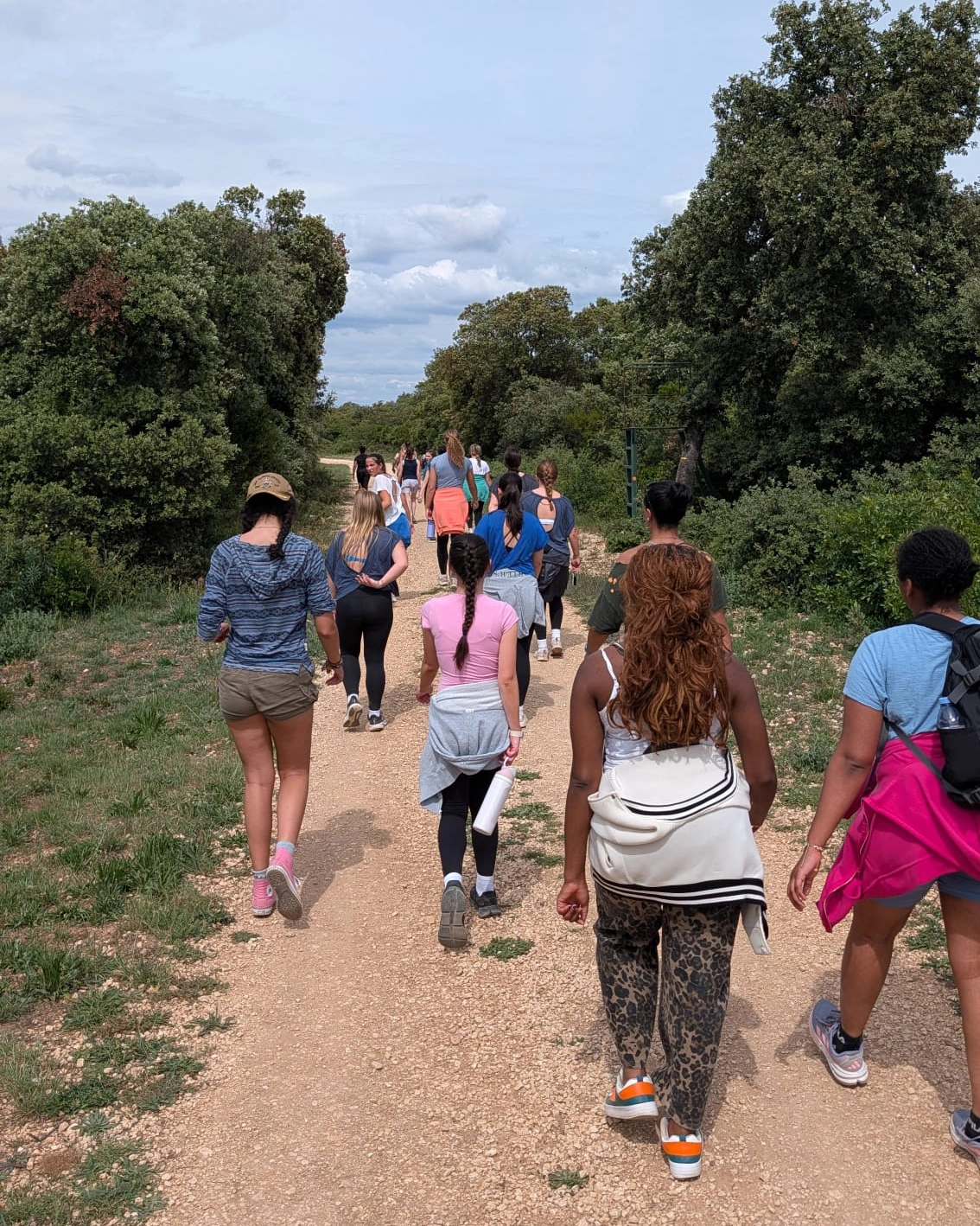
During the hike through the town of Saint Bonnet to the Pont du Gard, I continued practicing slowing down and noticing. It was a long and steep walk before we even got a glimpse of the aqueduct, but I stayed in the moment and enjoyed the time with my friends. I talked with our guide and learned things I would never know if I rushed through the hike. He told me that denim was actually founded in the very town where the aqueduct ended (Denim → de Nîmes) and taught us the history leading up to the Levi’s jeans we see today.
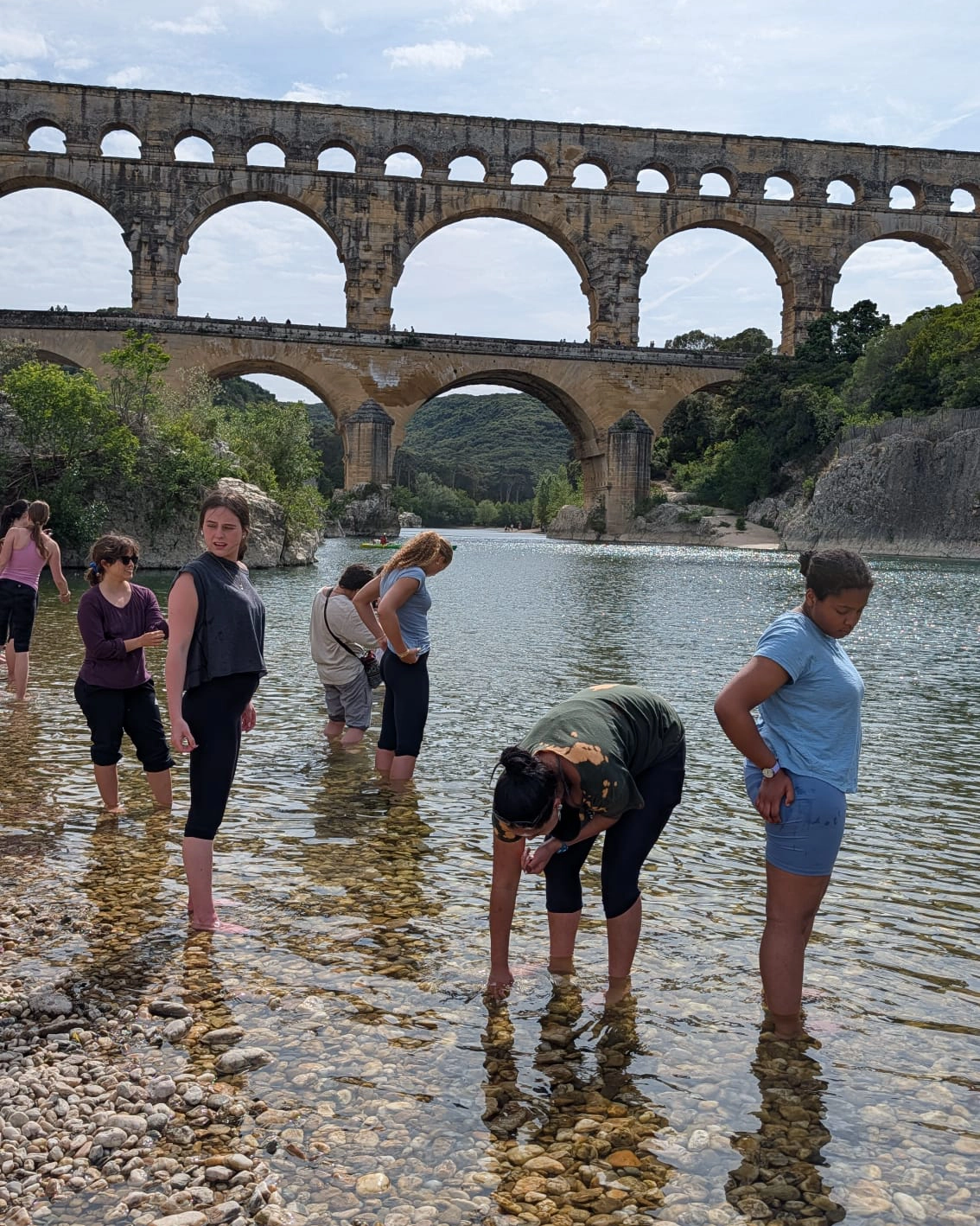
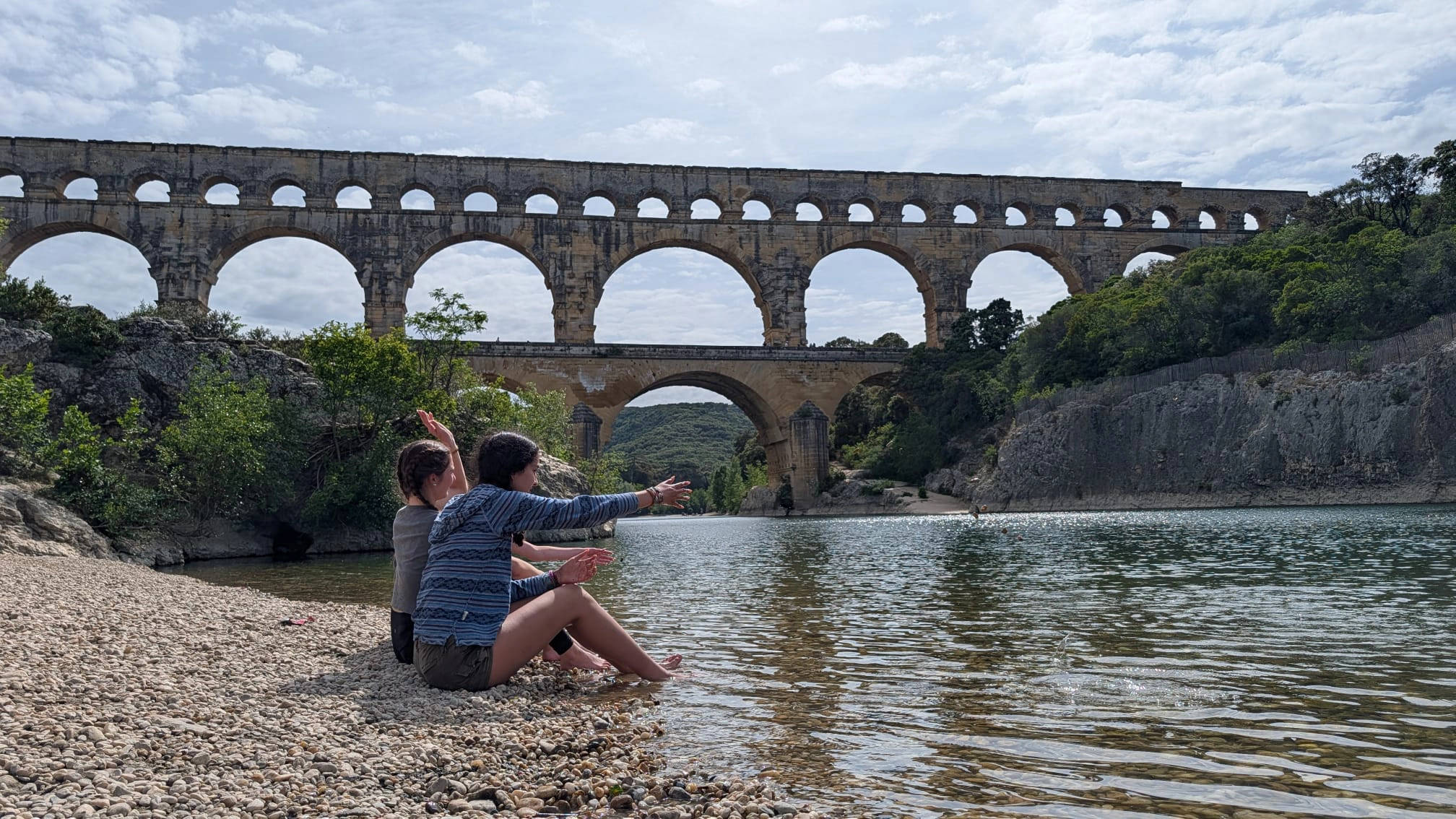
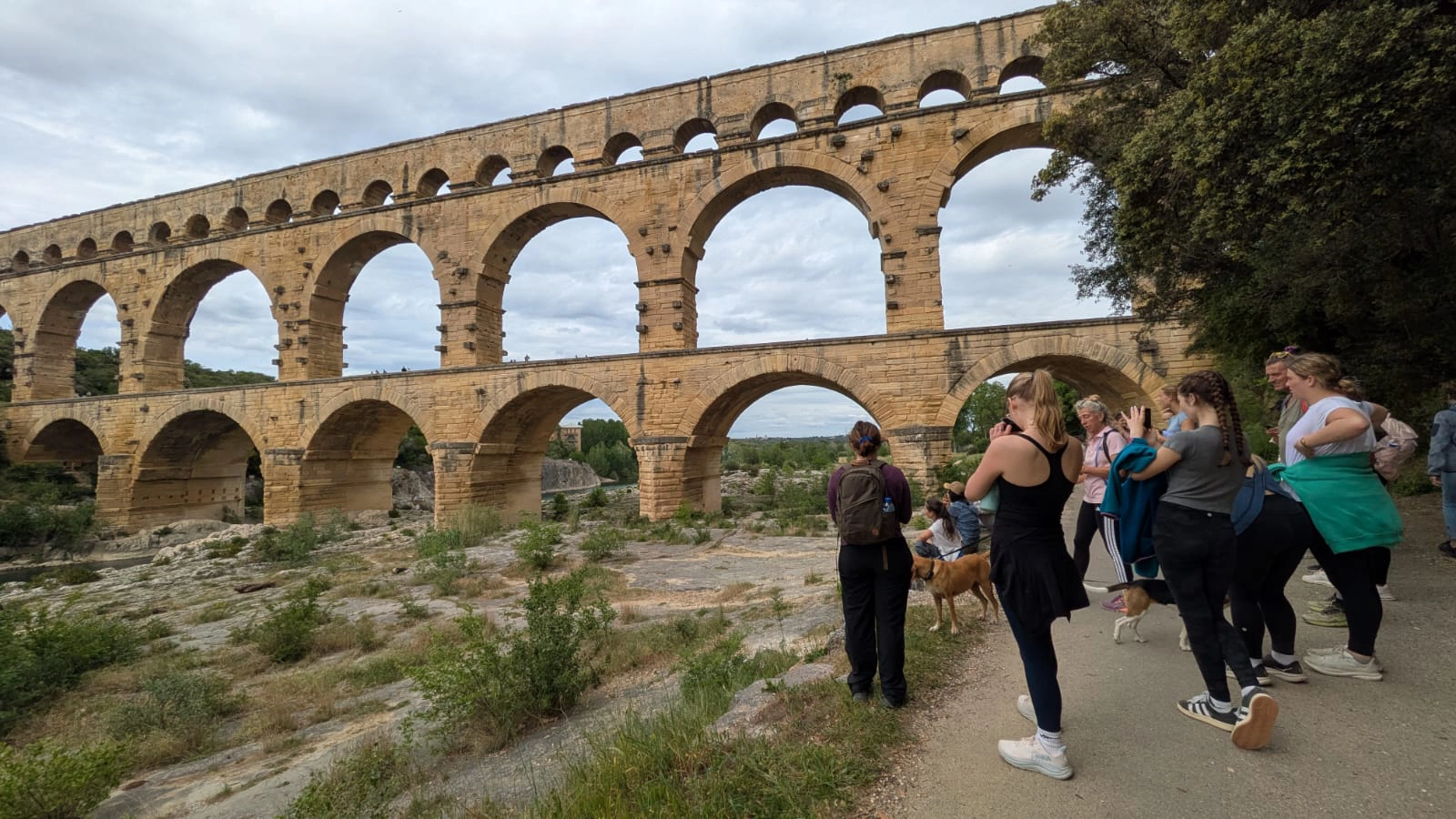
When we arrived at the Pont du Gard, I was able to fully take in and appreciate the stunning view of the historic aqueduct and the Rhone River. I looked and listened closely, living in the moment. I noticed the cement blocks running up the aqueduct and learned that it was for climbing up to make restorations. We closed out our hike by putting our feet in the Rhone River and staring up at the ancient marvel of engineering right next to us. I slowed down and appreciated the hike, not concerned with anything but the moment I was in. The hike was long but rewarding, and by earning the view and enjoying the journey, I was able to take it all in.
We ended our day by eating at Le Berçail, a restaurant on an island just outside the walls of Avignon. We had a stunning view of the Rhone River and Pont d’Avignon. As we discussed previously with our program leaders, a part of French dining culture is that it is slow-paced. You are supposed to sit and enjoy your meal and your company, with lots of time between each course. It is actually seen as “bad” service if they bring you the check without asking, because it might rush your meal. I deeply enjoy this slow way of dining because it truly allows you to take in your surroundings and connect with the people around you.
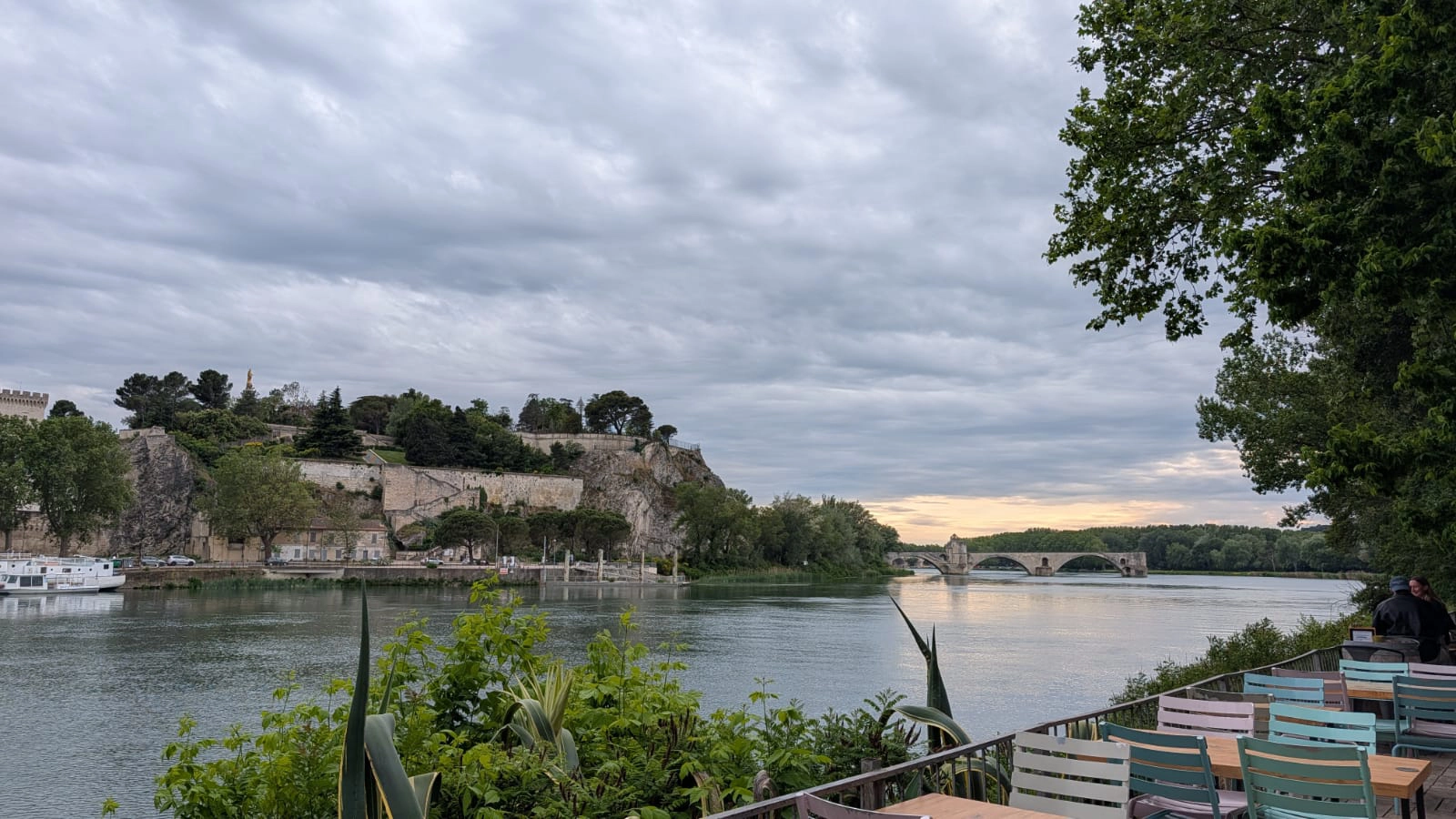
Our room in the restaurant was lively, filled with laughter as people joked and played card games. We were all able to discuss and debrief our days by talking and connecting with one another through food. I was also able to take in the restaurant’s atmosphere, as we were drawn to an incredibly beautiful “tree” we saw. After marveling over it for a couple of minutes, we asked and learned that it is an Agave flower of a cactus that only sprouts between 15–50 years. I would have never learned and observed this tree if it wasn’t for the practice of slowing down, connecting, and noticing.
Overall, through reflecting on my very full day, I learned a lot about French and American culture. In about a week when I return to Connecticut, I hope to adapt what I learned about slowing down and appreciating the little things. I think that this practice makes me more grateful for the incredible opportunity of this trip and understanding of my surroundings. I hope that all others are inspired to do the same and slow down and take a minute to be mindful. I am very excited to carry what I learned today into tomorrow and the rest of my life.
Student Author: Bella
Today we started off the day with a more chill wake up of 8:30 a.m. But by 9:15 a.m. we were on the move, heading to our first activity of the day: cooking class! 😁 When we arrived at the restaurant, my cohort went with Alex, our group leader, to discuss the impact of cities and compare them to Porter’s.
We had an invigorating conversation, naming spaces at our own school that reflected physical spaces in Avignon. One example was our dining hall and city squares/centers. Both are places of meeting and gathering where everyone regardless of economic class (in Porter’s case grade) or identification can talk. Another interesting term brought up was “sidewalk ballet.” Each city may look like chaos from the outside, take New York City for example, but really it’s the normal unspoken bustle of locals. Everywhere has its own unspoken “choreographed” ballet that people know and follow, even Porter’s! Once our conversation came to a natural pause, my team walked back to the cafe and prepped to begin cooking (wash hands, put up hair, tied aprons and gloved up).
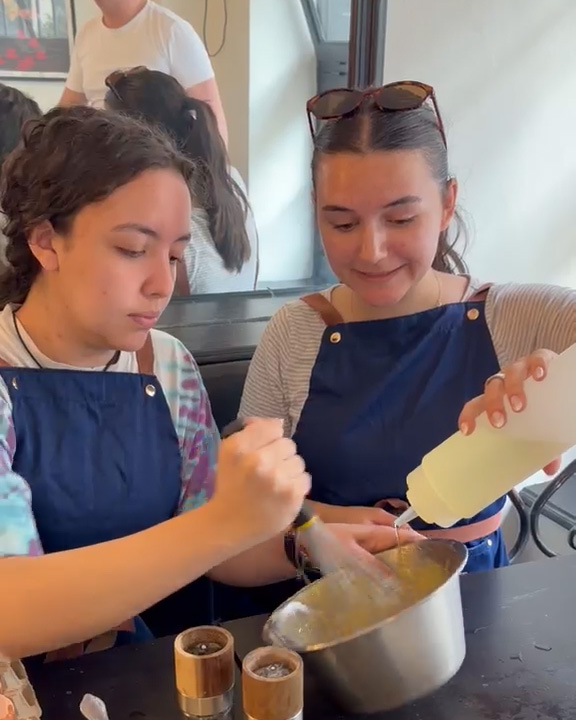
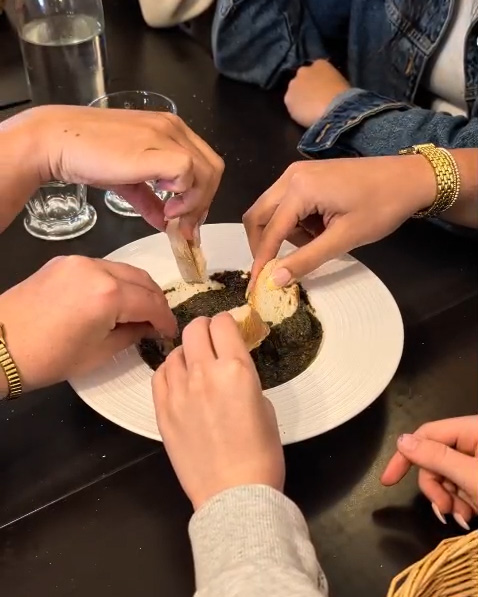
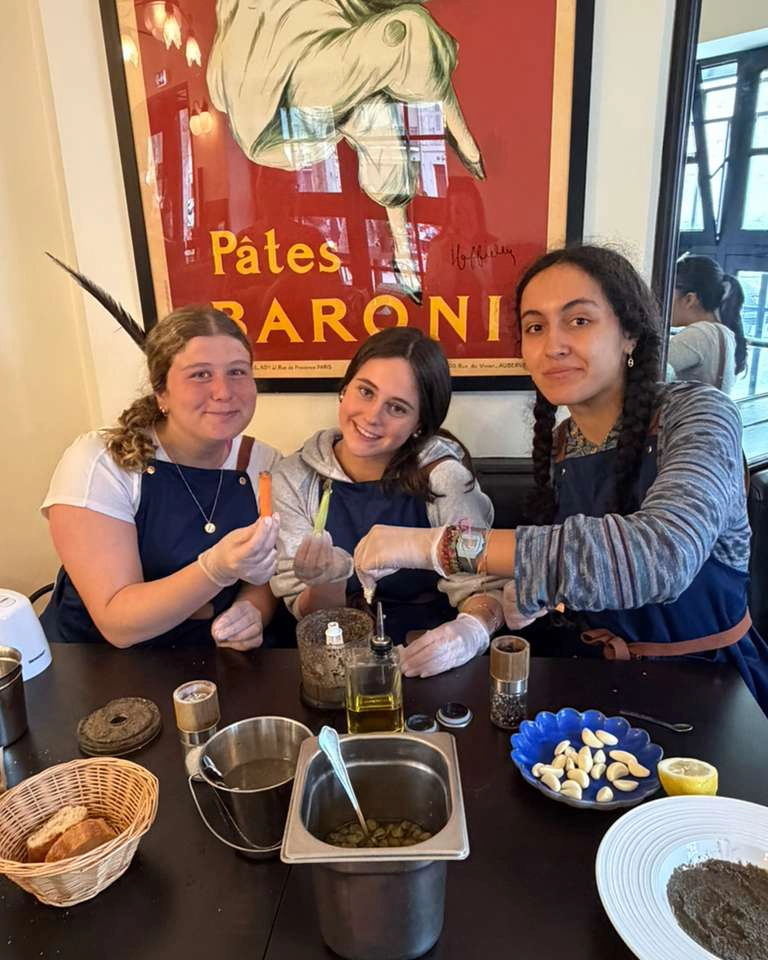
This was serious business. The chef began by showing us how to put together Croque Monsieur, a French dish much like grilled cheese but with ham, extra cheese, and béchamel. It was so delicious and I highly recommend. Next, my team moved outside the kitchen where we got started on a dip called tapenade. If you have ever had Sabra hummus with olive tapenade, this was just the top.
We also whipped and made our own mayo by hand. One thing me and my team noticed was that the people of France dip bread and fresh veggies in mayo. This was intriguing, but surprisingly good. It pushed me out of my comfort zone and while I might not be doing that when I return, I’m happy I gave it a chance. Shout out to Madame Archer, because cooking made us all think of you, and our ordering + conversation French skills are top notch.
After our well-earned lunch we packed our bags, filled our water bottles, and got ready to face the 5k hike in front of us. We met back up with Charlie, who I’m sure you remember from day 3, and got walking! The hike was tough, but we got through and even got to hear about the ancient Roman aqueducts and water supply system that were over 50 km long and were slanted one inch every yard. This water system brought much prosperity to the town of Nîmes, and allowed them to flourish greatly during the 9th to 13th centuries. In fact, the term denim originated from this town, hence the name “deNIM”.
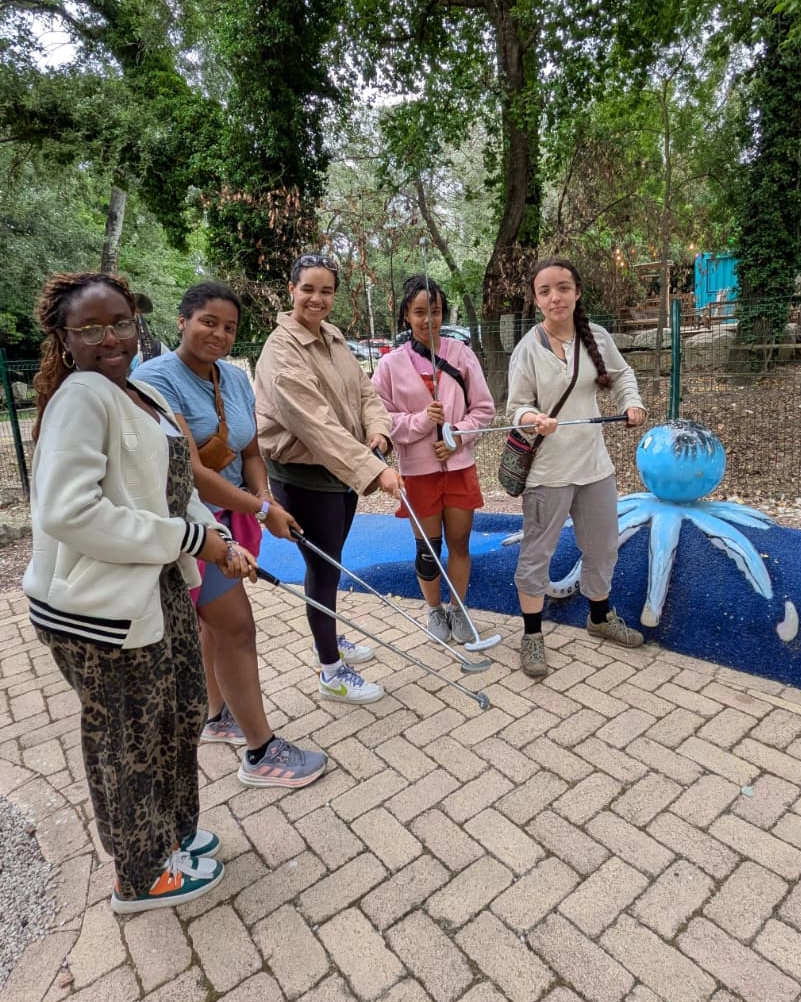
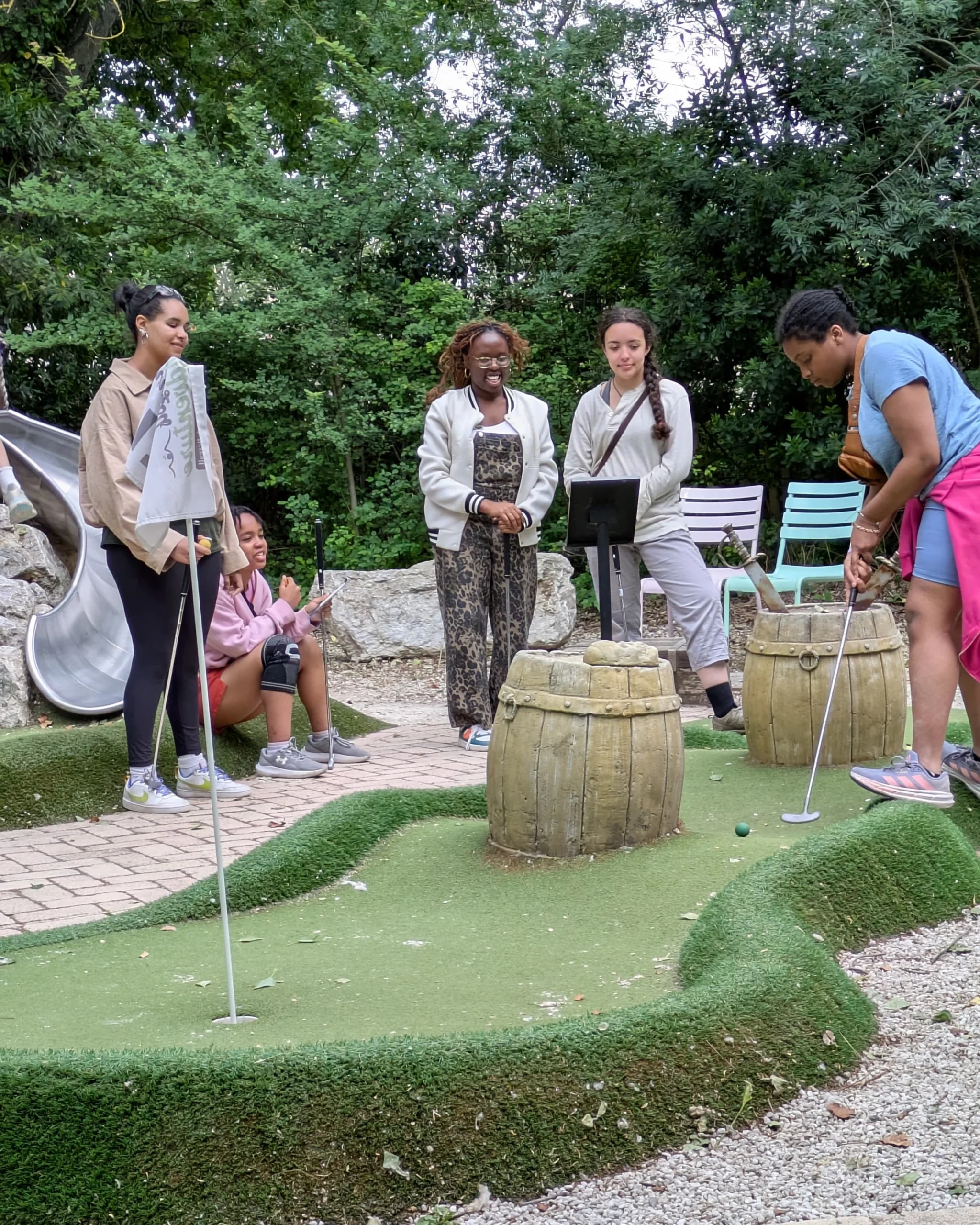
Much like how Nîmes became prosperous, many cities followed the same trend, like Hartford for example, which we talked about in class. After a long day of cooking and hiking, we took a ride across to the Rhone River to play some mini-golf, where I won of course, and finally had a delicious dinner + much needed debrief of the night.
May 2, 2026
Student Author: Victoria
Today we had a more relaxed day filled with reflection on everything we’ve been up to so far. With our jam-packed daily itineraries, this was an opportunity to step back and make noticings on things we have seen and learned so far through the various activities we’ve participated in.
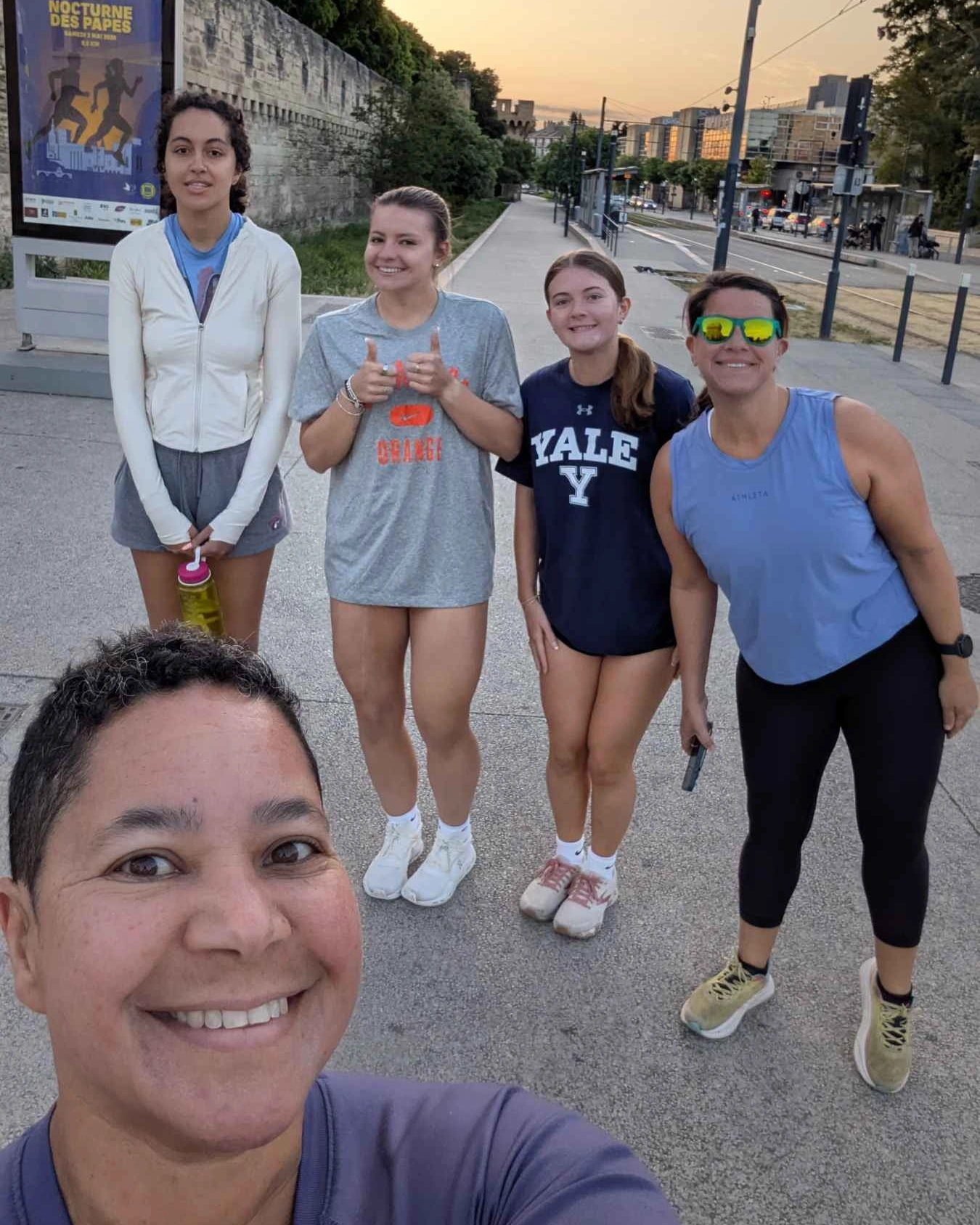
Thus far, I have been joining members of the Porter’s team and our guide Alex on daily morning runs, which have now become a part of my routine here and have played a significant role in my ability to adjust to this new environment. Though it is a quick 30 minutes, it is an opportunity to reflect as I take in the beautiful scenery of Avignon’s walls surrounding me. At first the silence felt loud and new to me, because I am unfamiliar with exercising without music. However, each day the silence is swept further away and filled with all of the sounds around me that I otherwise wouldn’t have noticed—birds, bike bells, voices, rocks beneath my feet—and they seem to make the run itself almost more comforting, because there really is so much around us beyond our phones.
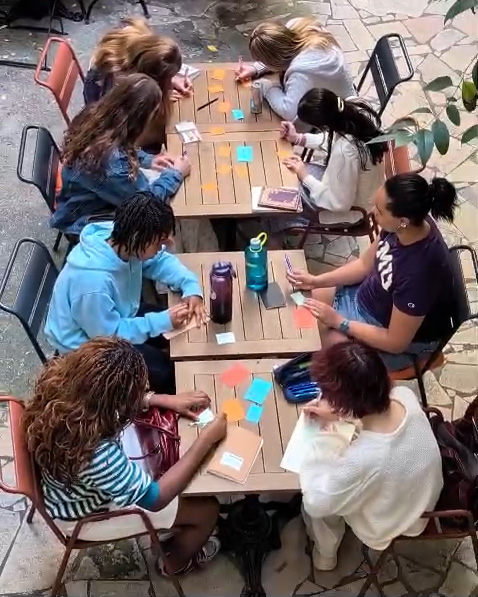
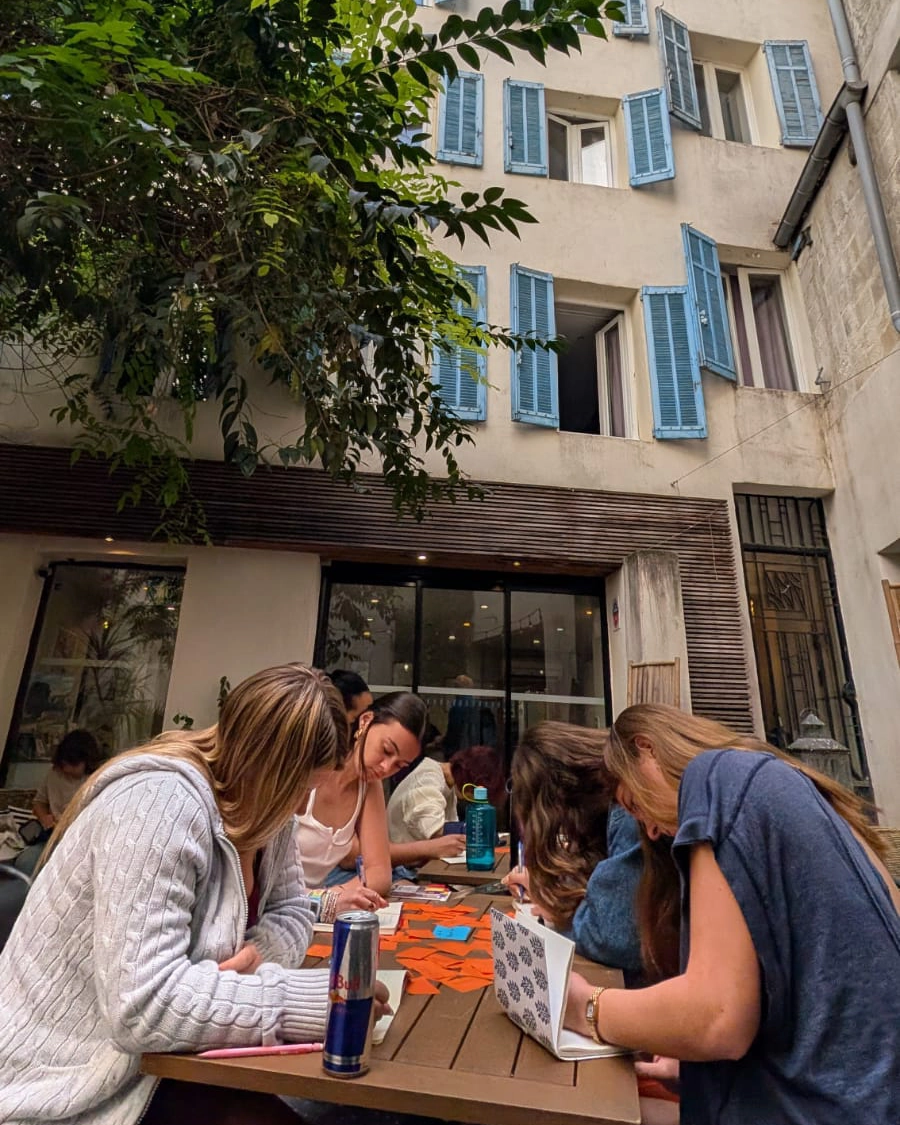
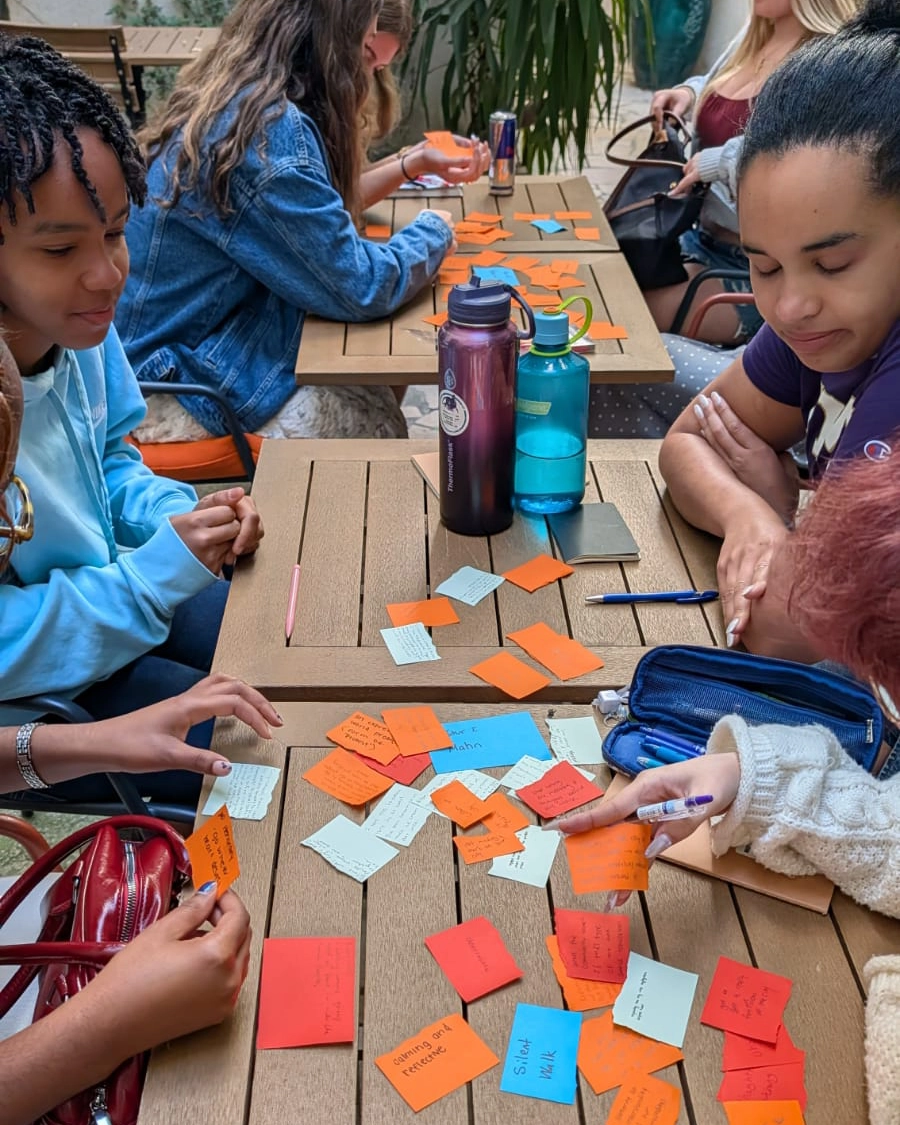
Our reflection activity with our cohorts this morning following the run was another reminder of how much more attentive we have been able to be without our phones. We started this activity off with writing quick noticings about everything we have done up to this point. After that we were asked to connect two comments from two different activities together, noticing how two drastically different experiences provoked some similarity in our minds. I drew similarities between our silent walk around Avignon and our Urban Sketching activity with Charlie. I found that both of these activities allowed us to observe and notice details while also sitting with the quietness that can be uncomfortable, both bringing me a comfort similar to the morning runs. All of the experiences together have allowed me to observe the city and notice different details that I wouldn’t have if I had access to my phone.
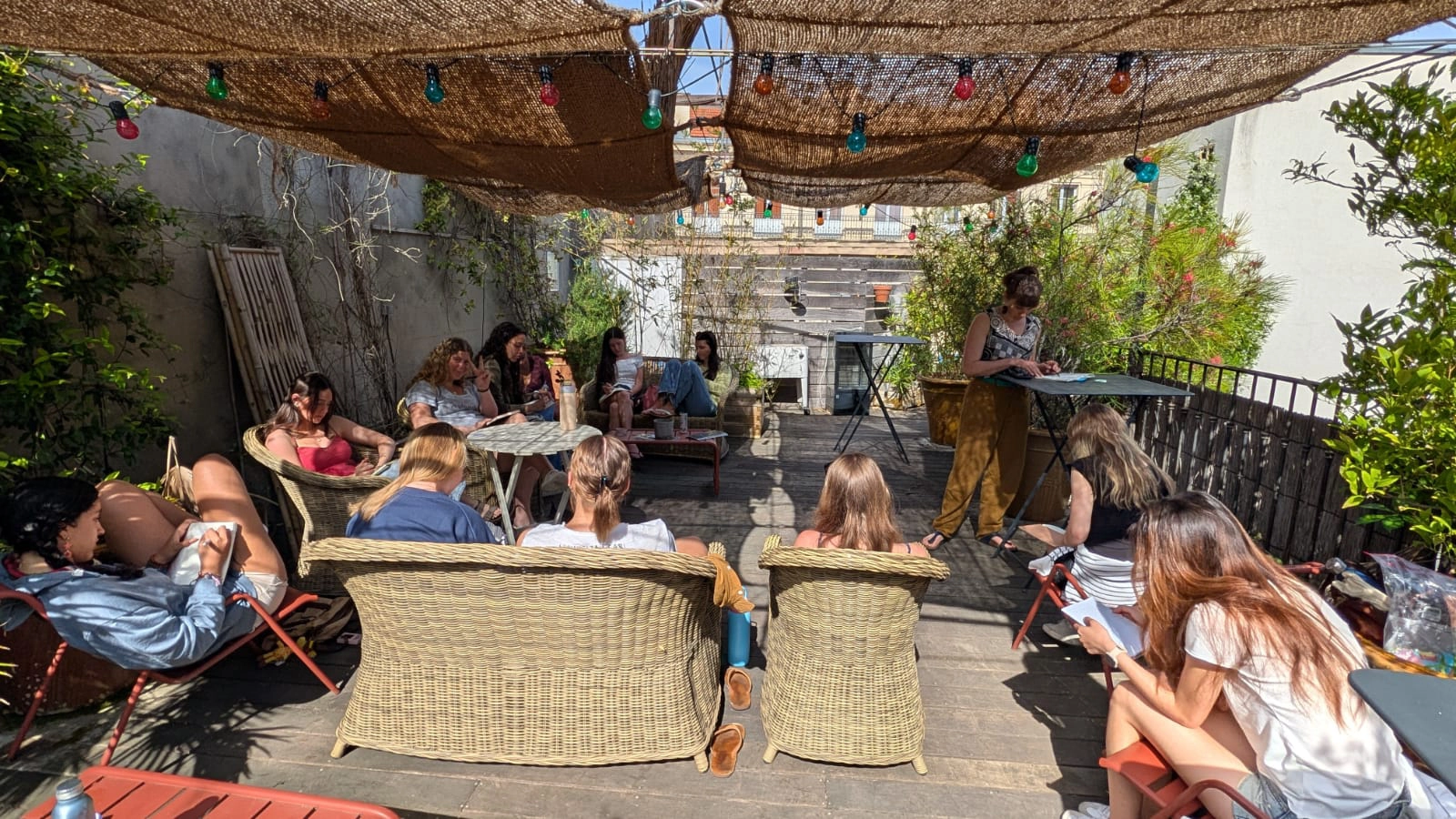
I believe that at home our phones become an outlet for us to fill silence with, as it is hard to not constantly be chasing for an input. However, this trip is a wonderful example of the fact that we can remain busy without our phones, but still calm and observant, as opposed to anxious and ungrounded. Each day that I spend here the silence feels quieter and gets filled by the voices of those teaching me about their homes or my friends and I discussing our days, noticings, (sometimes a heated card game is a good one too…). To cut to the chase, maybe not having a phone isn’t so bad after all, and in fact the outside world is a lot less quiet than you think once you turn the distractions off.
Student Author: Savannah
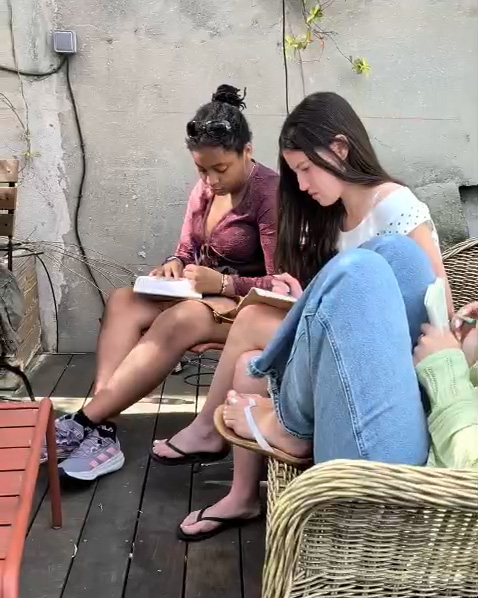
We started off with a very chill morning, beginning by forming groups and brainstorming ideas for our Urban Planning Project with Atlas. It was a moment to reflect on the previous days after lots of running around to tours and activities, which I am sure you’ve heard all about.
Then the whole group walked to Avignon’s market. In smaller groups, we explored the shops inside, taking note of how many people not only purchased food there, but actually sat down to eat inside. From where I come from, markets are solely for buying fresh food, but here it appeared to be a social hub, a way for the locals to gather and interact with the community. My group’s proximity to these people led to some memorable interactions, specifically with the shopkeepers. We needed to ask them about their best-selling items, but since we had a hard time speaking French, one vendor couldn’t understand us. We bonded with another vendor about it, connecting with him through shared laughter. Another seller even spoke to us in English, making us laugh with his jokes about the meats he sold and even serenading our friend, Bella, with a birthday song.
These experiences shape how I view the market. It’s a way to enjoy and support local food, AND people. Knowing that it was Saturday, I had to keep in mind that the demographic consisted of people beyond the usual. Tourists, like us, and surrounding residents outside of the walls with access to transportation are likely not there as much. It is the regular locals that the market has the biggest sociocultural impact on, which is why it’s important their voices are heard when it comes to making decisions about the market.
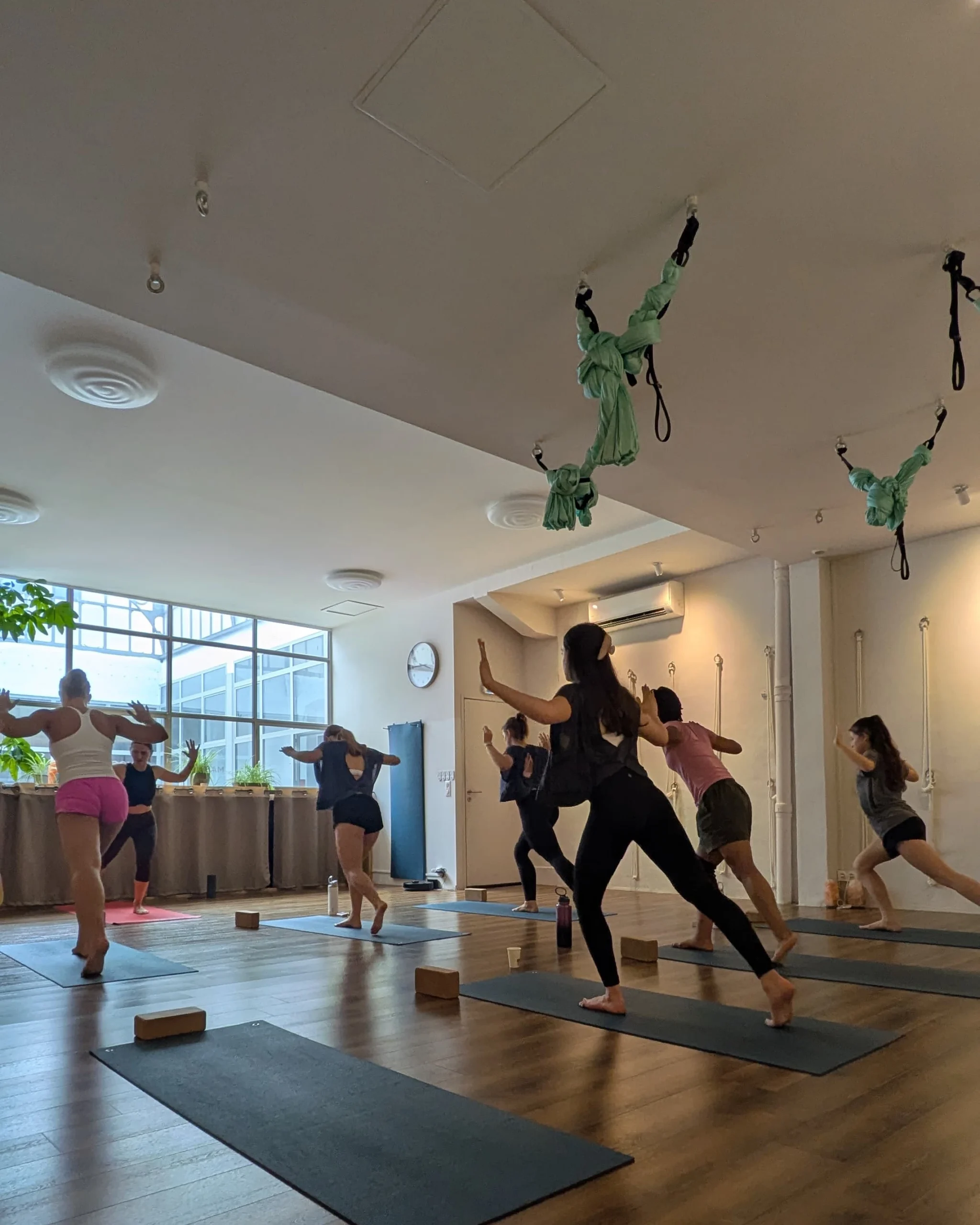
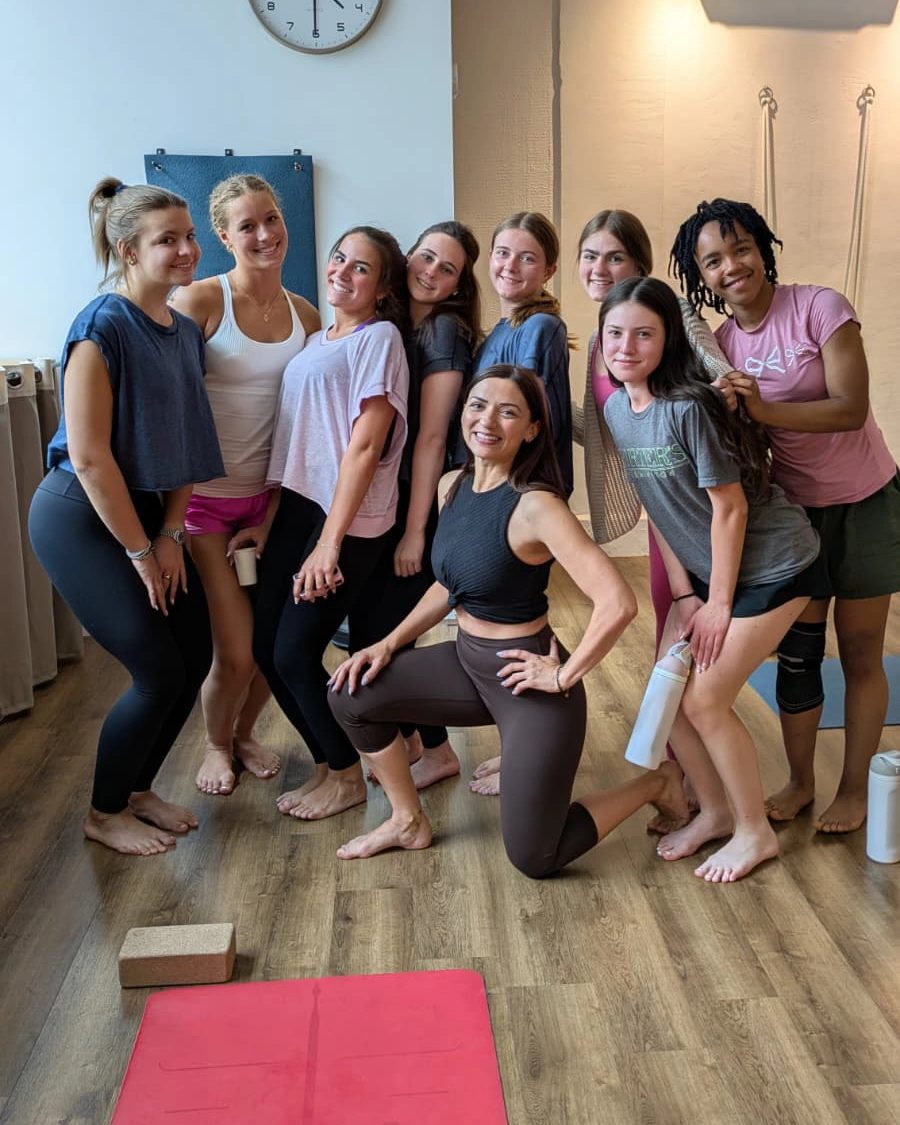
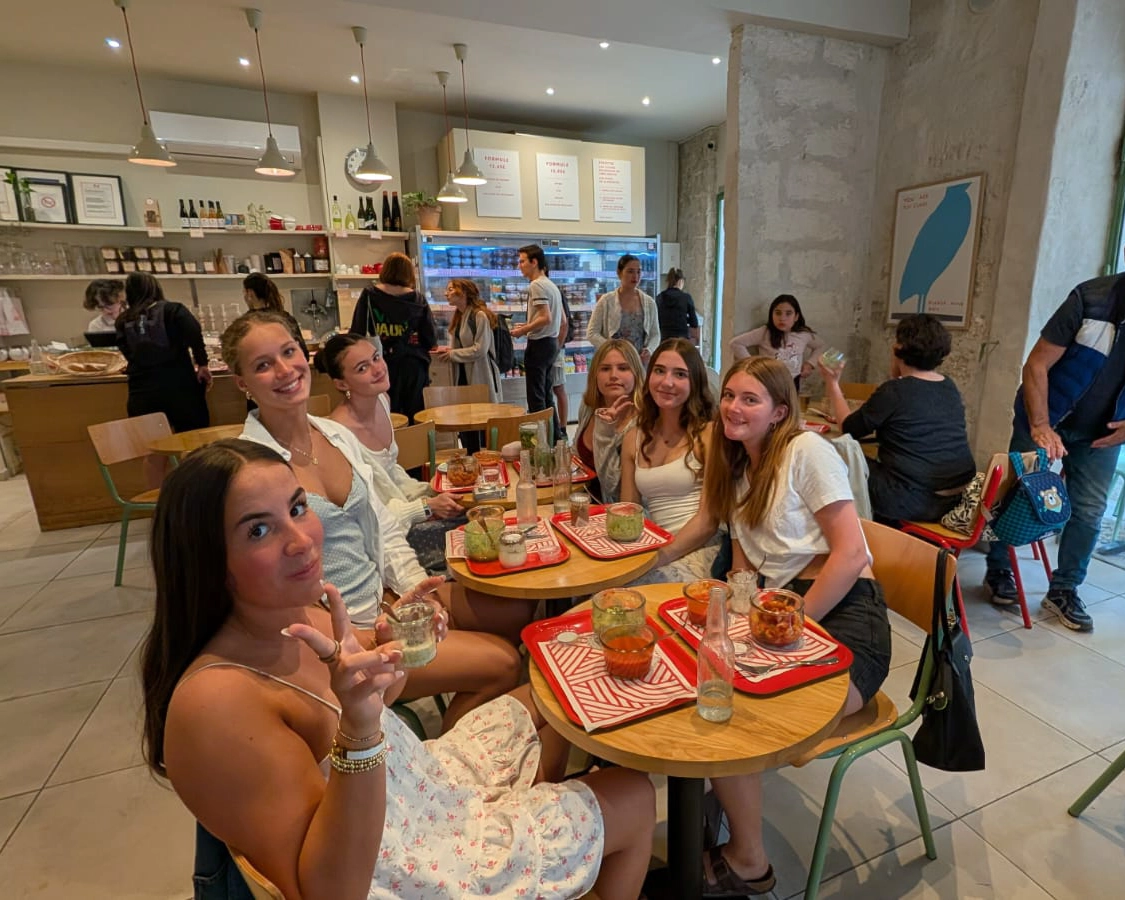
In the afternoon we were given a choice about our activities, and my team was certainly challenged at our Pilates class. For dinner we split into our cohorts and got to explore Avignon’s very own version of fast food. It came cold, in a jar, and when you were ready to eat, the cashier warmed it up. I have never eaten in this way before, and I was skeptical at first, but I can honestly say it broadened my cultural horizons. Looking around the restaurant I could see a lot of families there for a quick, but quality meal. Unlike the market, this time I was looking from the outside perspective, watching bonds grow between locals so casually. It made my experience hit closer to home, as I was reminded of my typical lifestyle. We ended the night with our daily debrief as a cohort, highlighting our joys and challenges of the day.
May 1, 2026
Student Author: Lucie
Today, we took a day trip to the beautiful city of Marseille. The bus ride to the city from Avignon was about an hour. On the bus, there was music being played and the sound of laughter all in the air.
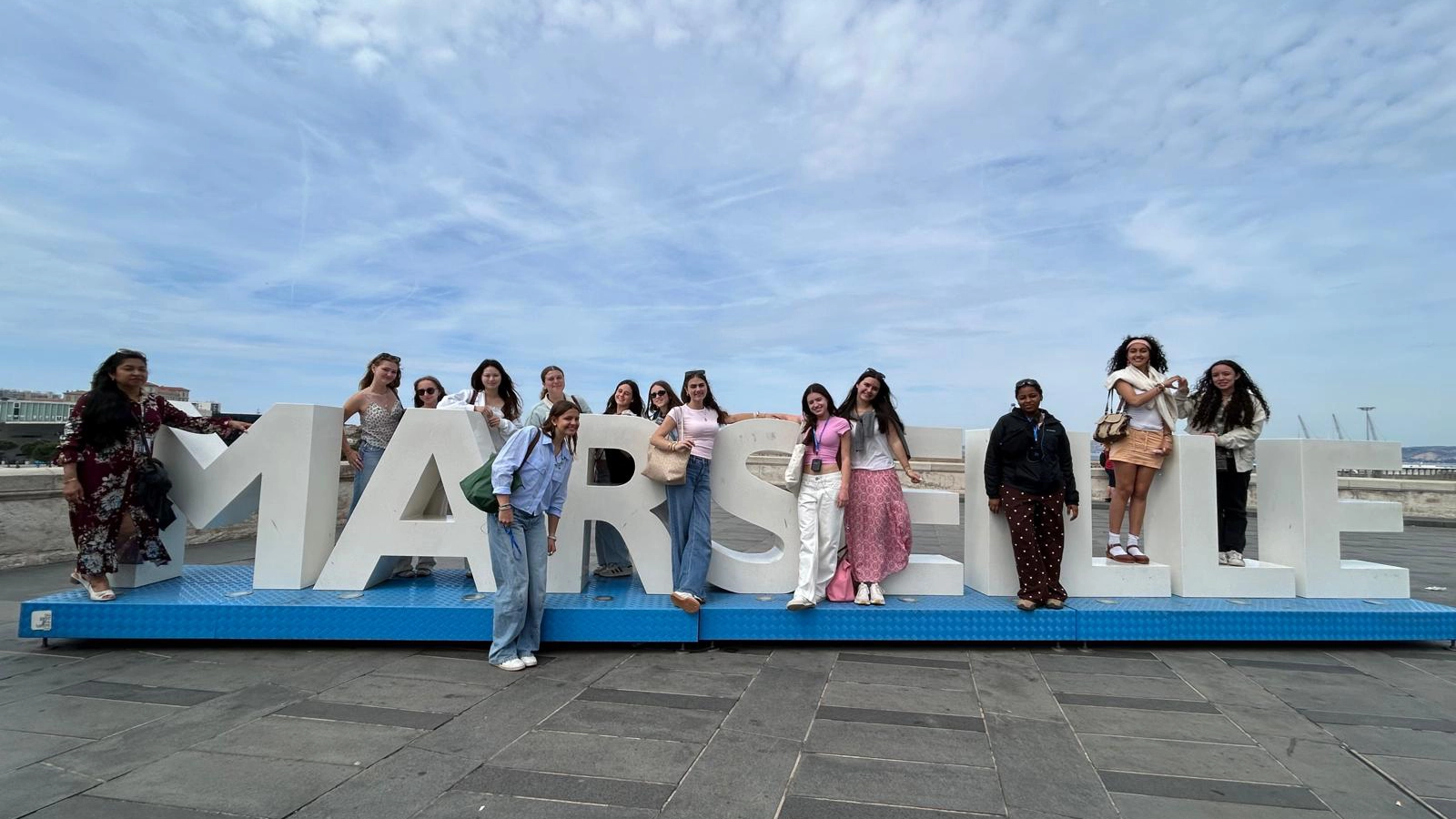
Once we arrived in Marseille, the group as a whole got split into the two cohorts. My group started off the day by taking a two-hour tour around the port and city to learn all about the culture and history of Marseille. One thing that really stuck out was the street art all over the city that make the city the what it is.
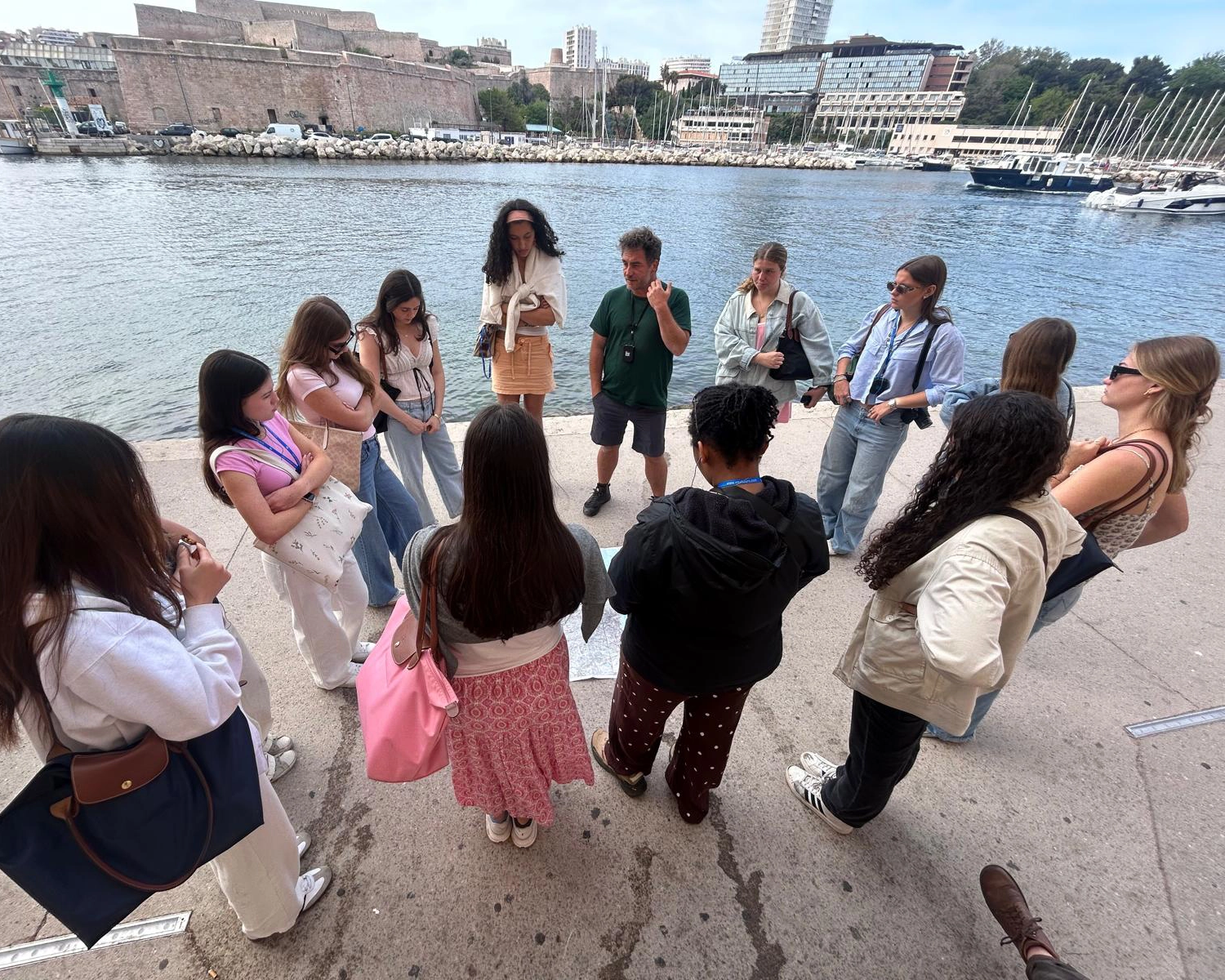
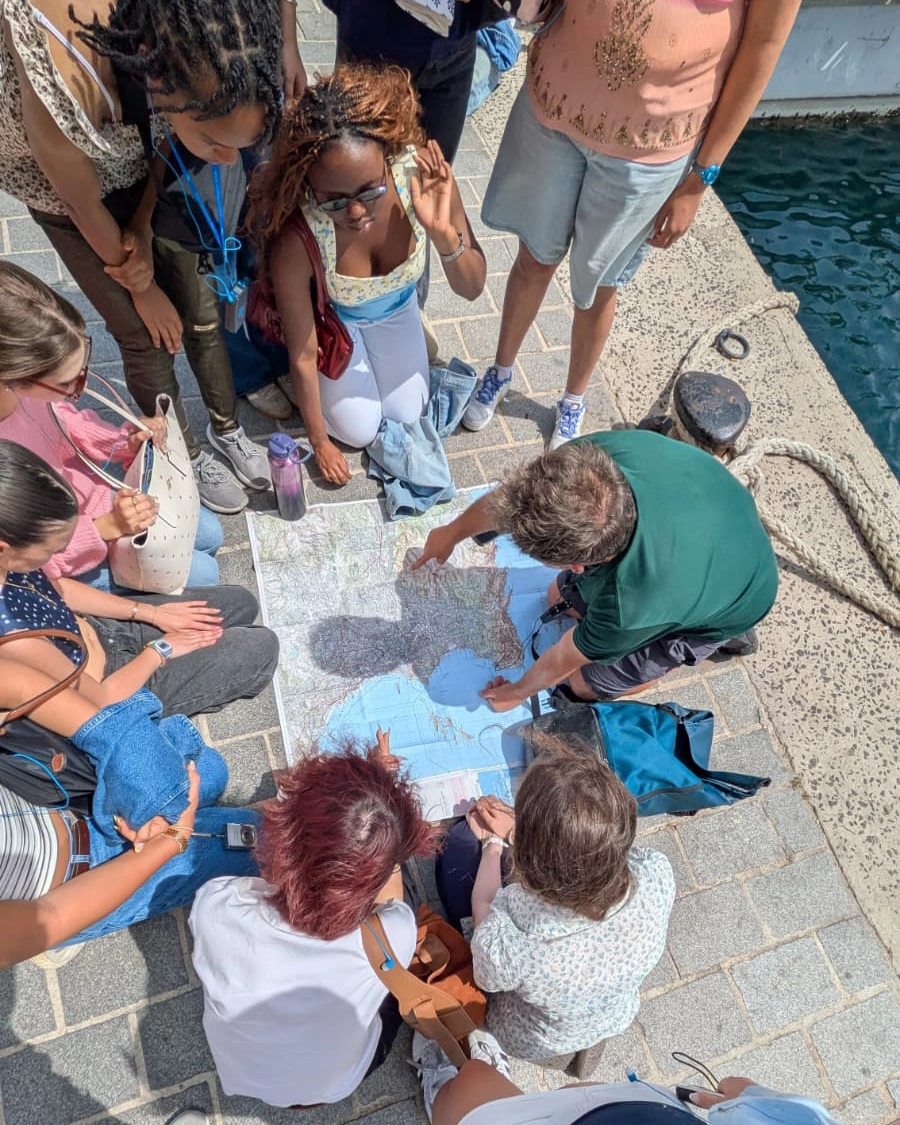
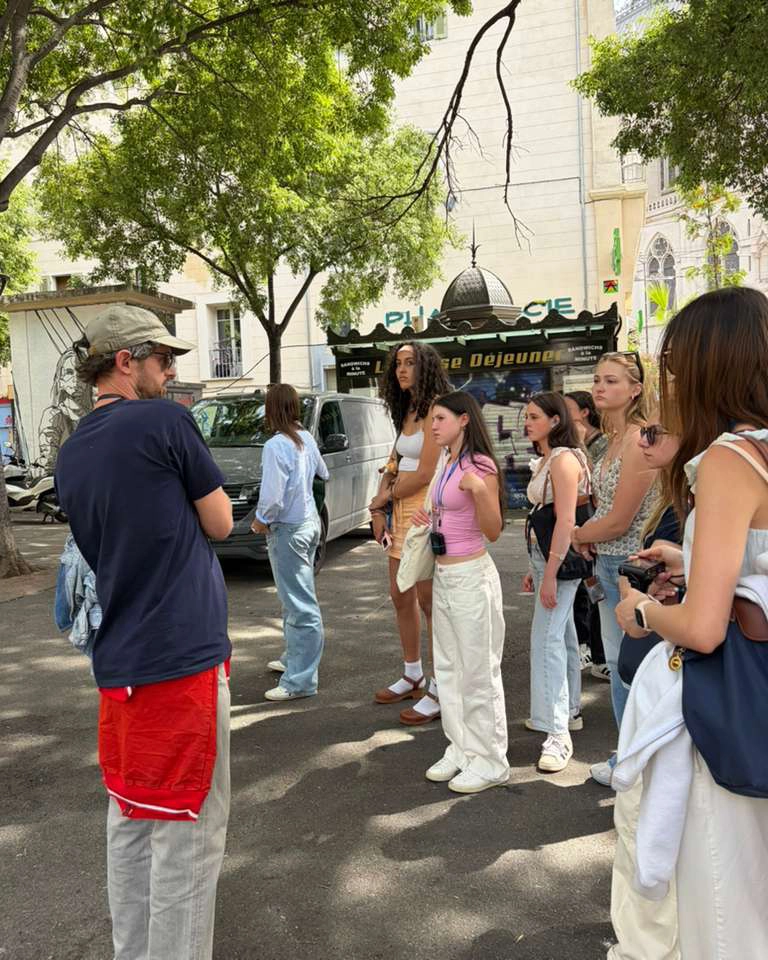
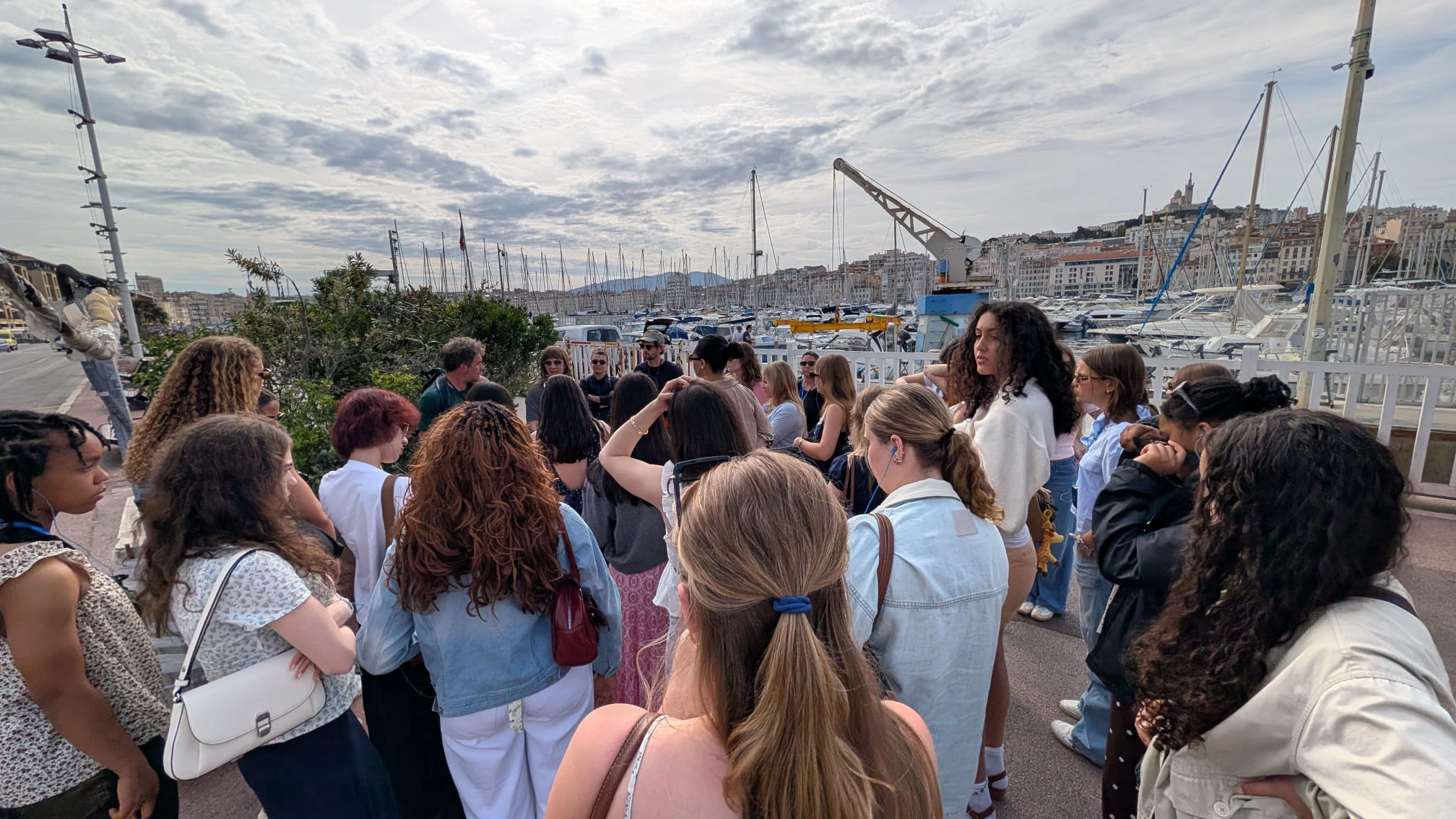
For lunch, we had our first “DIY” lunch, so we could pick where we wanted to eat and with whom. Once we were done with lunch, my group and I got to swap tours with the other group. In this tour, we really got to dive deeper into what Marseille’s culture really looks like. Every city has something that truly makes it special, and Marseille’s is definitely street art. Everywhere that we walked there was art, and it truly made the city feel alive. Marseille is truly such an amazing place, and I cannot wait to see and do all that we are going to in all the time we have left!
Student Author: Gabbi
Today we had a little bit of a switch-up from the past three days in Avignon, and we traveled to Marseille! Before our one-hour bus ride, me and four others went on a morning run around the walls of Avignon. Going on the runs in the mornings has allowed me to see the city from a new perspective by exploring what is on the outside. I really enjoy observing all of the people on the way to work in and around the city. After the run, I ate breakfast and got ready for the day in the hotel with my roommates.
Shortly after, we started our journey to Marseille. The vibes were very high with lots of chatter, taking pictures, playing card games, and listening to music on the speaker. Being off of our phones has become an afterthought for most of us by day 4, and I have found it a lot easier to stay engaged in the tours and build friendships.
Once we arrived, my cohort’s first activity in Marseille was a walk around the city with an impressive paid graffiti artist, Mahn Kloix. Mahn explained to us how graffiti in Marseille is illegal, yet almost every building at eye level had graffiti. Many people climb onto the roofs at night to create their artwork to avoid getting caught. The difference between Mahn’s work and the other artists’ work is that Mahn gets permission and is paid. The similarity: their intention is the same. To get a message across to the people.
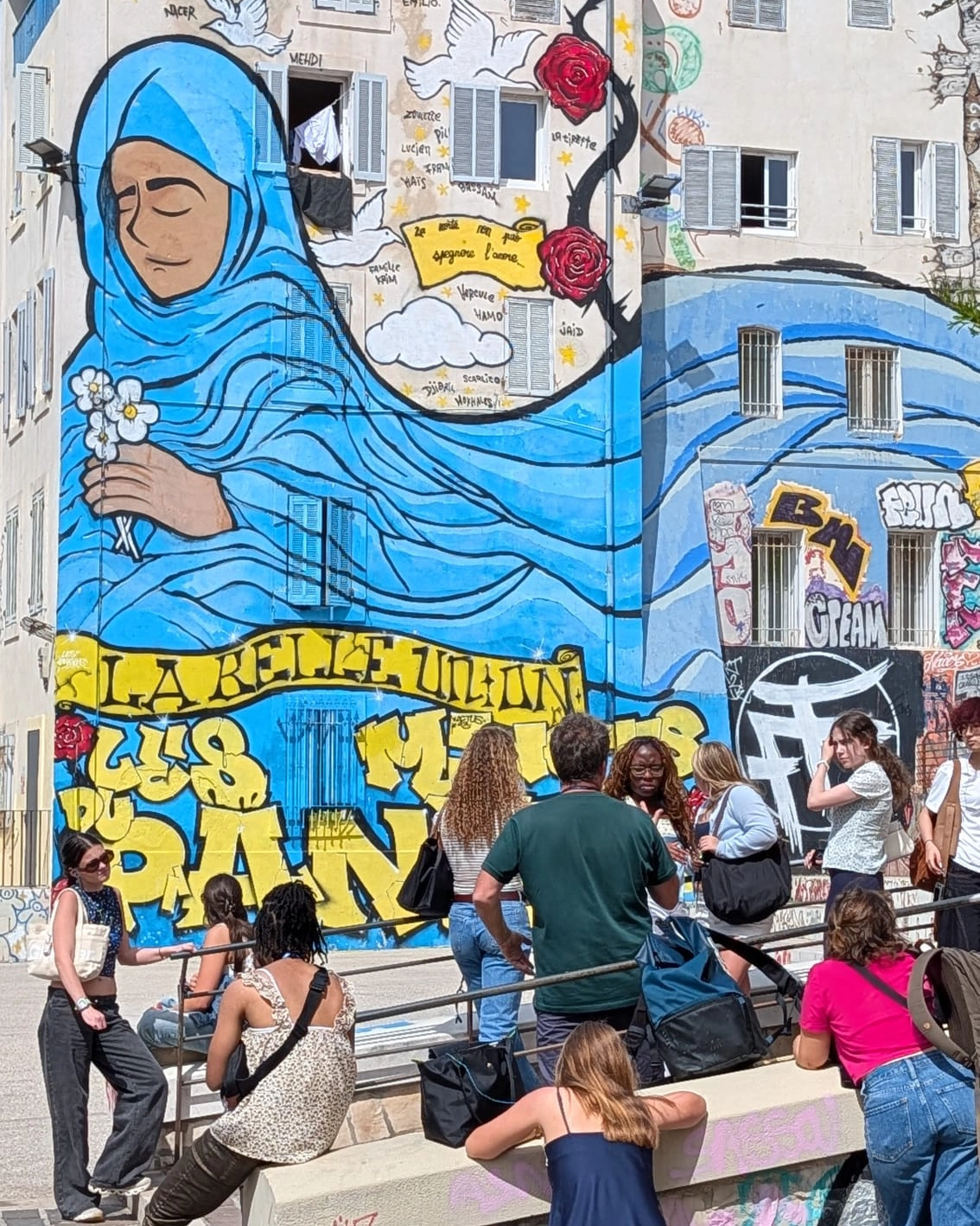
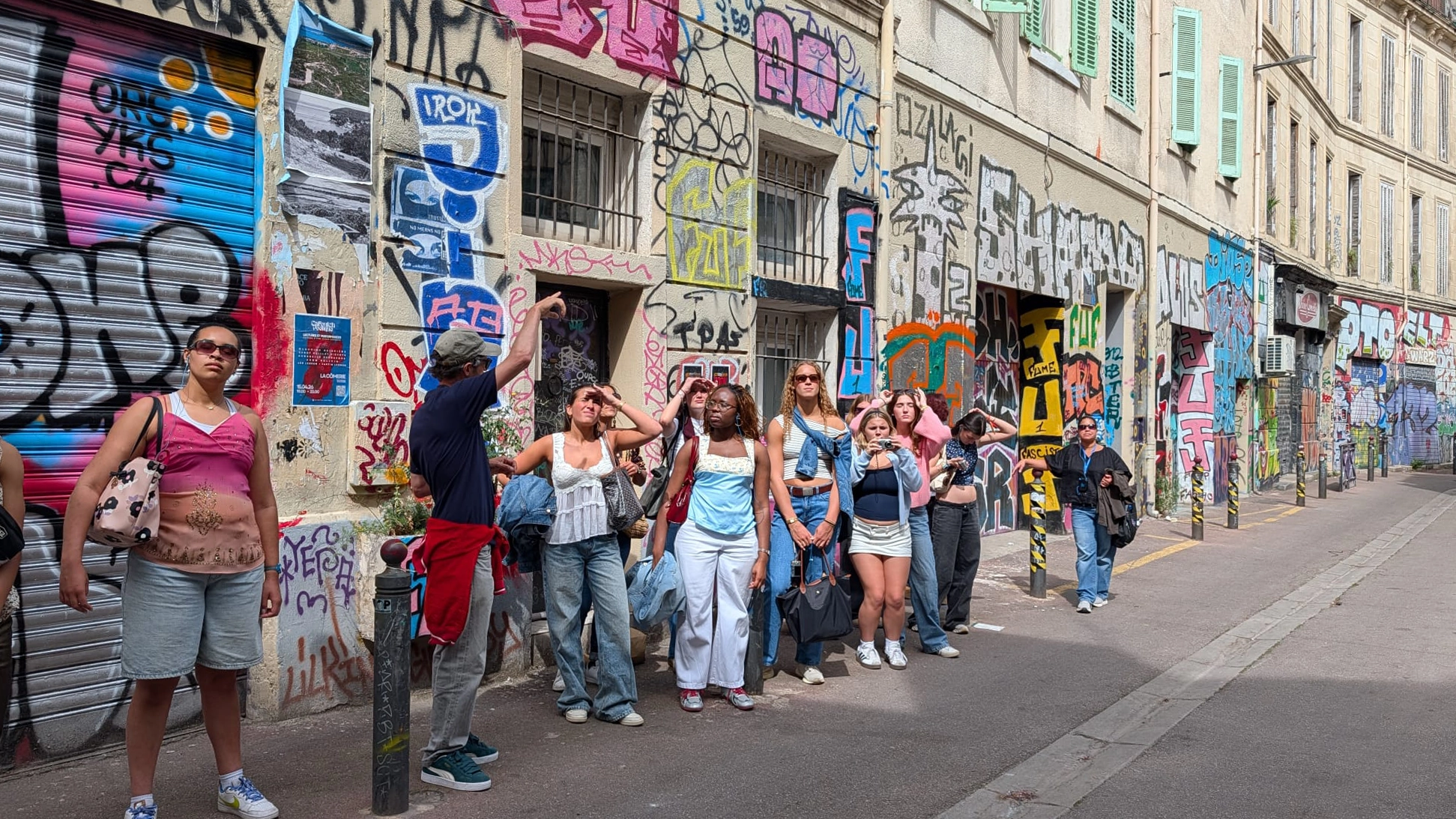
Mahn showed us three of his murals that all had super personal and fascinating stories. When thinking about how we inscribe ourselves on the world and their impacts, it was clear to me that Mahn was trying to uplift marginalized groups or reverse the narrative as perceived by others. I asked Mahn how his work had been received, and he said that people had found it both comforting and intimidating. Overall, the city strongly embraces the graffiti, either by making their own or interpreting what is already there. I loved listening to Mahn talk so passionately about his artwork to make others’ voices heard.
After our morning tour, me and my friends grabbed lunch at a beautiful restaurant overlooking the port. It was really fun to recap our mornings and take in the ocean breeze. Our second tour was with a lovely man named Olivier. He is an urban planner and, similarly to Mahn, his passion for his work was really inspiring to see. He shared wonderful stories detailing the history of Marseille, which he said, “If you got me a coffee, I could sit here and talk about this for 2 hours.” The port was gorgeous as well as the art, and the city is so busy and diverse compared to Avignon.
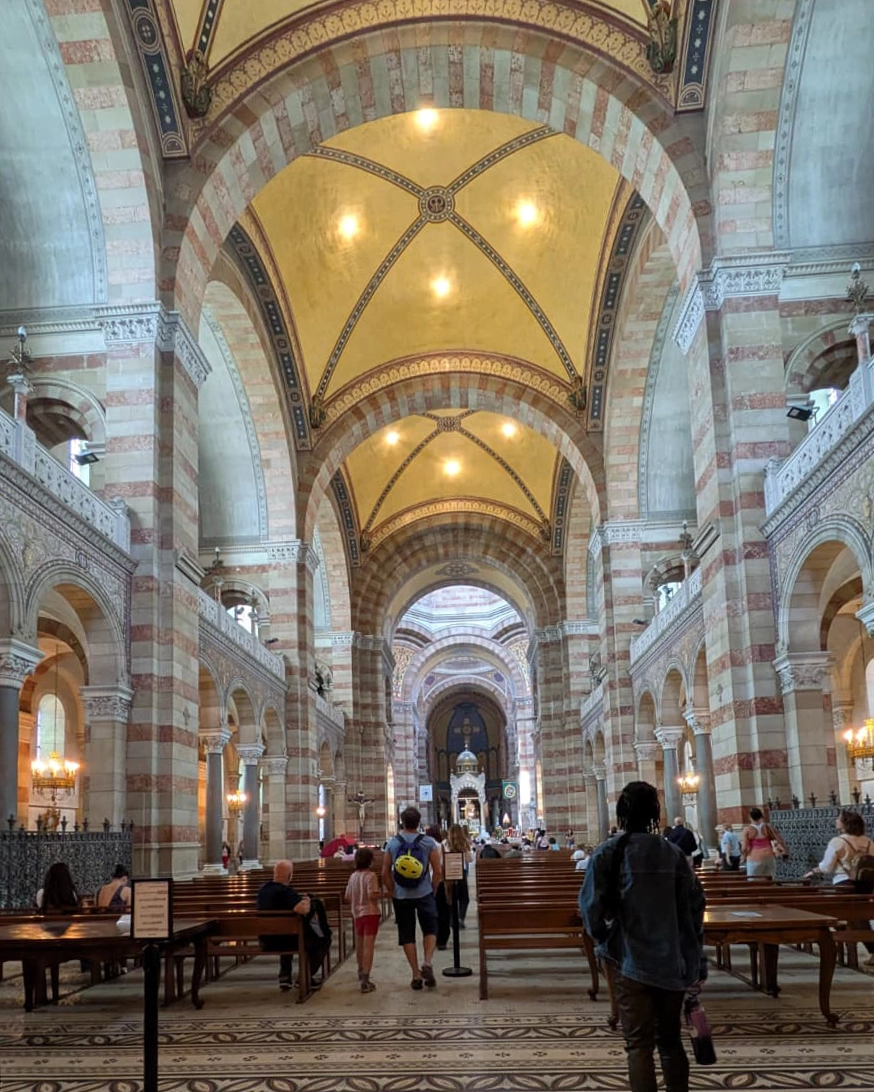
On the bus ride home back to the hotel, I was able to realize from this experience today on the tours how important pride of place truly is to everyone. Mahn and Olivier displayed so much passion for their work which rubbed off good vibes and high engagement throughout the whole day. This first experience in Marseille’s beautiful and lively city is one that I will never forget, and it opened my eyes to two very creative and important perspectives. Olivier mentioned that Marseille has many scars from the past, and through the way he and Mahn inscribe themselves on the city through their knowledge and talent, they are showing to us how past history can be embraced and healed over time.
April 30, 2026
Student Author: Lillian
It has been an eventful and intriguing day of exploration. The Peppeirini cohort started their day off strong with the tour of the Palais des Papes. Coming to Avignon, this is the site I had built up the most anticipation for. This is due to the fact that I researched it meticulously for my artifact summative. Walking into that palace, I knew the facts; I was ready to experience the enormous medieval palace.
The palace was both large in size and impact. The city once revolved and developed around when the Papacy was moved from Rome to Avignon due to unstable conditions. With this change, Avignon became a booming economic city and the large-scale Gothic style palace was constructed.
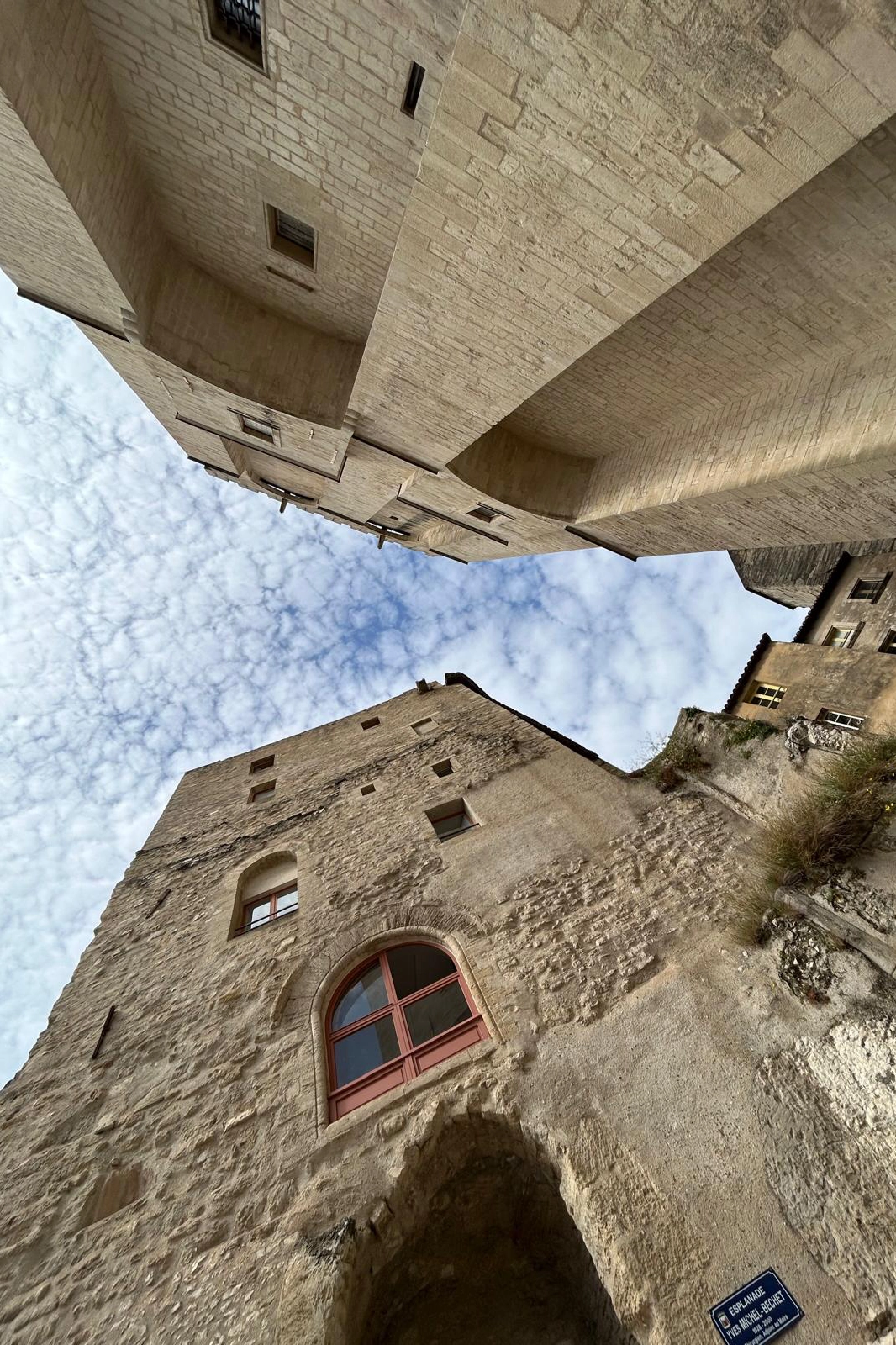
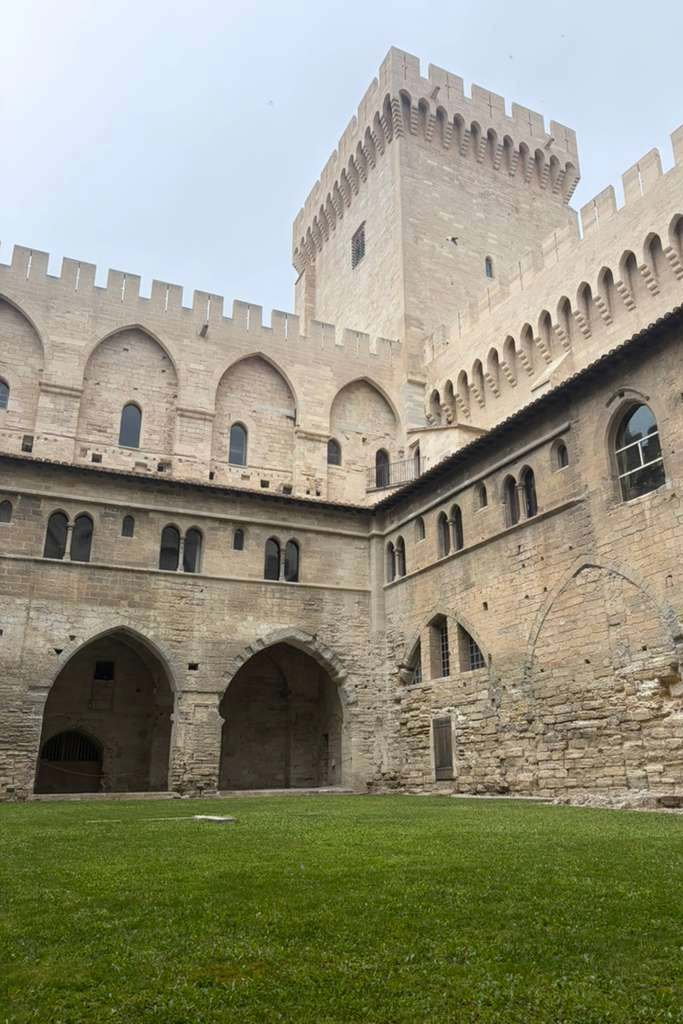
During that time period, the palace was essential and acted as the center of the city. Some would think that fact would change once the Papacy returned to Rome—but being in the city today showed me that wasn’t true. People gravitate to the center around the palace as it is very impressive and fascinating to gaze at while sipping a coffee. It also hosts tour groups to educate tourists and travelers like ourselves.
With our wonderful tour guide Françoise, we immersed ourselves and discovered what it was like to live in the palace during the Papacy. This experience really opened my eyes on how impactful learning and researching an artifact can be both on me as a student and city locals. Coming in having background information allowed me as a learner to ask deeper questions and form a connection of interest with my guide. Françoise deeply appreciated my genuine curiosity about the Pope’s Palace—a site she cares so deeply about! She even expressed how surprised she was with the group’s knowledge and engagement.
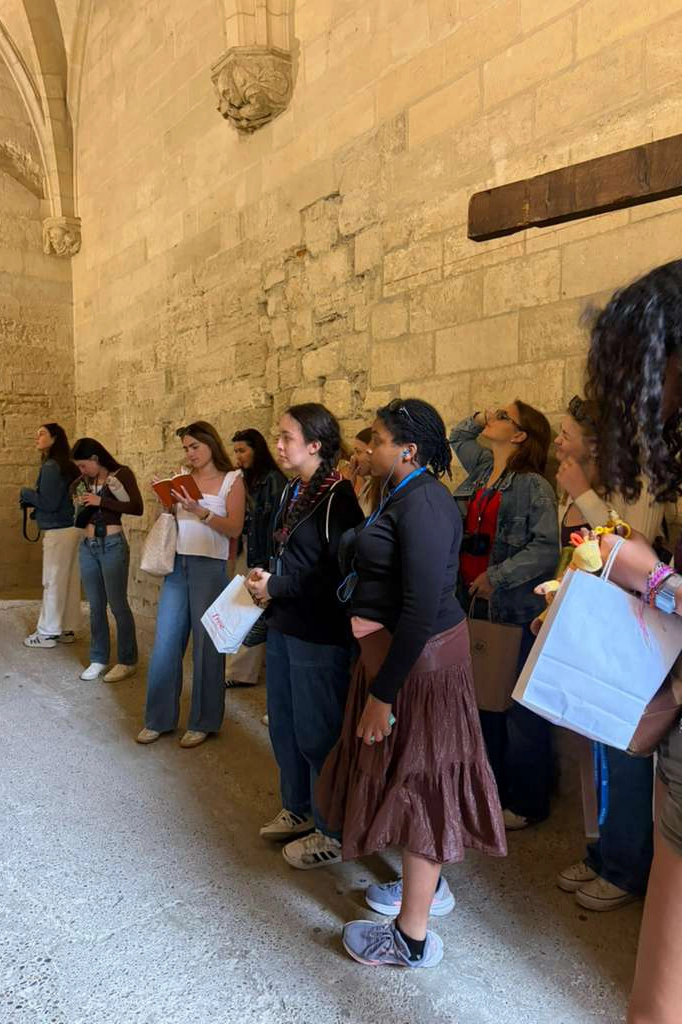
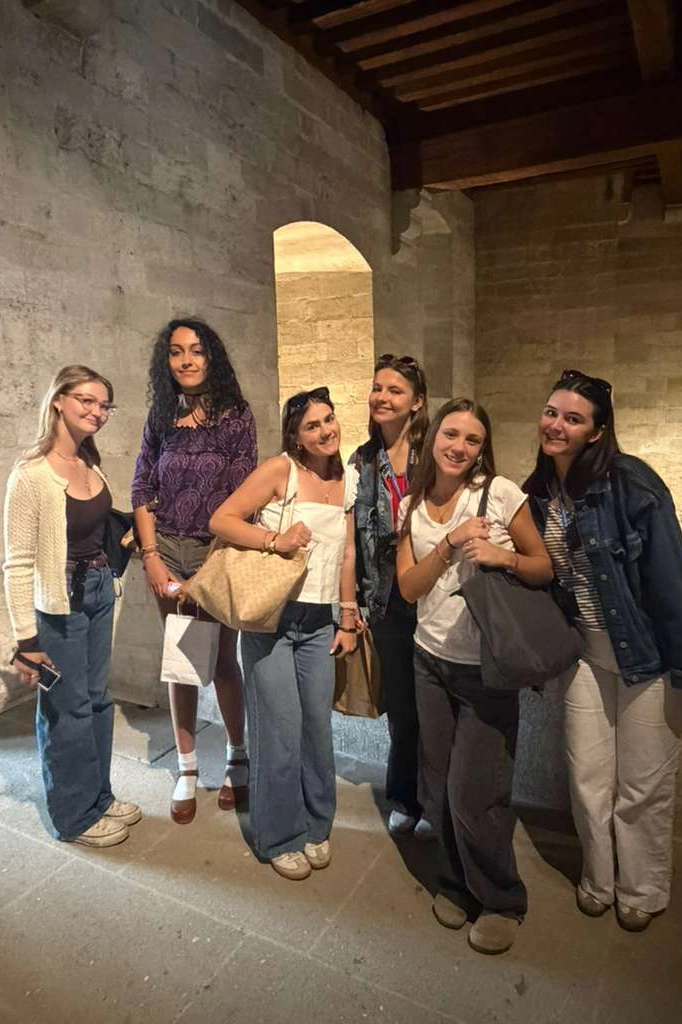
This made me feel rewarded as a global citizen and traveler. Next, the group discovered a hidden gem: a local flea market! Only a few “rues” off of the main plaza, this market runs Tuesdays and Thursdays by local vendors. Experiencing this intimate cultural event meant traveling beyond the traditional tourist experience.
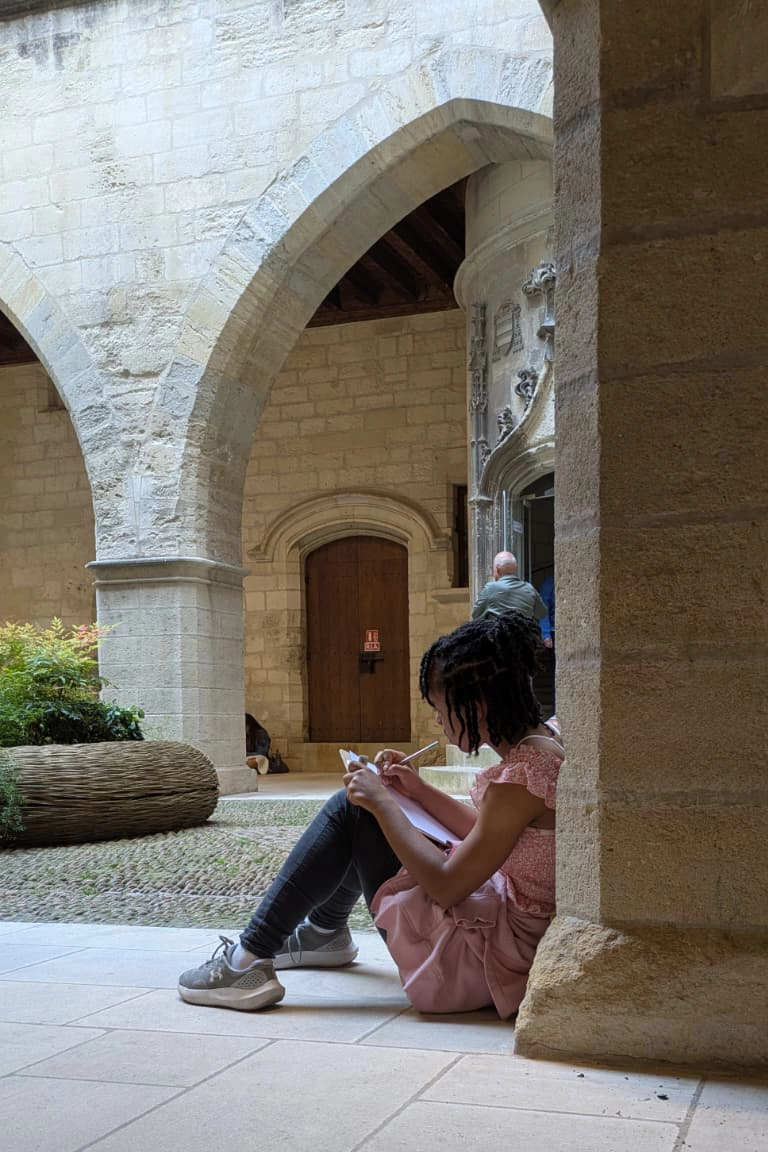
We then had a sketching class with a local artist from Avignon, Charlie. She taught us about dimension and urban sketching. It allowed me to see the city from a different perspective. I was able to admire the medieval architecture while also creating a physical object to remember my time here, that is not just a photograph.
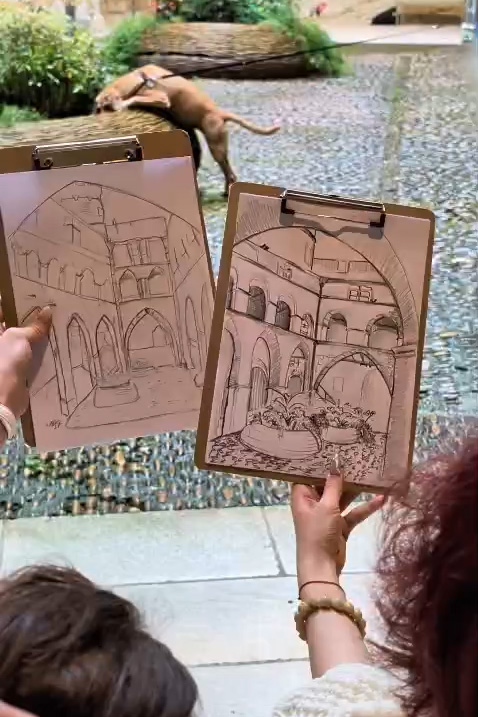
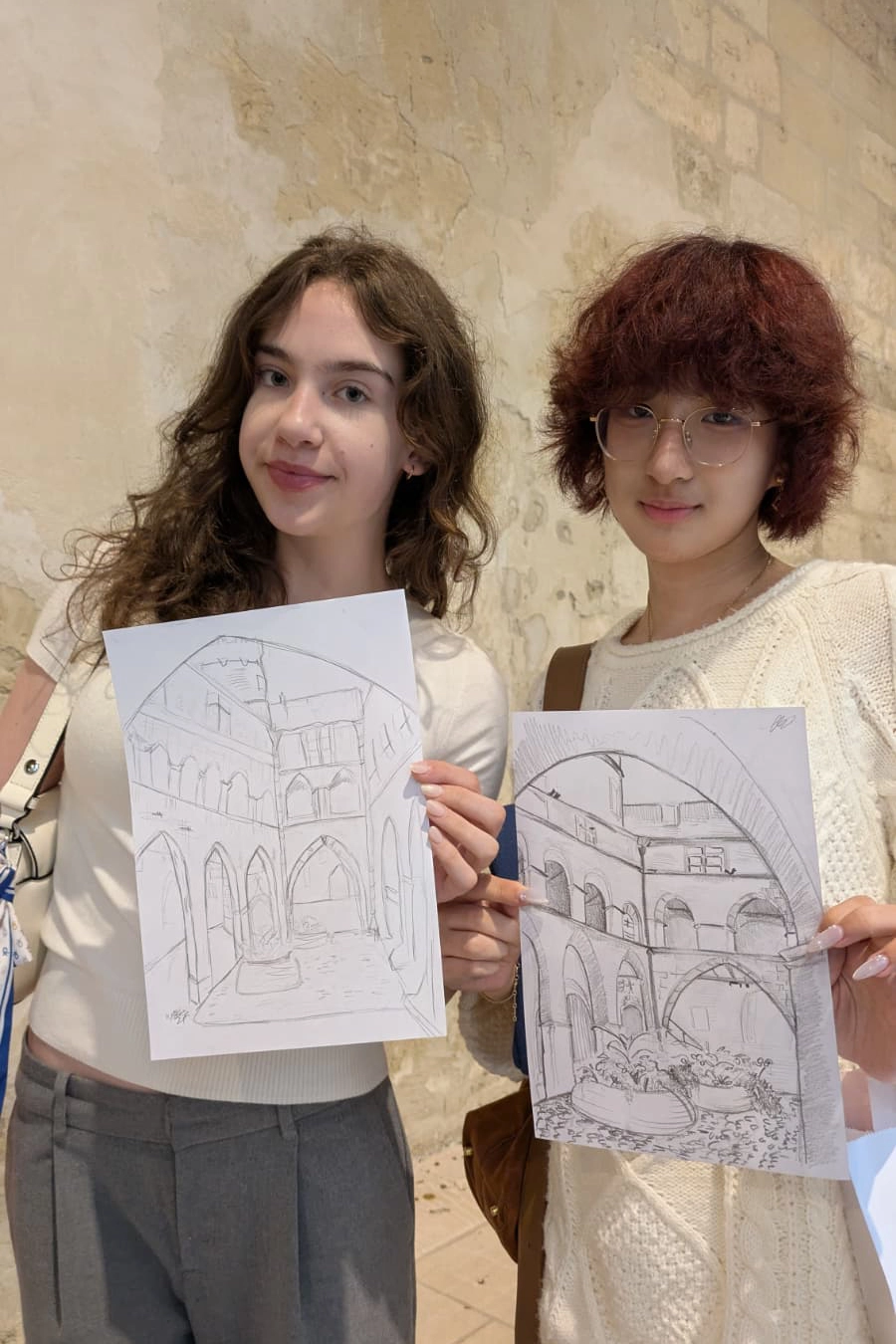
One of the highlights of my day was trying escargots with my dinner cohort. This was a unique French experience that expanded both our mindsets and taste buds. It was both slimy and delicious! This fun moment in our group brought us together and let us experience a cool and unique French dish most people are scared to try.
This day was jam-packed with fun and exciting events that are making this trip impactful and very memorable.
Student Author: Lucy
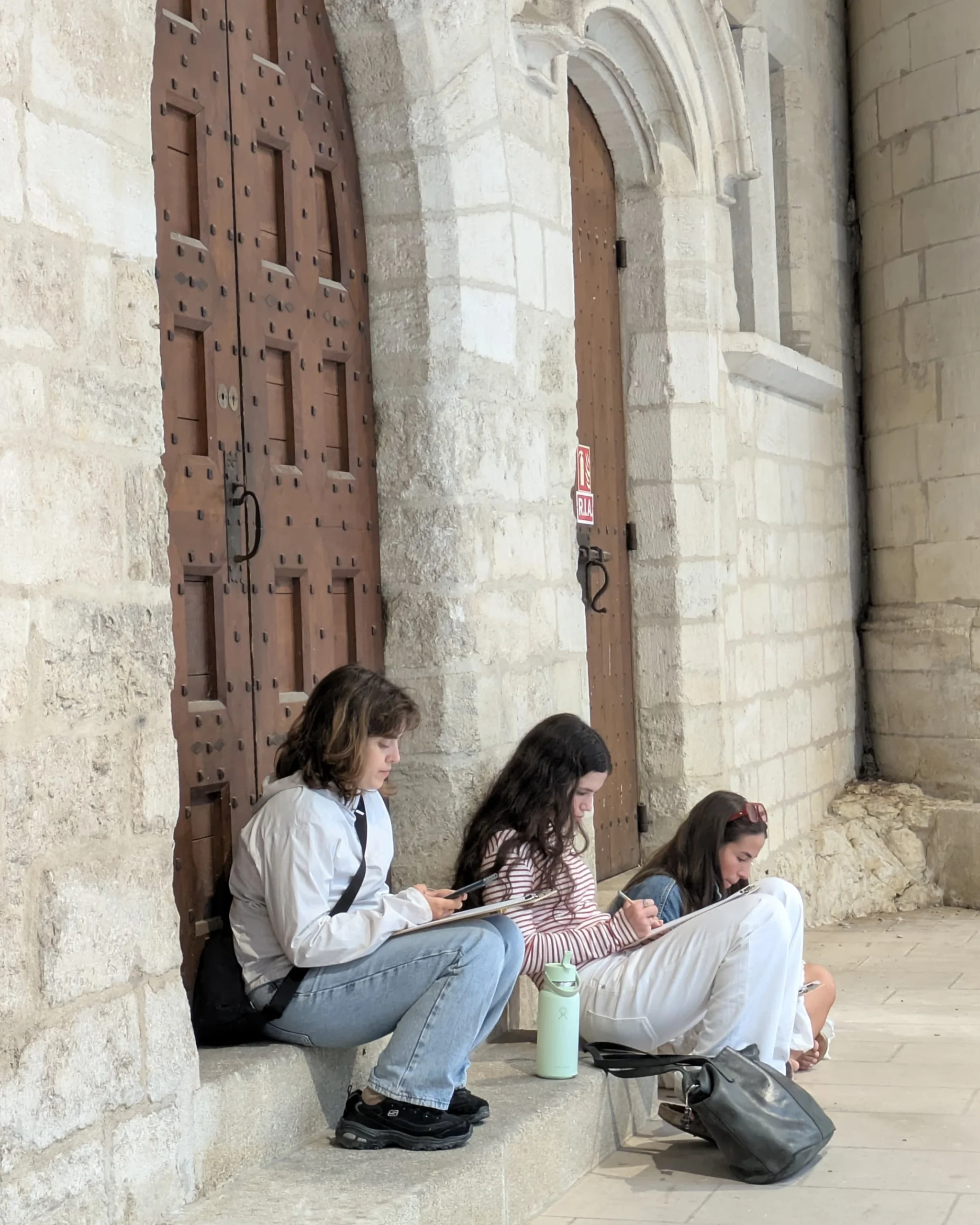
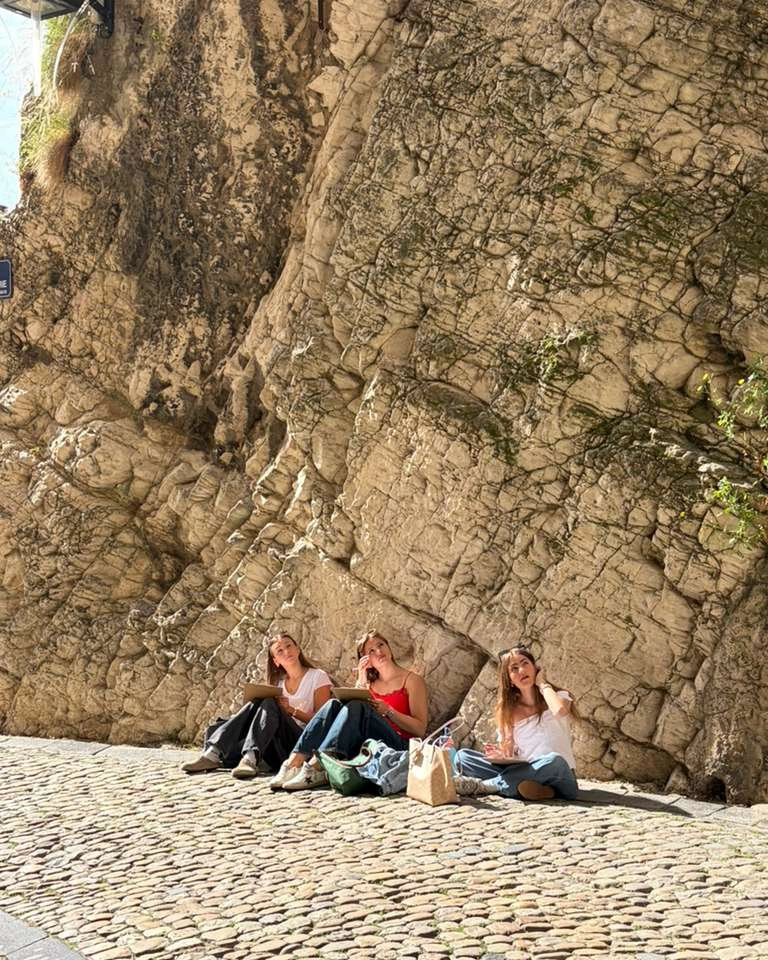
Today, my cohort first went to an urban sketching workshop with a local artist named Charlie. She provided us with sketchpads, and we were then instructed to either draw the roofline of a side street or an arch attached to the Palais des Papes. I decided to draw the arch. As I sketched it, I began to notice architectural details that I don’t think I would have seen if I had just walked by it. For example, certain windows in the Palais des Papes are different sizes.
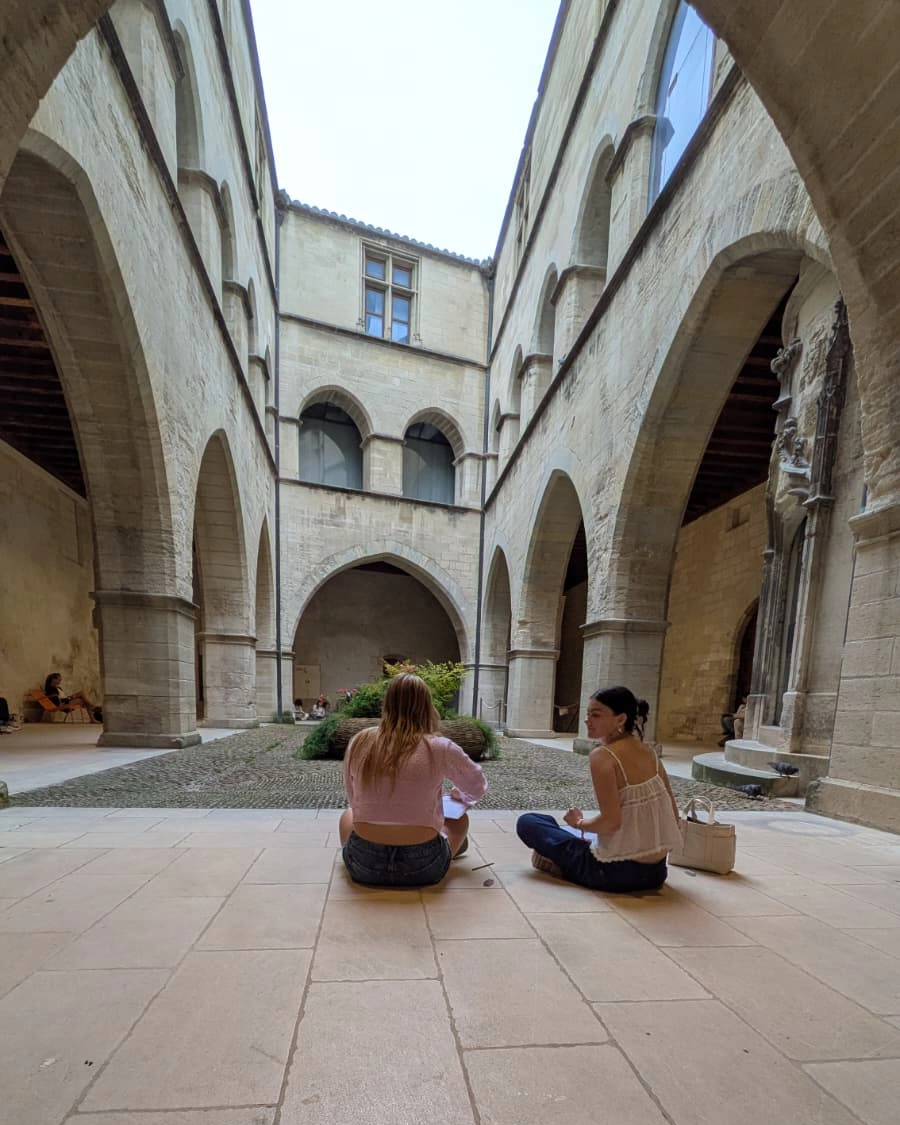
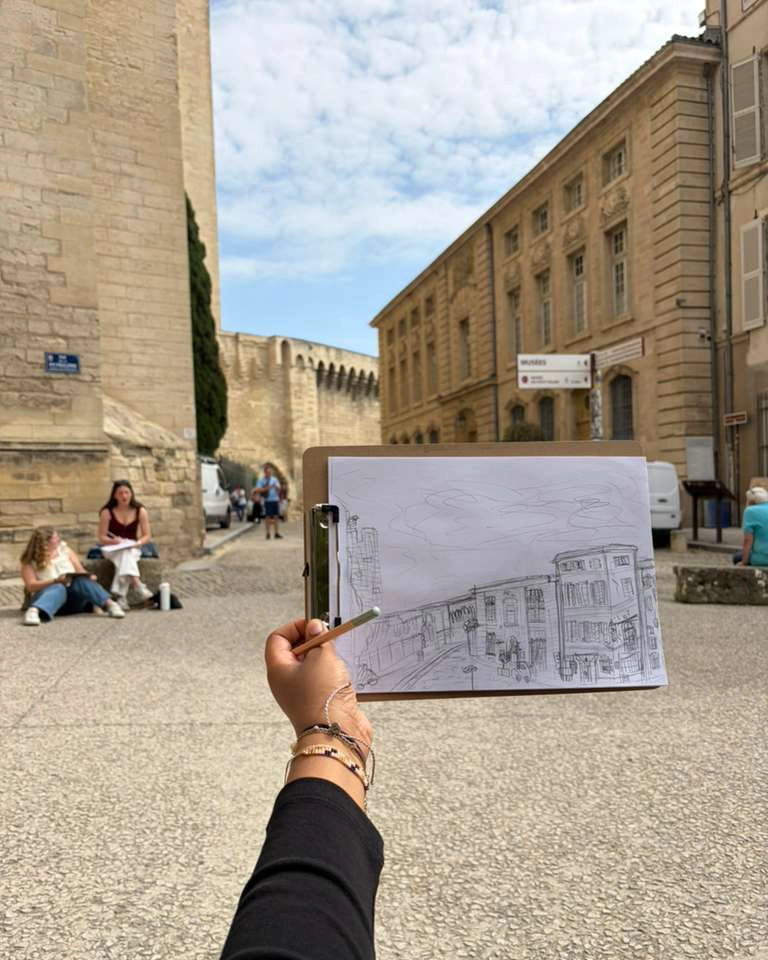
Based on my prior knowledge of the building, I came to the conclusion that the lack of consistent construction could most likely be attributed to modifications made to the building as it served different purposes throughout history. For example, government officials, who lived in the palace directly after the Papacy officially left Avignon, made efforts to eliminate some of the building’s Medieval Gothic qualities. This decision was made because it was extremely expensive to maintain the intricate architecture, and government officials felt that they didn’t need to live in that level of luxury.
I noticed even more alterations made to the Palais des Papes when my cohort went inside for a guided tour this afternoon. We were shown frescoes and paintings that had been severely damaged by the soldiers who used the palace as barracks from midway through the French Revolution to the early 20th century. Furthermore, there are clear outlines of where “ceilings” were placed in rooms that once were soldiers’ bedrooms. That is, one room on one level could have been broken up into four floors since the ceilings in the palace are so high.
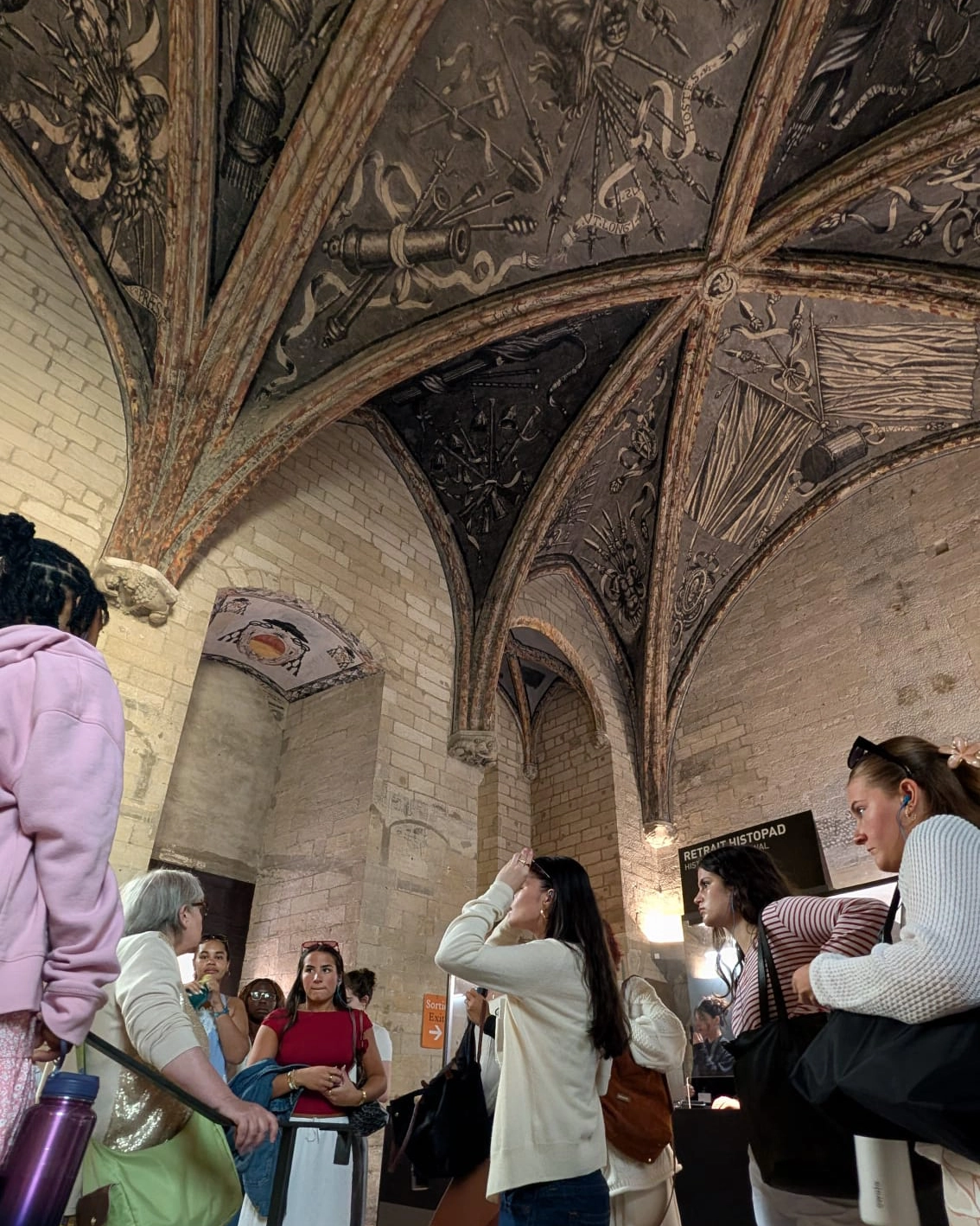
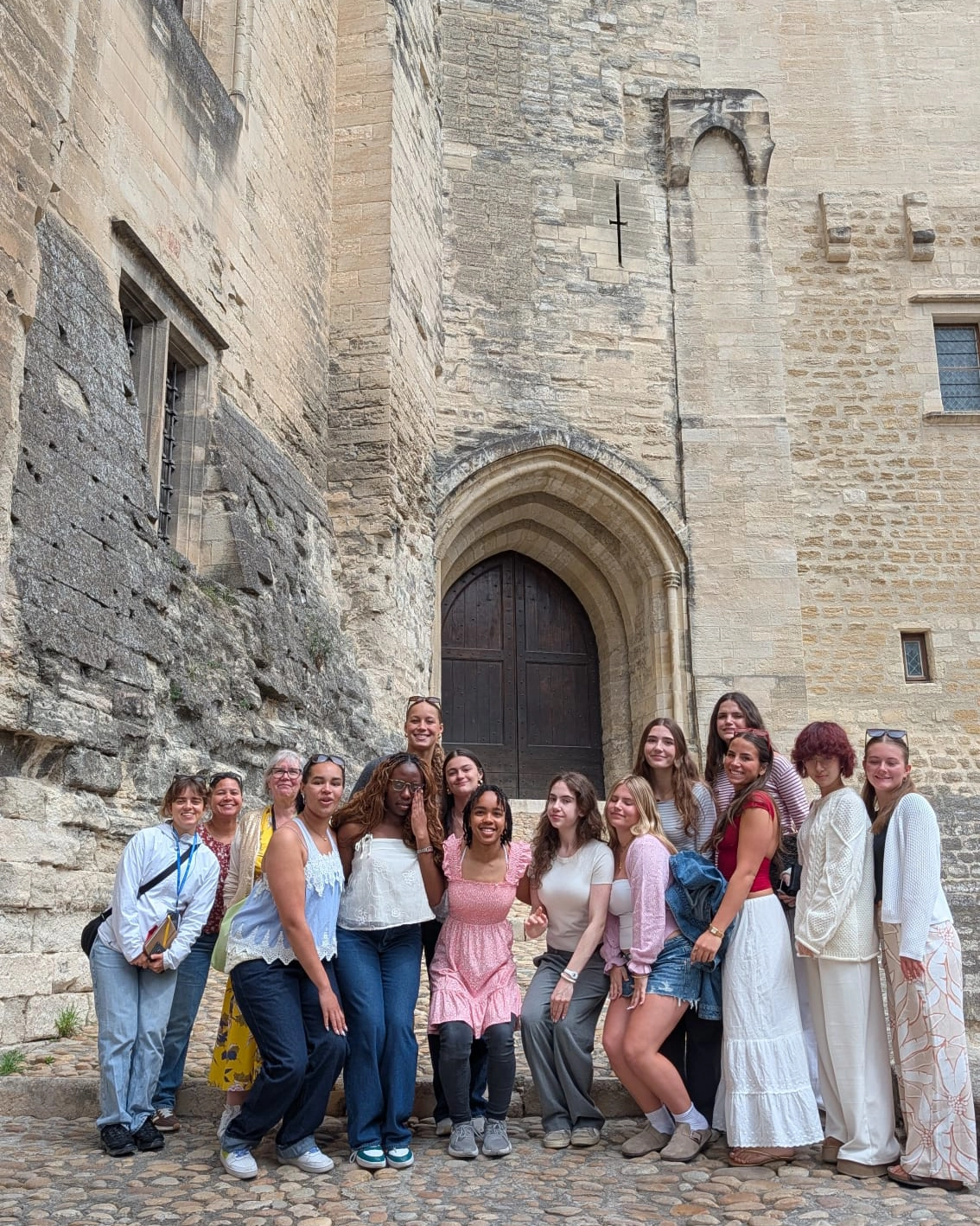
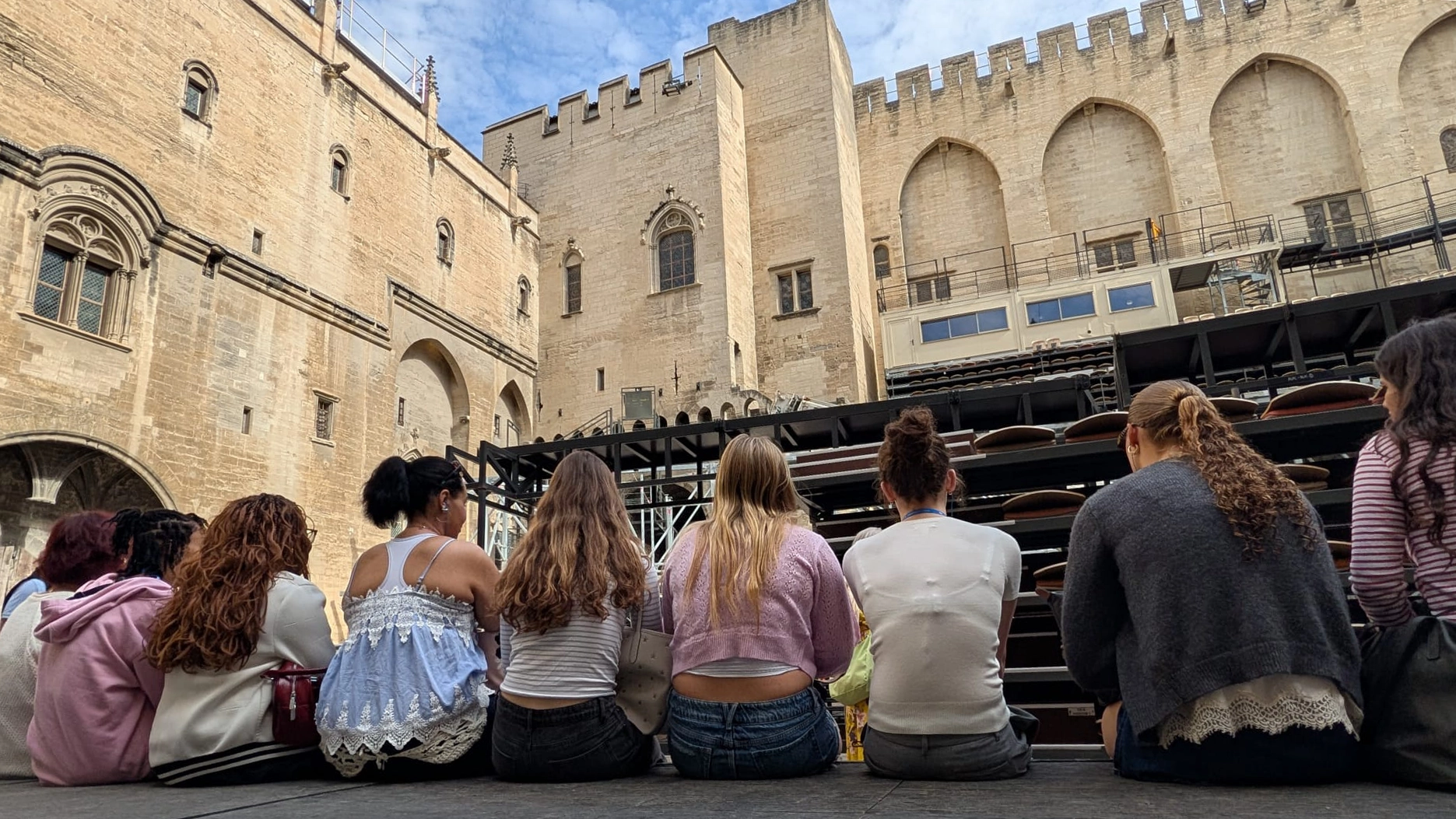
Engaging with the Palace today provided me with a real-world example of how a structure can be repurposed, and how those repurposings can potentially cause damage. However, this damage only applies to the building itself, and not to the preservation of its history.
I also really enjoyed the meals we had today! Both meals my cohort had were in the same plaza as Les Halles Market — a Provençal market full of local food vendors.
April 29, 2026
Student Author: Ava
Last night was our first night sleeping in the hotel so today felt like our first official full day. We spent the morning bonding with our cohorts by answering rapid-fire questions we had for each other. We then gathered as a whole group to discuss assumptions we had about Avignon prior to our arrival. Many of us were expecting French people to be “mean” based on stereotypes we have learned in the past. We are all surprised because that is not the case and everyone is so friendly.
I was also surprised to learn that tipping is not an option at many restaurants and tax is included in the prices. Another thing we noticed is the prominence of smoking in Avignon. We engaged in a discussion about how people used smoking as a way to cope after the world wars and it then became normalized and integrated into the culture. Even though smoking fizzled out in the United States, in other countries like France, the habit was passed on to other generations.
After lunch, we walked to the Rhône river and learned about the history of Pont d’Avignon, which is the bridge that lies over the river. The bridge no longer connects to the other side because the current was too strong and destroyed 18 of the bridge’s arches, leaving only 4 remaining.
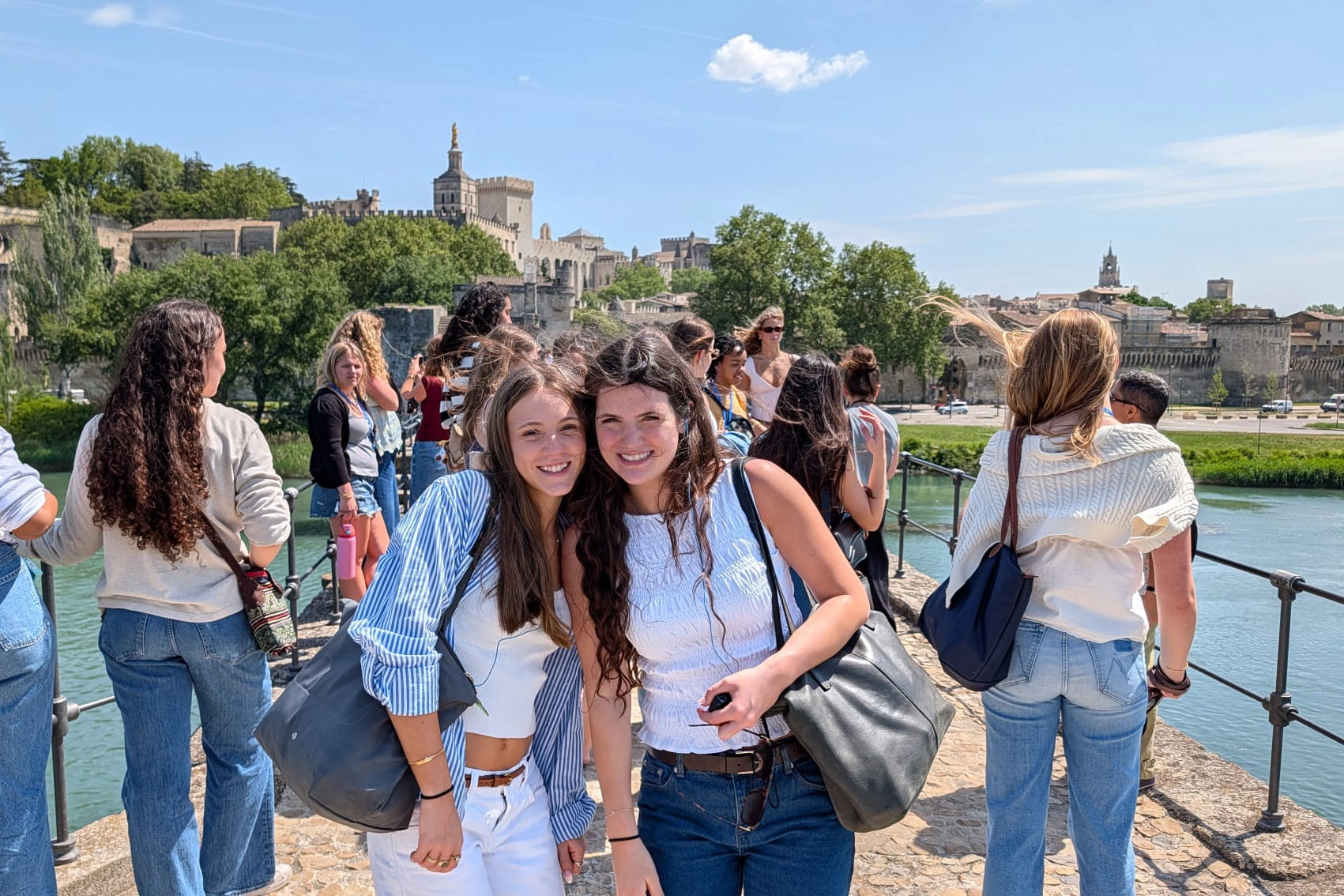
Later in the afternoon, we split into small groups and arranged a scavenger hunt for another group. We used the hints we received from another group to complete the scavenger hunt given to us. This activity was so fun because as we walked around I noticed all of the beauty and elegance Avignon has to offer. I love everything about this place from the cobblestone roads to the window shutters on every building. The weather has been so nice and there are so many people outside making the people-watching so good.
I love watching the locals interact with one another and get an idea of what life looks like in Avignon. I love it here already and I am excited to explore the city further and immerse myself in the culture.
Student Author: Harper
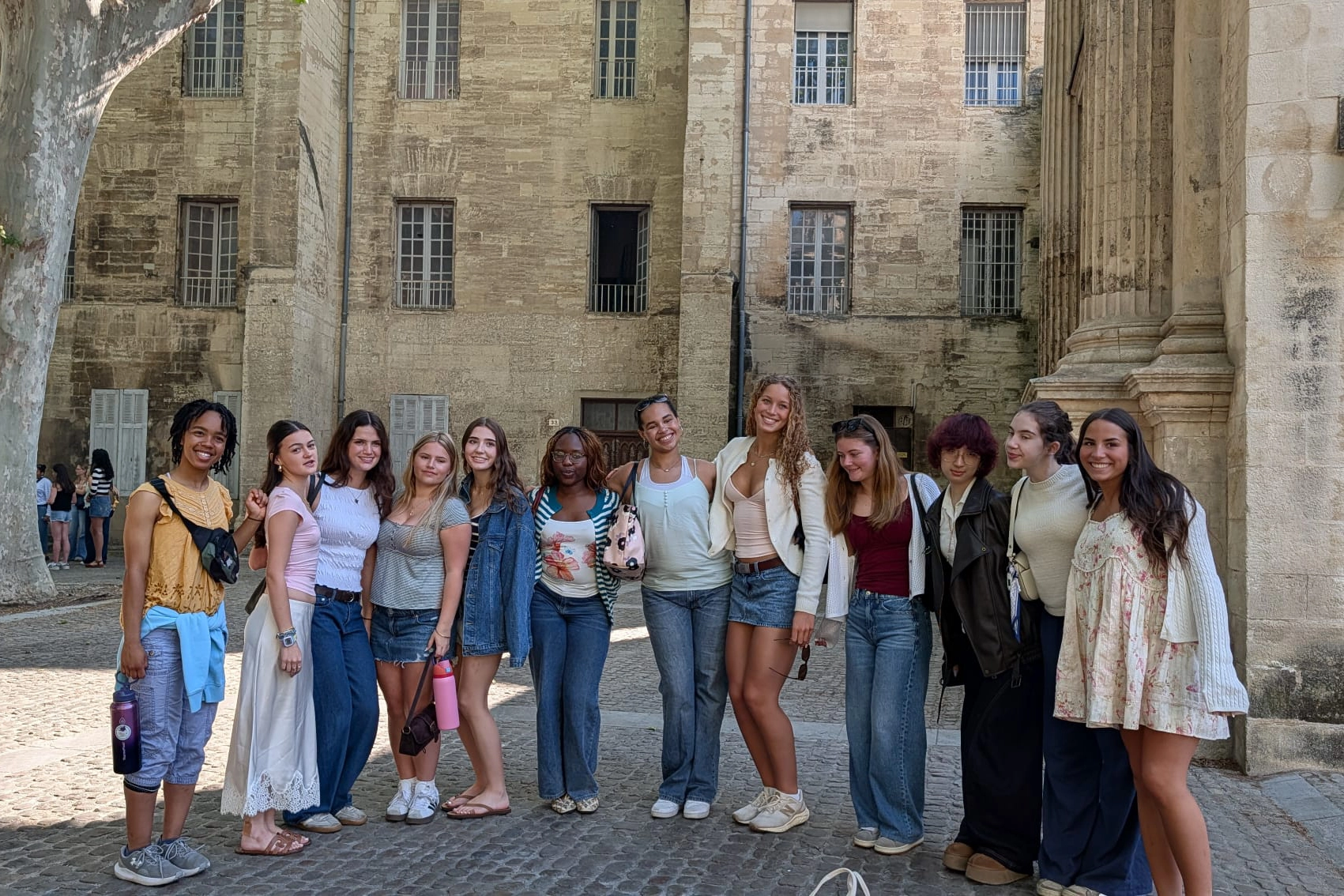
Today is Wednesday, and it is our second day in France. We did a lot today: ate pizza & ice cream (sprinkles offered by Kate), played a reverse scavenger hunt around the city, and went shopping in the markets. But out of all the activities, my favorite was visiting the river and crossing the Rhône —or more, half-crossing— the bridge no longer carries its full 22 arches across the entire area like it used to.
Honestly, I knew this would be my favorite because of the history. If it was anything like the other structures that were older than America itself, my first thoughts were academic-based: “When was the structure toppled first?” “Who ordered for the city’s protection as a historical monument?”
But on the way over, we were scampering away from the walls for the first time since we landed, and Elsa, our tour guide from the city, turns to us…
“Does anyone know about the story of Bénézet?”
It’s a historical tale—I never learned it myself, but for Maizey, she studied it.
“Yes, it’s about the boy who heard voices from angels to build the bridge.”
The cars were loud. I fixed my bag as Elsa nodded, though the furrow of her brow told us that’s not where the story ended.
“Yes, but when it comes to history, there is always interpretation. Read between the lines, think about why people wrote or said what they did instead of always who and when.”
For me, that moment shaped my day. She was right, and it gave me a moment of reflection. Since we got there, I’d been looking at the narrow alleyways and ancient corridors from an “inside” the box perspective: What, factually, occurred here? But, as we made our way across the bridge, my mindset changed. Instead of trying to only imagine the facts, I let myself enjoy the idea of Catholic monks or noblemen on horseback traveling to and from Avignon. I imagined their dialect, diet, reason for going—I had fun. I immersed myself more than I could have with the “insider” thought process, too.
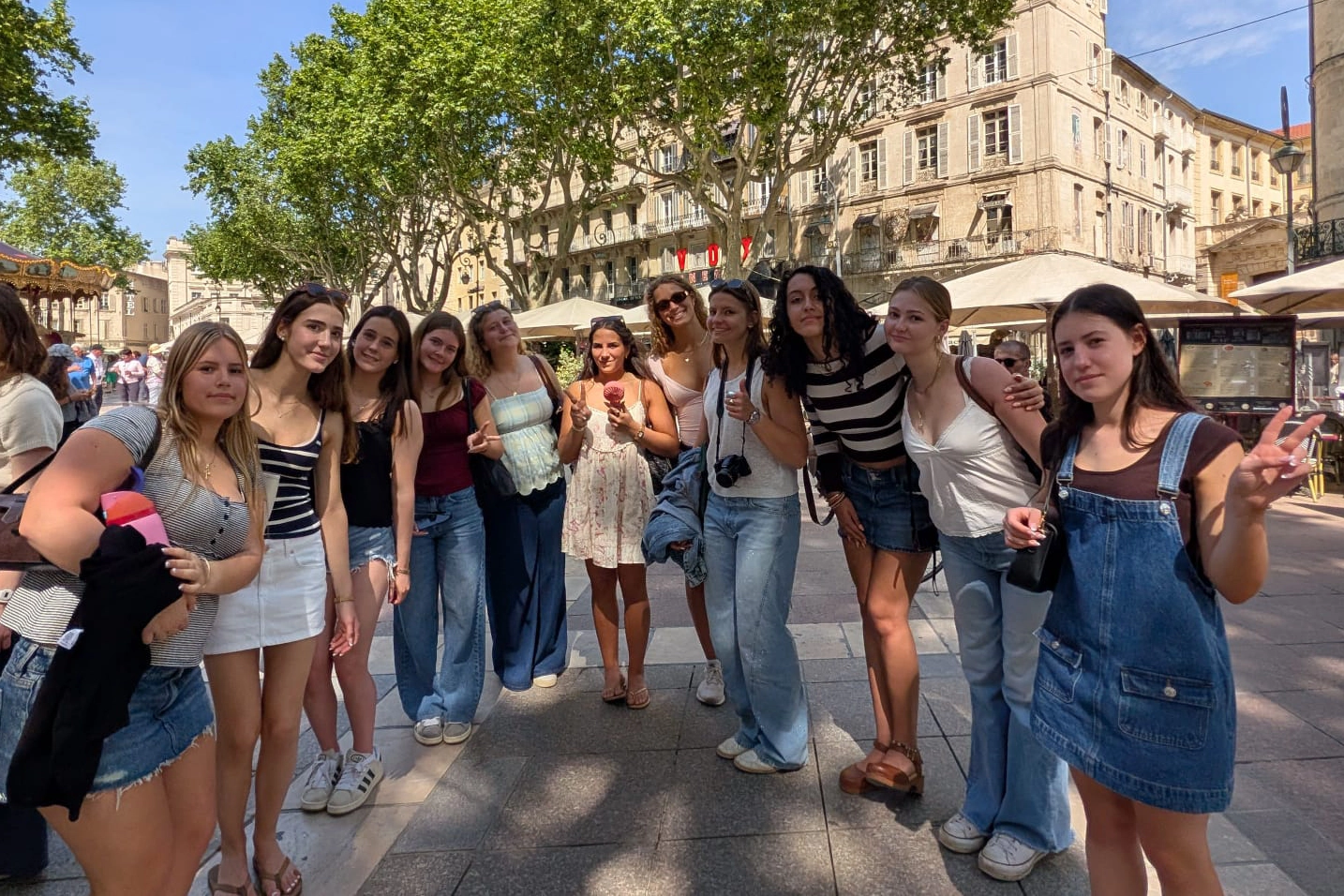
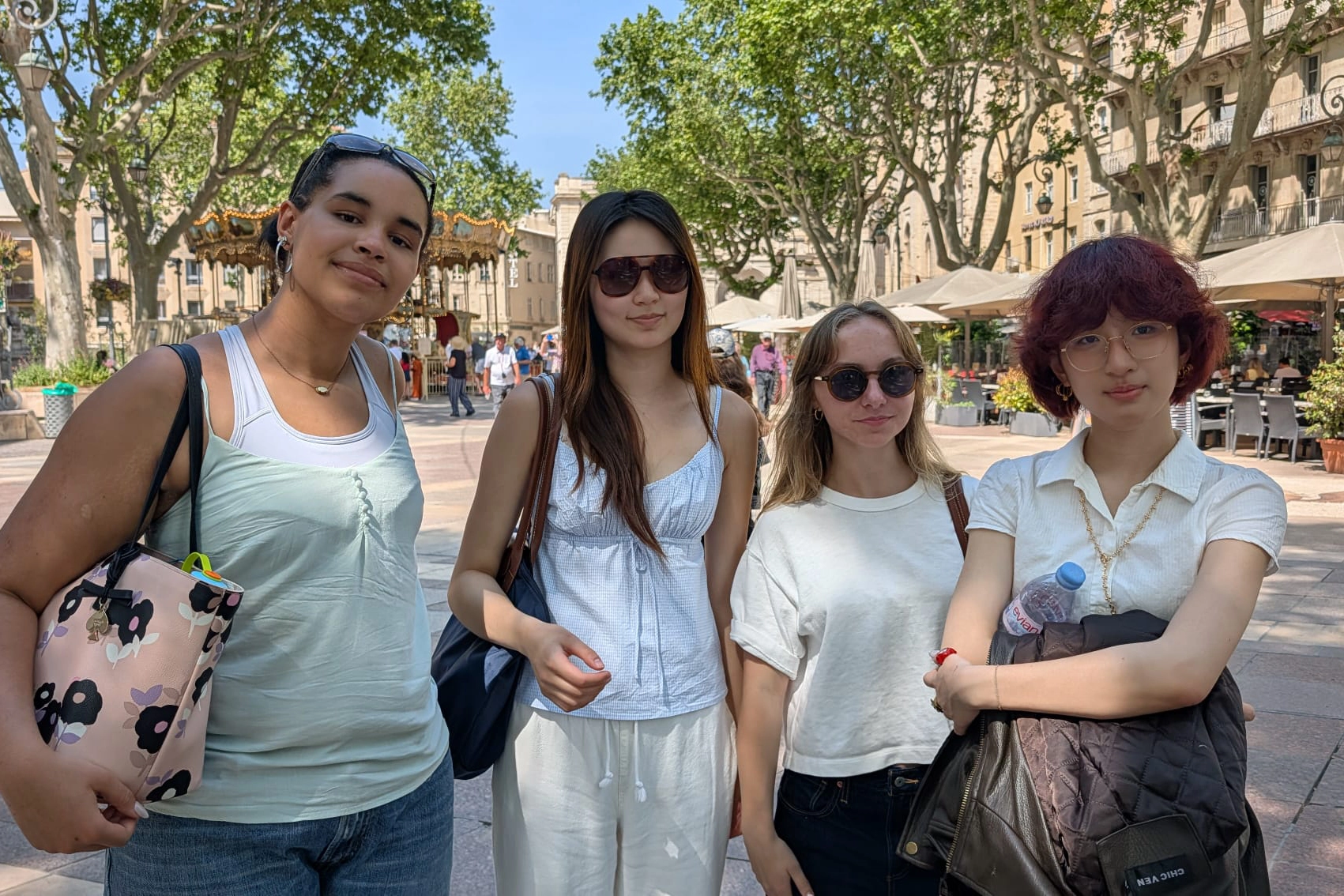
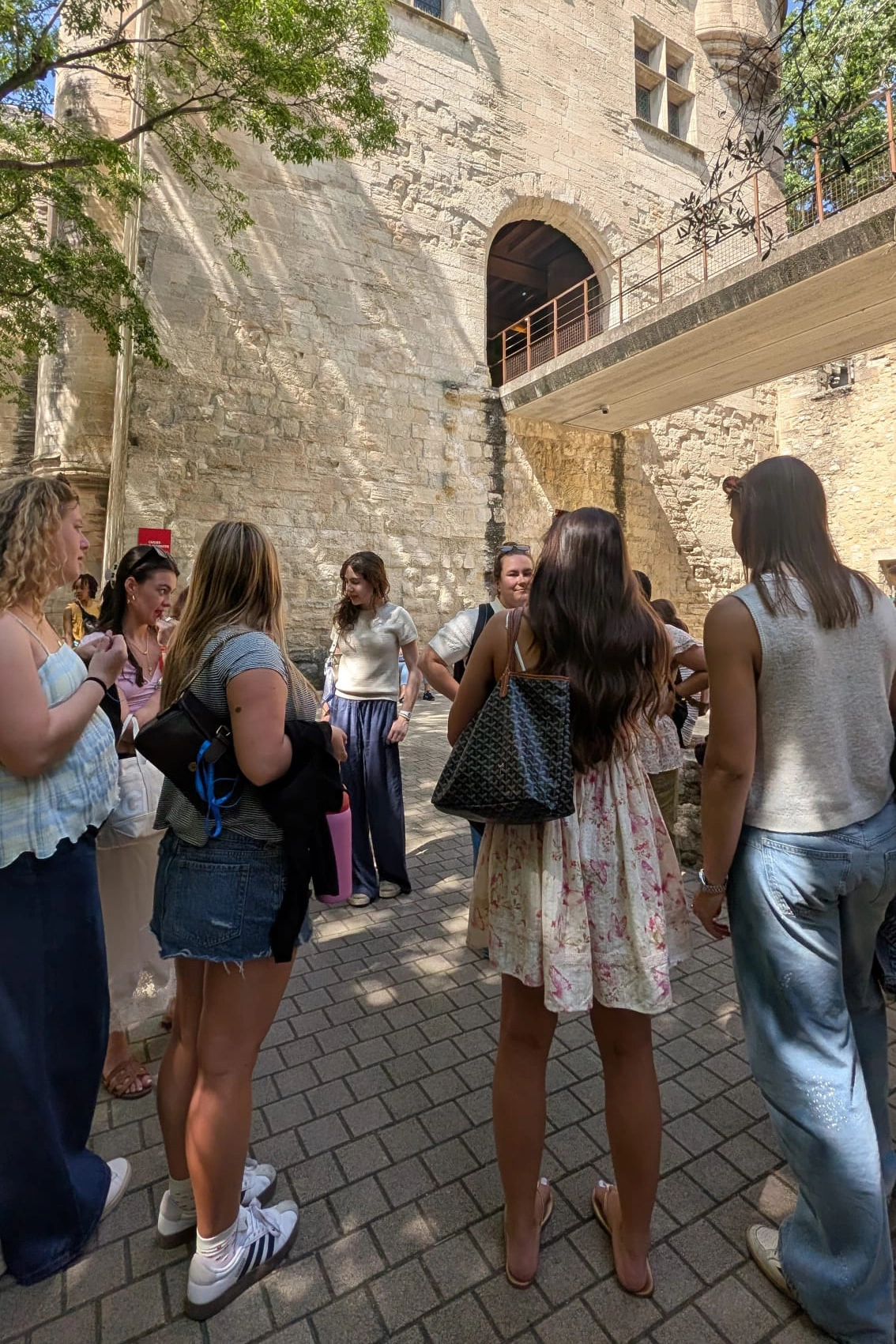
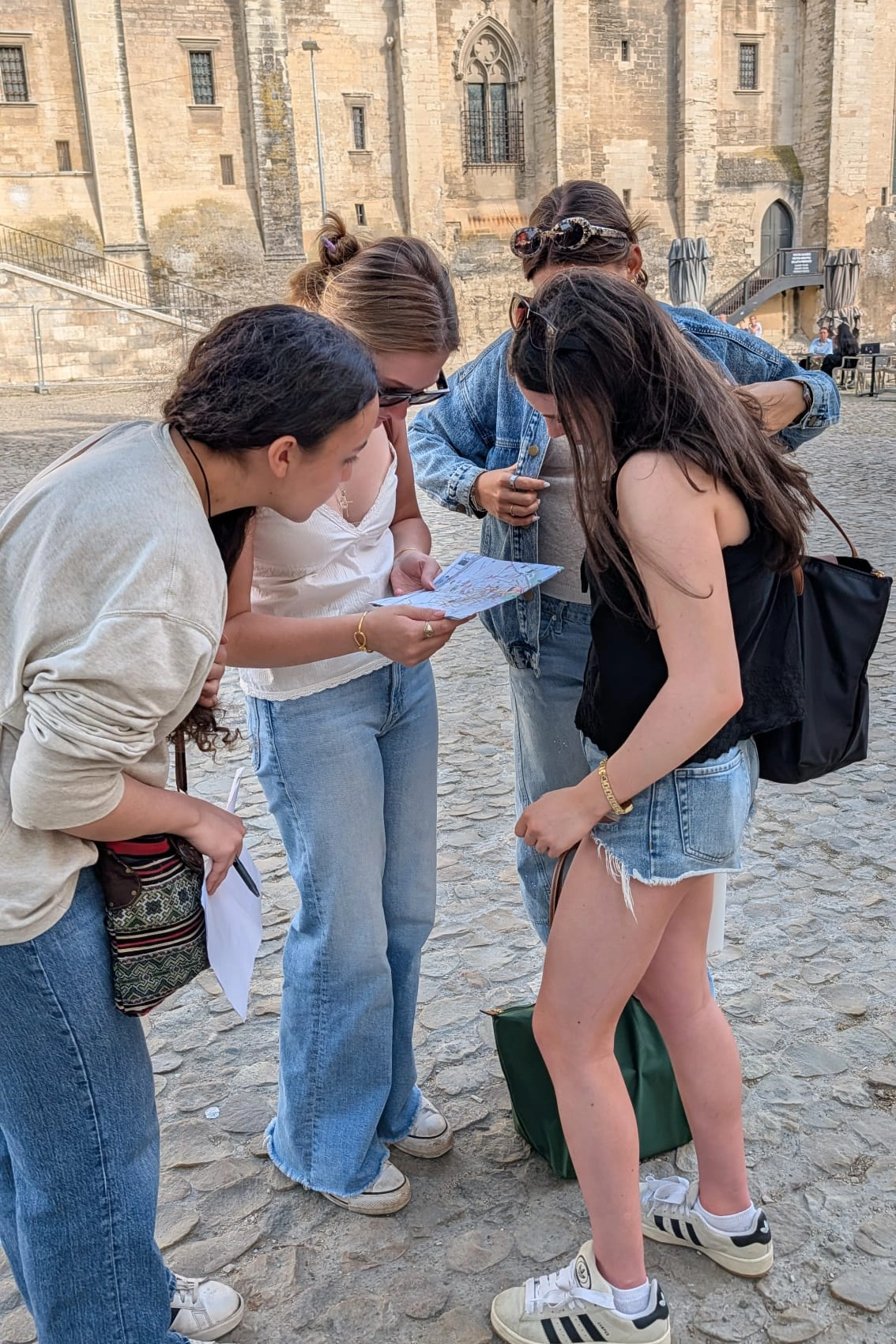
Looking back on the city, I felt relieved in a way. I had always felt pressure to overachieve at school, sports, and hobbies. Something that persists. But after I took the walls of what I could think about and reflect about instead of what I had to, I went back into the walls today with an “outside the wall” mentality. And for that, I am grateful.
April 28, 2026
Student Author: Maizey
Hello from Avignon! We started our long journey at 10:00 a.m. at Porter’s, saying goodbye to our friends and family. We then drove to JFK where we hopped on a redeye to Paris. We were all exhausted after the hours of travel and the two screaming babies on our flight. We were greeted by one of our wonderful guides, Alex, and we enjoyed our first croissant of the trip. Although, we were just getting started.
At 8:30 a.m. (France time) we boarded our train that would take us to our final destination of Avignon.
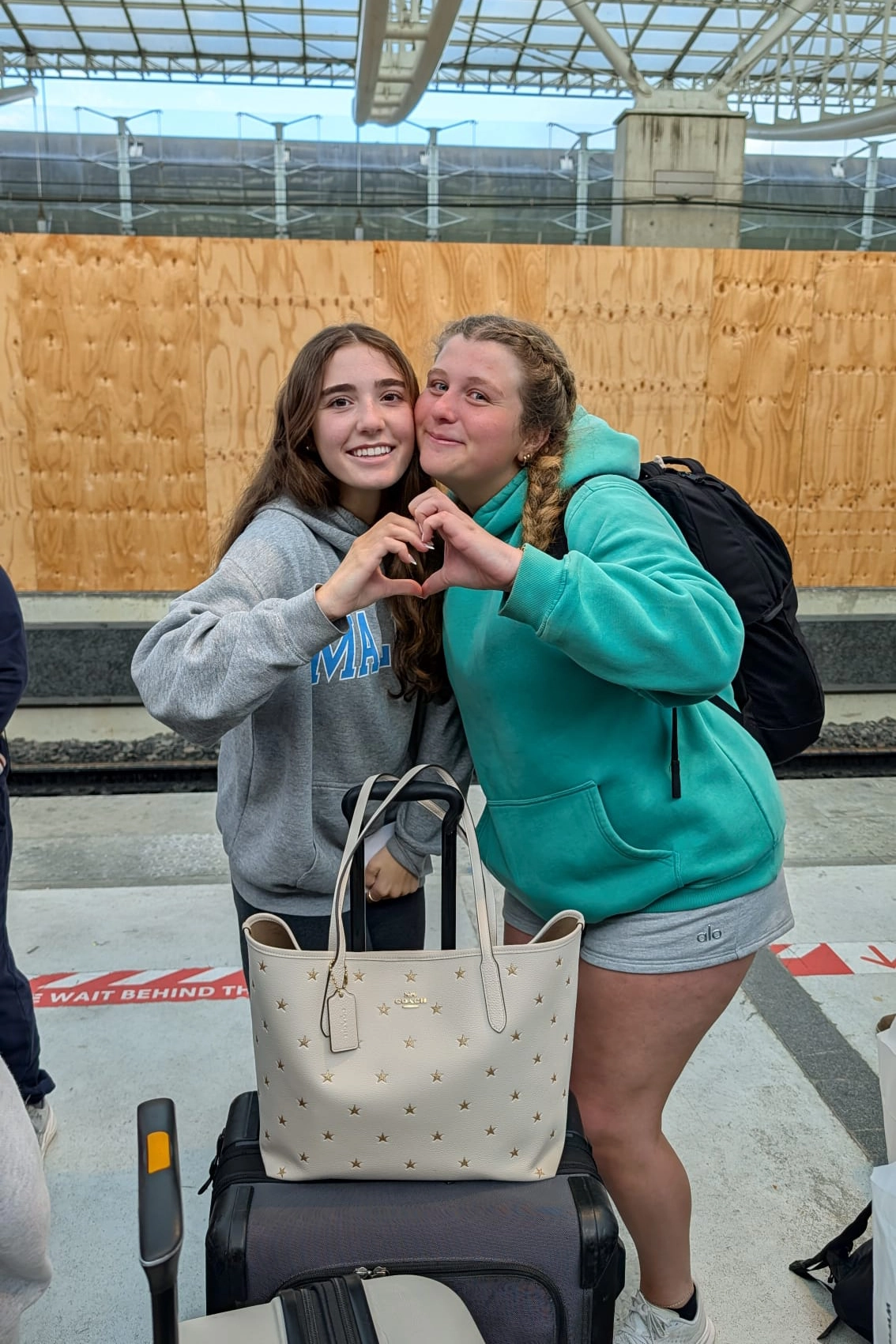
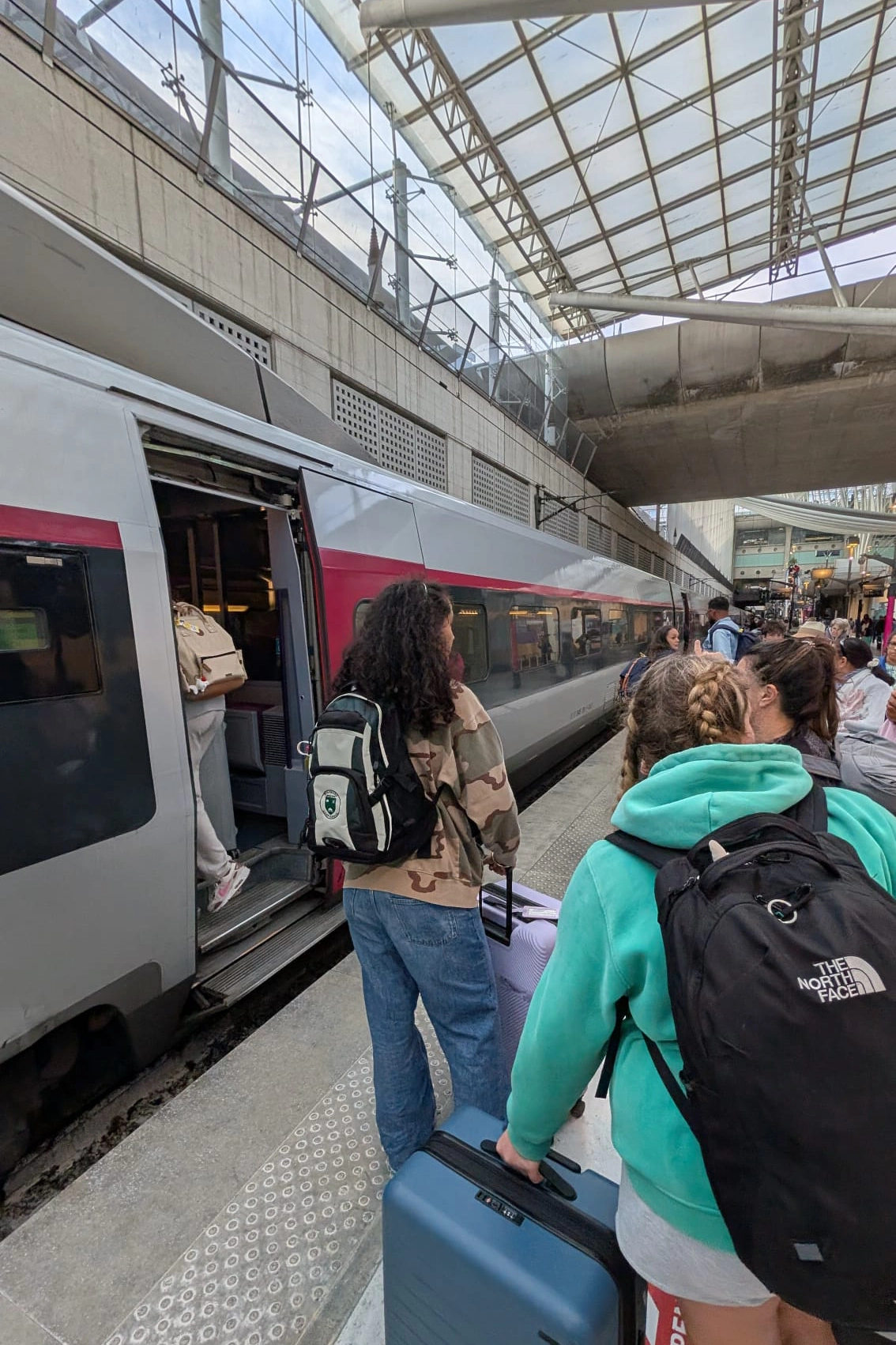
Riding through the countryside was one of my favorite parts of the day. Immediately after leaving the station the scenery shifted revealing green hills filled with farmland and crops. Not only was the scenery beautiful but it was also the first time we all interacted without our phones. You could hear our laughter throughout our car as we dug through all of our card games. This was also a time for many of us to rest. It was super cool to see each place that the train stopped and compare how different each one was from the next.
After our 3 hour train ride, we finally arrived in Avignon. My immediate observation was the architecture. The city is unlike any other. Even passing by train stops, there were obvious differences between the locations even in such close proximity. The city is beautiful with large walls surrounding the heart of the city. You feel an immediate shift as you enter through the gates.
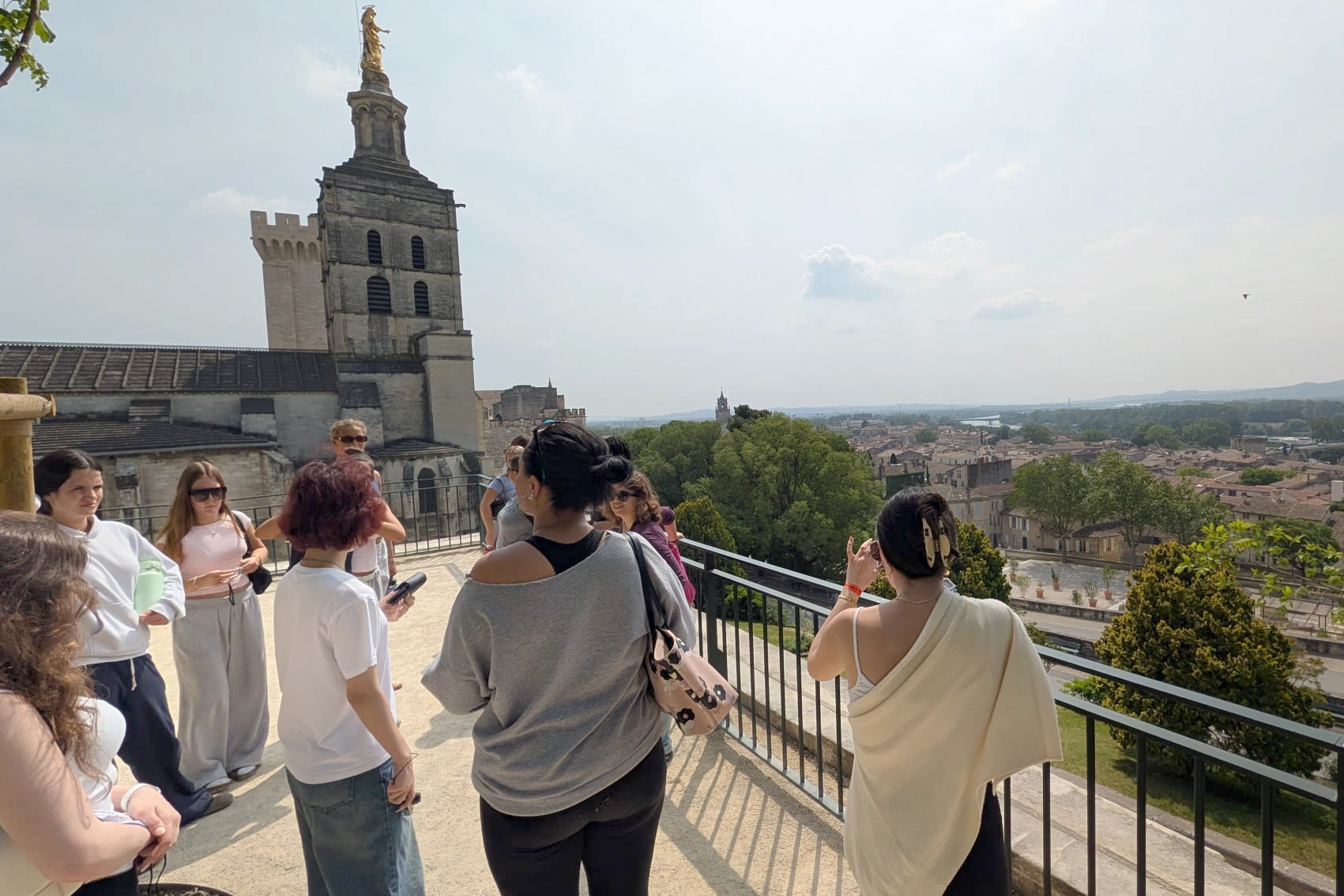
In our orientation activities we were able to explore the city through silent walks. As someone who really likes to talk, I wasn’t expecting to like this. But it allowed me to examine each street specifically, the modernization, a reflection of different time periods. Walking around the city felt like a whole new world. The streets are narrow and very few cars pass through. Coming from the U.S.A. I have grown up knowing cities like Boston and New York. These cities continue to expand and modernize.
In comparison, shifts in modernization are viewed very differently in Avignon. As I mentioned, the streets reflect the many stages of Avignon’s culture showing us the impact that preservation efforts can have on a city and its values.
I also know that my perspective as a tourist adds to my observations. I do not know everything about the city’s history and culture but I look forward to learning. Especially from others whose experience of the city is completely different from my own.
I miss everyone and am so excited to share everything when we get back!
Student Author: Kate
This morning, we landed safely in Paris! The flight was very smooth. I mainly read my book, listened to music, and tried to sleep. We had two meals while on the flight, a dinner and a breakfast, which felt very silly because they were served at times that we were not yet used to.
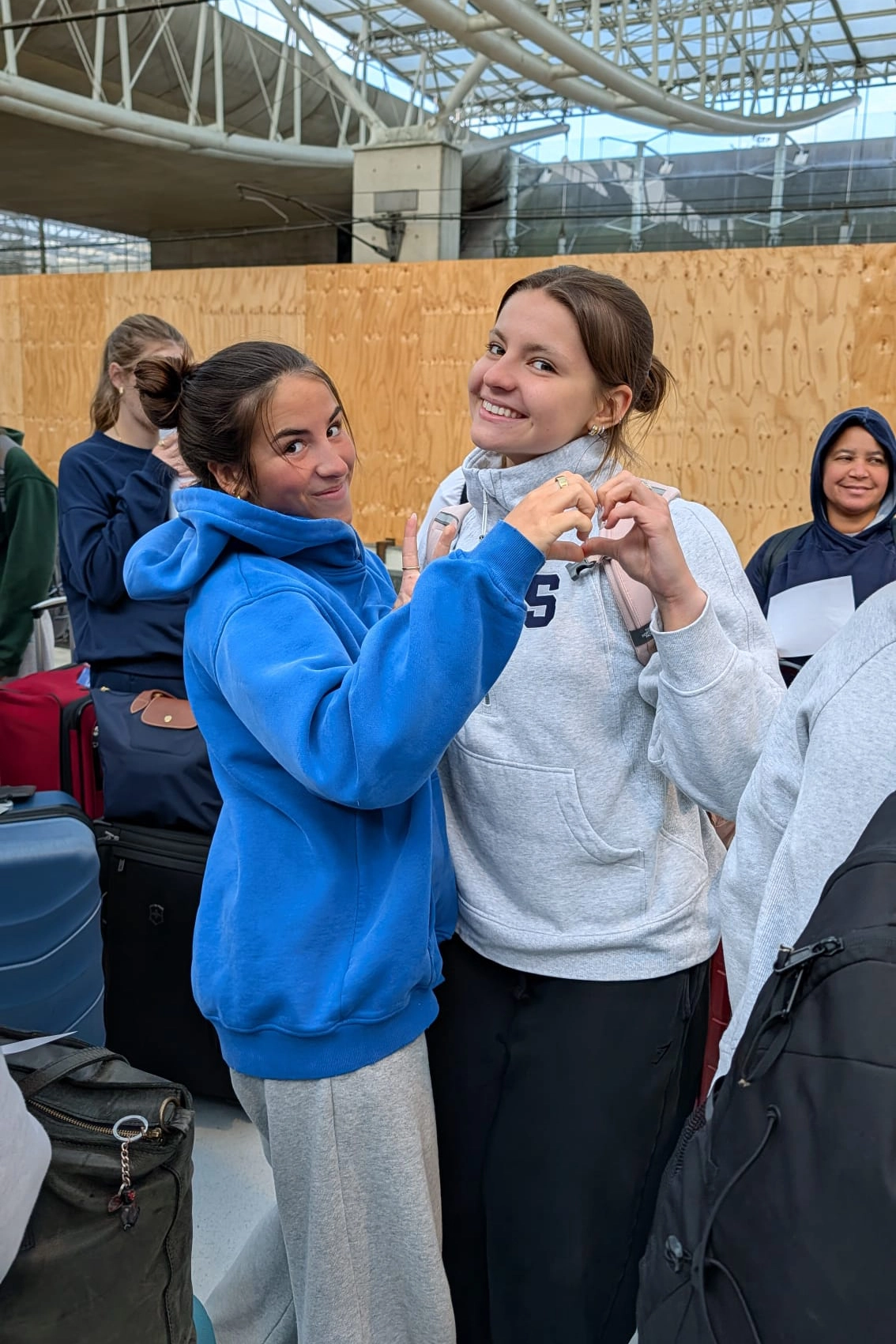
At the airport, after getting through immigration and while waiting for our train to Avignon, we met one of our lovely tour guides! She was very friendly, helpful, and brought us all croissants! Then, me and a couple of friends attempted to order lattes in French; when the person taking our order started replying in English, we knew we needed to keep practicing. The latte was very yummy and warm (the only option, which surprised us all). After finishing our drinks, we boarded our train, and immediately upon leaving the train station, outside the window to my left were beautiful fields of green grass, blooming yellow flowers, and tall trees with rich brown trunks and dark green leaves. Many people (including my lovely roommate Katharine) noted that the rolling hills were especially beautiful. Then pretty much all of us decided to catch up on our sleep for the rest of the train ride.
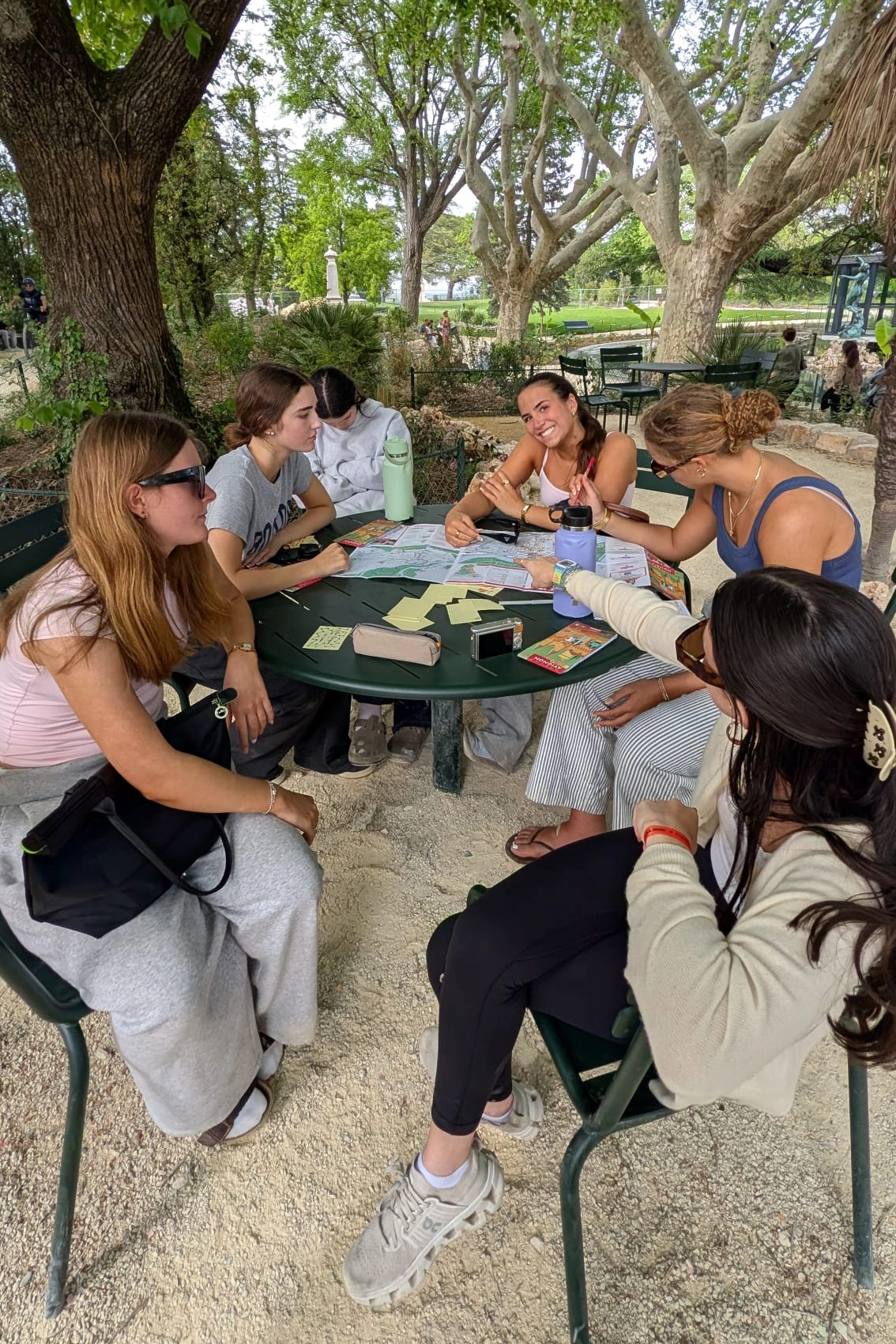
At this point in the day, I was already beginning to see a lot of ideas that we talked about in class come to life—one being the tourist vs. traveler mindset. We identified in class that a tourist in these spaces would be loud, disrespectful, and not blending in with everyone, while a traveler would try to immerse themselves in the culture, even in small ways like trying the local coffee shop rather than defaulting to something you already know. A traveler is also respectful and aware of who is around them. I can definitely see all of us intentionally shifting into the traveler mindset so that we can be the most interculturally competent and fully immerse ourselves in this unique experience we get to have.
Once we arrived in Avignon, we got off the train and took a quick bus ride into the walls of the city. It was so cool to see them in person after talking about their significance so much in class. We dropped our bags off at the hotel and began our activities. We began by splitting into our cohorts, where we split up even further into three groups. We then took turns leading each other around, just walking wherever we wanted to walk, turning when we wanted to turn.
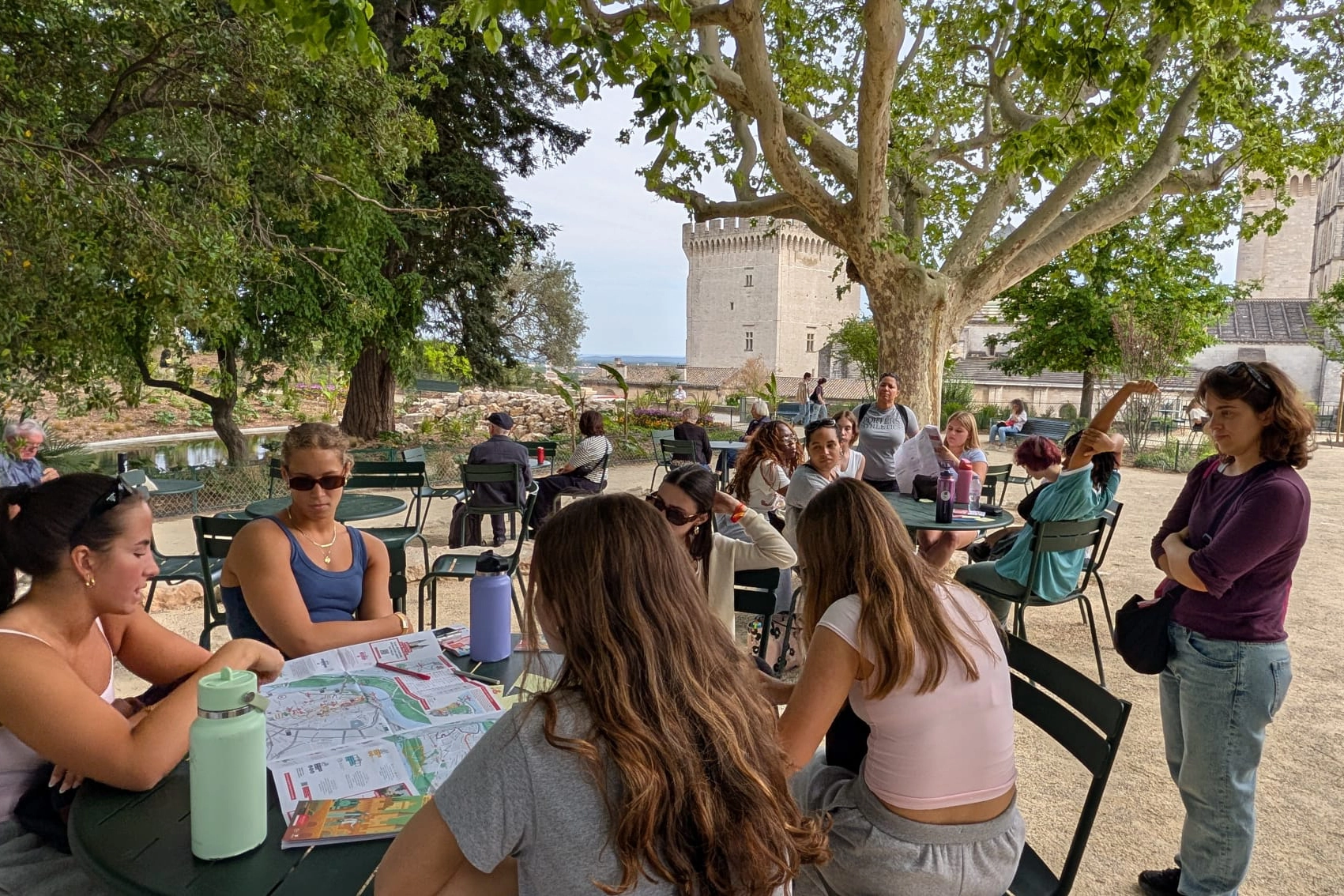
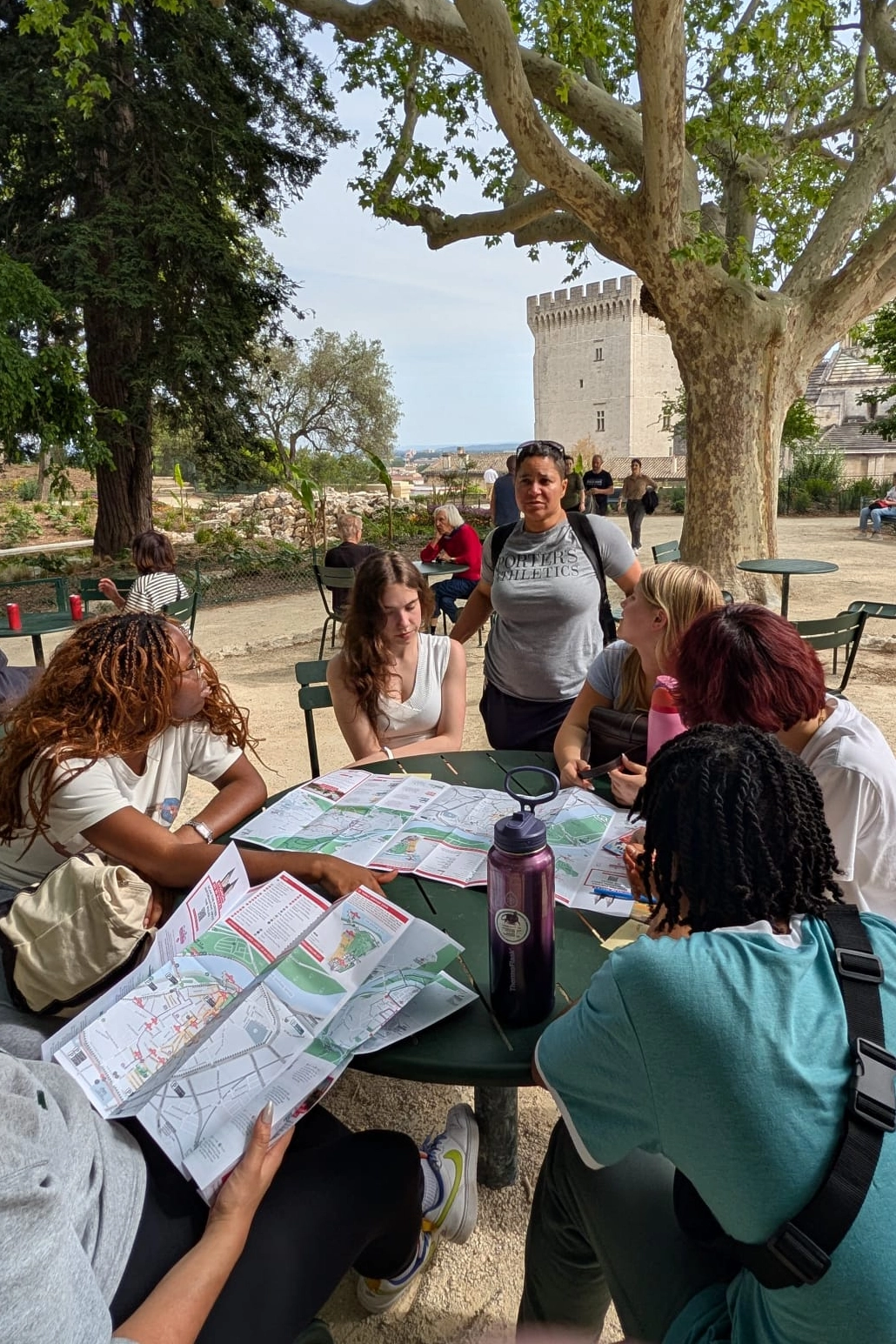
Just from our 20-minute walk, I was able to see why people would want to live in cities, particularly ones like Avignon. Avignon is a very walkable city; we only saw a few cars and many bikes. Transportation in a city is much easier and in many cases very accessible. But that can also be why people leave cities. When it is difficult to go from one place to the other, especially for things like your job, people don’t want to stay because of these challenges.
As someone who grew up in a city that is not very accessible by transportation options like walking or public transportation, when I step into cities like Avignon, they surprise me, especially to see the amount of walkers, bikers, and the occasional (free!) buses that residents use to get around. I am looking forward to continuing learning my way around Avignon and immersing myself in the culture!
I miss everyone at home and school, but fret not, I will be back soon with many stories, pictures, and VLOGS!
Follow us on social